








TimesofIndia.com in Singapore: By mid-morning, the courts inside the OCBC Arena had already settled into their rhythm.On one end, South Korea’s Kyungbock High School looked every bit the early favourites, their players physically bigger and noticeably more imposing than most of their opponents. Singapore, with four teams spread across the boys’ and girls’ categories, found the going tougher against more established basketball programmes.Around the arena, coaches barked instructions, and teenagers from across Asia shared courts that, for the next week, would become the centre of the NBA‘s ambitions in the region.The facilities are first class, the organisation unmistakably NBA. But what stood out most on the opening day of the Rising Stars Invitational wasn’t necessarily the basketball itself.It was the diversity. Players from Japan, China, South Korea, India, the Philippines and Australia, each carrying different basketball traditions and ambitions, all arriving in Singapore with the same dream.For some, it is about winning. For others, simply being here is part of something bigger: Opportunity.For Rui Hachimura, perhaps more than anybody else, that word carries special meaning.The opportunity he wished he had.The Los Angeles Lakers forward is not just Japan’s biggest basketball export. In 2019, Hachimura became the first Japanese player to be selected in the first round of the NBA Draft when the Washington Wizards picked him ninth overall.The 27-year-old, who won three consecutive national high school championships before moving to Gonzaga University, remains the only active NBA player from Asia and has increasingly embraced the responsibility that comes with it.“You know, I think when I was a kid, I always want to play overseas,” Hachimura said on the sidelines of the event.“I think this kind of opportunity is very important. I don’t know how long this has existed, but when I was in high school, I don’t think it existed. So that’s why it makes sense.”Looking around the arena and watching teenagers from across Asia compete under the NBA banner, Hachimura admitted he recognised a younger version of himself.“Yeah, of course,” he said when asked whether he saw himself in these players.“When I was in high school, I got invited [to the] like [of] Jordan Brand Classic, NBA Academy and all that. But those are times that I actually go and learn myself. I can see my level and my goal.”“So these kind of stuff is going to help them. Especially in Asia, there are a lot of kids, a lot of players that want to be in the NBA. So this is really good stuff.”And perhaps that was the sentiment echoed most frequently throughout the day: Pathways.
Thinking beyond Japan
For years, Asian basketball has searched for figures capable of changing perceptions.China had Yao Ming, an eight-time NBA All-Star and the first overall pick in the 2002 Draft. Japan found its breakthrough star in Hachimura, who has since been joined by Yuta Watanabe and Yuki Kawamura in carrying the country’s basketball aspirations.
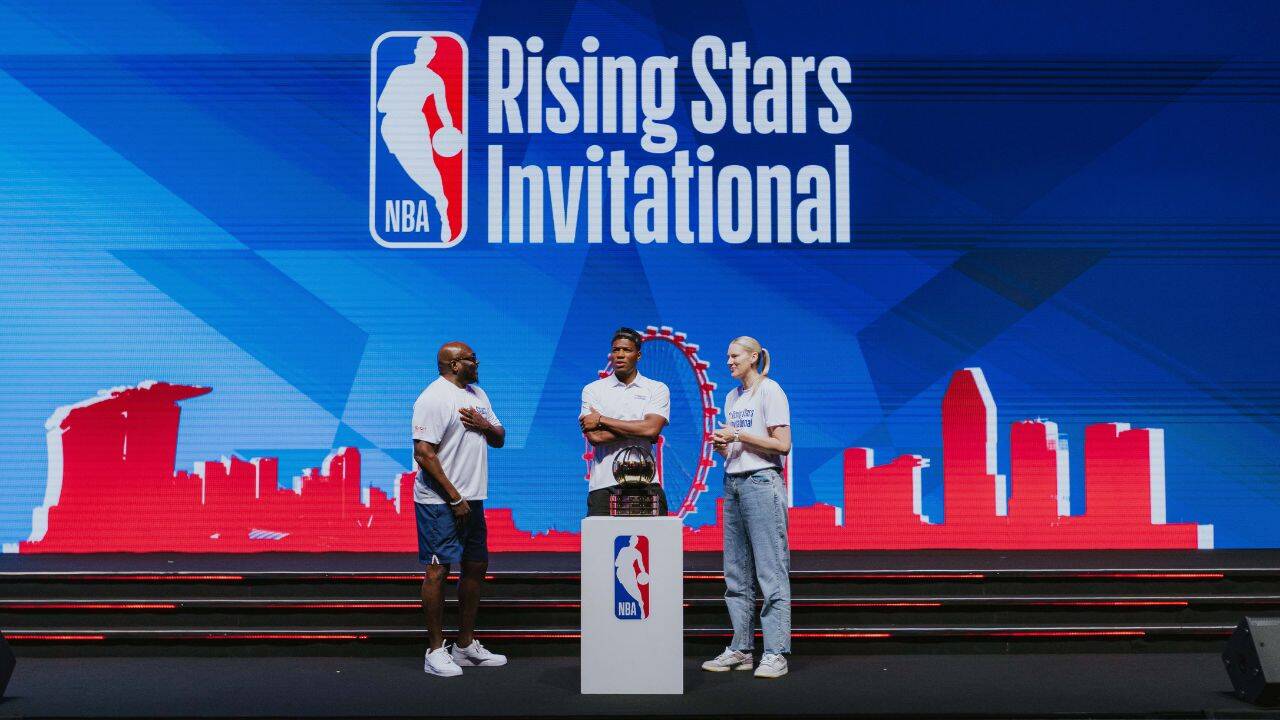
NBA stars under one roof (Photo by NBA Rising Stars Invitational)
But for Hachimura himself, the conversation has moved beyond national boundaries.“Especially for me, I think I have a responsibility. My country Japan, but also the whole Asia,” he said.“Right now, literally I’m the only NBA player in Asia. So that’s the tell that we need to grow our basketball culture and bring more Asian players into the NBA.”“I think we have a lot of potential, but I think there are few opportunities. That’s why I decided to come here and try to help the whole Asia continent to bring more players to the NBA.”Later, when asked what success for Asian basketball would look like a decade from now, Hachimura again returned to the same theme.“I don’t want to talk about Japan,” he said, adding.”I think about whole Asia. That’s my vision.”“I want to inspire those kids and I want to have more kids from Asia be NBA players and do their thing. I’m thinking how I can help with that.”
The challenge remains bigger than talent
For Hachimura, physical disadvantages are no longer excuses. “There is always this disadvantage for us,” he said.“But I think there are a lot of ways to prove that. You guys see Yuki Kawamura. He’s literally this height and he competed every day, every game.”“You just got to believe in yourself and find a way.”

Asia’s best talents in action (Photo by NBA Rising Stars Invitational)
More interestingly, Hachimura believes the challenge is not purely physical.“It’s the personality too,” he said. “Basketball is an interesting sport. It’s a team sport but a lot of times it’s individual too. Showing what you can do is really important.”“That’s the things that I had to learn when I got to Gonzaga [University]. They always told me I play like I’m shy or something.”“But you can’t be like that. You always got to be aggressive. You got to be the guy trying to change the whole game. I think the Asians don’t have that, so I think I have to teach that.”
Building pathways
Three-time WNBA MVP Lauren Jackson, widely regarded as one of the greatest players in the history of women’s basketball and a central figure in Australia’s rise as a global force, believes opportunity is becoming the defining theme of this generation.A Basketball Hall of Famer and one of the faces of the NBA’s Her Time To Play initiative, Jackson has seen the women’s game evolve over more than two decades.“I think women’s basketball is driving it globally,” Jackson said. “I think there’s no doubt that the WNBA has definitely lifted the stakes.”“We’re seeing the recognition because of women’s basketball and it’s such a great time for women’s sport.”For Jackson, tournaments like the Rising Stars Invitational are important because they create visibility.“This tournament creates an opportunity for all the other countries to really have a pathway to the elite,” she said.“They can see their way to the NBA and that’s something that’s never been done before, particularly in the Asia-Pacific.”

Lauren Jackson (Photo by NBA Rising Stars Invitational)
Mitch Richmond, a six-time NBA All-Star, 2002 NBA champion with the Los Angeles Lakers and a member of the Naismith Memorial Basketball Hall of Fame, has witnessed the league’s international expansion from close quarters.Part of the famed trio at Golden State Warriors alongside Tim Hardaway and Chris Mullin, Richmond believes the NBA’s efforts to globalise the game have been decades in the making.“I saw it coming,” Richmond said of basketball’s global growth.“When I was playing, the NBA always had me go overseas and they were really trying to expand.”

Mitch Richmond (Photo by NBA Rising Stars Invitational)
“To see it all come to fruition right now, where the NBA is growing in so many places and continues to grow globally, it’s really a sight to see.”And when asked about countries like India, where cricket remains dominant, Richmond preferred patience over urgency.“You have to start somewhere. You have to take those baby steps. It’s about teaching and learning. You have to get the youth excited.”
A tournament and a question
The lone Indian representatives, Velammal International School, will begin their campaign on Tuesday.Their task is difficult. The gap in infrastructure and basketball culture between India and some of Asia’s established powers remains evident.
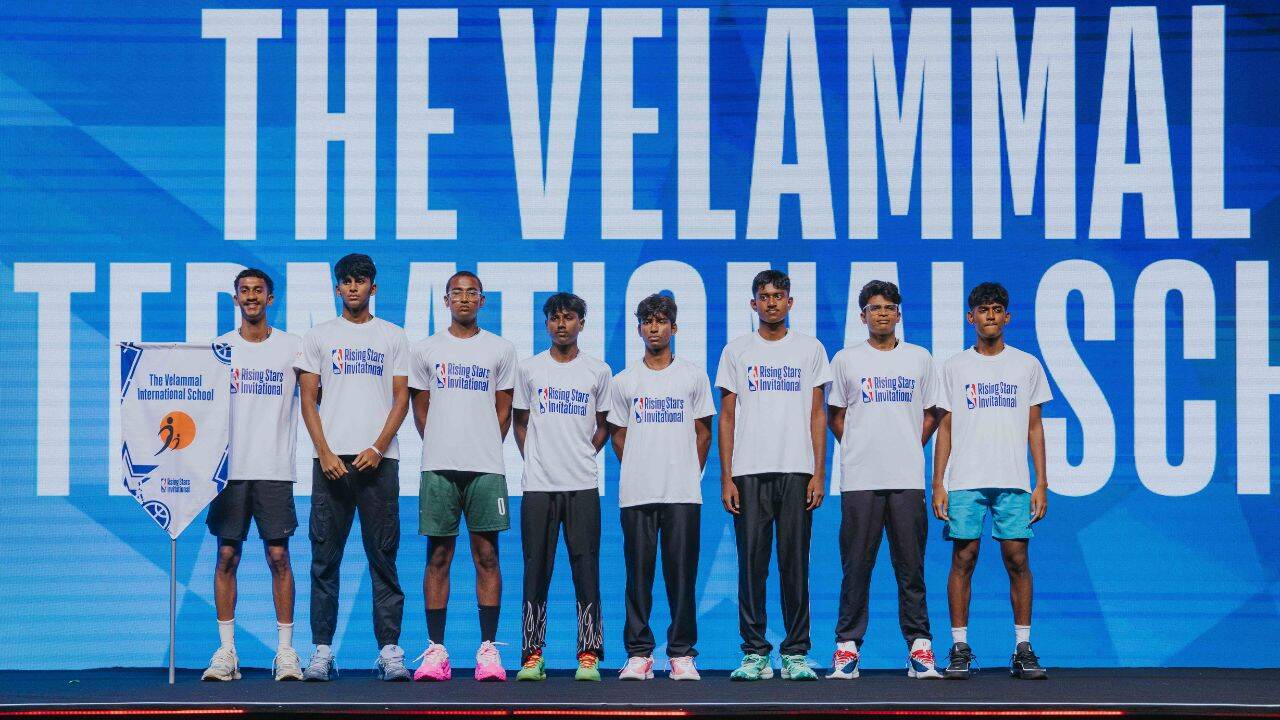
The lone Indian representatives (Photo by NBA Rising Stars Invitational)
Yet, that is perhaps the larger significance of this week. Because for Hachimura, success is no longer measured by what Japan achieves.“I have a bigger goal now,” he said. “Not only Japan but whole Asia.”Inside the OCBC Arena, surrounded by teenagers from across the region, that vision no longer feels entirely distant.And for countries still waiting for their breakthrough moment, that might be reason enough to keep believing.