










(RNS) — Although my parents raised me from my birth in Baltimore and I had the happiest of childhoods, I only came to really know my father, Rabbi Simcha Shafran, who died in 2016 at 91, in the final 30-odd years of his life.
That’s because he spoke very little about his life before his immigration to the United States in 1947, and his becoming a citizen shortly thereafter. And I was too stupid to ask him about those years.
It was only around 1990, as an adult living with my own family in Providence, Rhode Island, that I learned about his youth.
The lesson arrived in the mail, on a cassette tape sent me by someone who had recorded a speech my father delivered to an audience on Holocaust Remembrance Day. He apparently felt more comfortable relating his story to strangers than to his own children.
I came to realize his reticence had been because he hadn’t wanted to burden my sister, brother and me with the weight of the harrowing years of his youth.
How, for instance, at the age of 14 in his native Poland, Simcha Bunim Szafranowicz — the name he was born with — had stubbornly insisted his parents let him study in yeshiva, even though what would come to be known as World War II had begun mere weeks earlier, and the family was fleeing the approaching Nazis.
How SS men who had caught up with his family and other refugees from their town, Ruzhan, killed his uncle in front of him and packed my father and hundreds of other Jews into a synagogue, locked them in and set fire to neighboring homes. Preparing to die, the Jews were rescued at the last minute by a German army official who passed by and ordered the Jews to be let out. It was the Prophet Elijah, they suspected — who, in Jewish tradition, appears throughout history to save Jews — here, in strikingly unusual disguise.
How the boy’s parents reluctantly gave him their blessing — they didn’t know, after all, where would be the safest place for him — and said goodbye to him. As it turned out, for the last time.
That was the beginning of a journey that would take young Simcha to Siberia, and then America, where, as Rabbi Simcha Shafran, he would become a revered, beloved rabbi of a congregation.
In the fall of 1939, the boy who would become my father, holding his tefillin — the small leather boxes holding pieces of parchment with certain Torah verses on them, bound to leather straps and placed on one’s arm and head — and some apples his mother had given him, set out for the Novardok Yeshiva in the Polish town of Bialystok.
En route, he discovered that all the Polish yeshivas had relocated to Vilna, Lithuania. In the train station, he recalled, he heard and heeded a voice in his head crying “Simcha! Get on the train!” to Vilna, and managed to pull himself onto the platform between two cars.

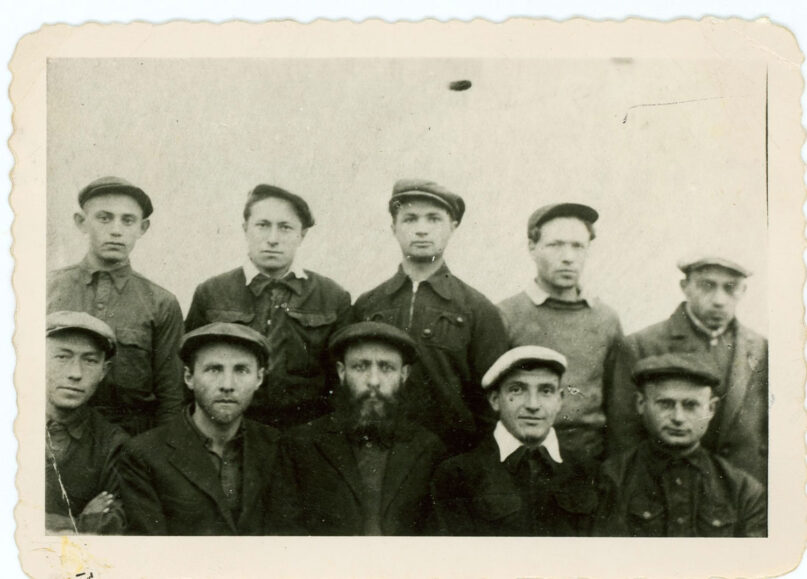
Rabbi Simcha Shafran as a boy, top left, after being released from Siberia. Photo courtesy of Avi Shafran
He ended up in the relocated Novardok Yeshiva in a Lithuanian town called Birzh, where the yeshiva functioned until the Soviets took over in 1941 and demanded that all refugees become Soviet citizens.
My father and his fellow students knew that accepting Soviet citizenship would have made them cannon fodder in the army, and they refused the offer. As foreign nationals, they were put on cattle trains, with a hole in each car’s floor acting as a toilet, and, weeks later, arrived at a Siberian work camp, where they were ordered to fell trees, chop wood, harvest grain and grind it.
My father was the youngest of the group that spent the rest of the war in the frozen taiga, along with their teacher, Rabbi Yehudah Nekritz.
When working, they would discuss Talmud lessons or recite Psalms. They would not allow the Soviets to rob them of their spiritual heritage. In their shelter, they always had a chessboard, mid-game, in front of them, in case their overseer — who hated religion — should stop by.
The exiles used an assortment of tricks to avoid working on the Sabbath, clandestinely baked matzos for Passover and jerry-rigged a sukkah, a special hut, in the middle of the night to observe the Sukkot festival.
The group survived those years. In 1944, the young men were transferred westward and eventually smuggled into Berlin’s American zone. My father had a bullet wound scar on his arm from when a bribed guard betrayed them and sprayed the truck they were in. I was in my 30s, I think, when he first showed me the scar.
The refugees organized a yeshiva in a town near Frankfurt and resumed their Torah studies. In June 1947, after establishing contact with a relative in the U.S. willing to sponsor him, my father arrived at Ellis Island.
With the $75 given to him by a Jewish social service organization, he bought a new pair of tefillin, his old ones having been well-weathered by Siberia.
In New York, he met the daughter of a respected Baltimore rabbi, Noach Kahn, and courted her. They had only Yiddish in common, and my father, impoverished but resolute, dated my mother by taking walks with her, sometimes subway rides, and singing songs from his yeshiva days. He had a sweet voice and what struck everyone as perfect pitch.
The couple moved to Baltimore and my father became the rabbi of a small synagogue. He picked up English quickly, thanks largely to my mother, who helped him translate sermons he wrote in Yiddish into English.
His income from the synagogue was paltry, and so, even with the counseling, weddings, funerals and hospital visits, my father found the time to attend night school to study accounting. In addition to his rabbinic responsibilities, he became an auditor for the city of Baltimore. He took his obligations seriously, and his co-workers were impressed by his integrity. They said they could set their watches by when he left for lunch break and when he returned to his desk.
Throughout his more than 60 years as a rabbi, my father made deep impressions on young and old, seekers and scoffers, intellectual and spiritual sorts alike. There wasn’t any trick. With his radiant smile, he just presented himself, and Judaism, honestly, without pretensions. Someone once remarked that he had always assumed that to be a successful rabbi in America, a man had to be tall and sophisticated, speak the Queen’s English and hold himself aloof — until he met my father.

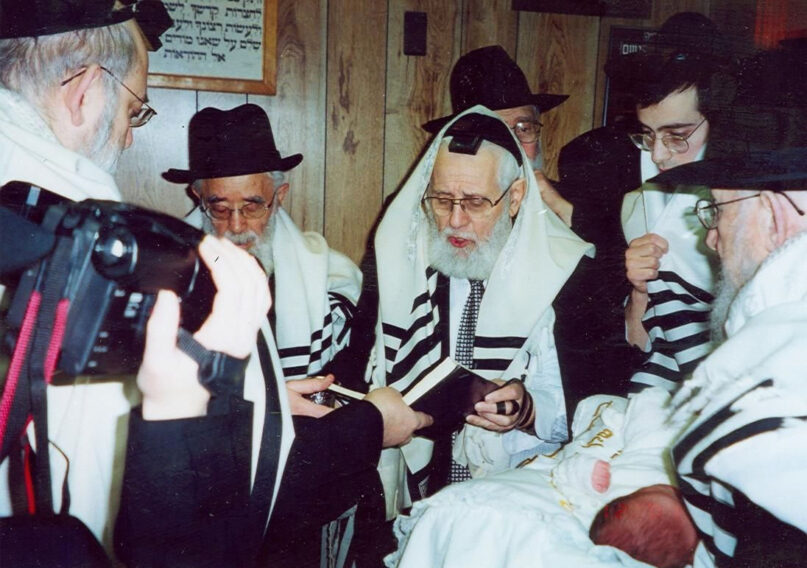
Rabbi Simcha Shafran at one of his great-grandchildren’s circumcision ceremonies. Photo courtesy of Avi Shafran
When, after more than 40 years of marriage, my mother died in 1989, my father was devastated. But the inner strength that saw him through so much emerged with time and he resumed his life with vigor, even marrying again. His second marriage lasted for 20 years. When my stepmother fell ill, my father cared for her, as he did for my mother, during her final illness.
He walked 3 miles daily, well into his upper 80s. In 2012, he published his memoir, “Fire, Ice, Air: A Polish Jew’s Memoir of Yeshivah, Siberia, America.” Only a brain tumor slowed him down and, eventually, ended his life.
On his last morning in this world, he made a final request. It was hard to understand him, but his daughter-in-law said she heard him say “tefillin.” When she asked him if that was what he wanted, he nodded yes, and my brother fetched my father’s tefillin and placed them on my father’s arm and on his head. It was then, after fulfilling that observance, that my father relinquished his soul.
On the final day of the Jewish week of mourning, a baby boy was born to one of our sons. At the child’s circumcision, he received his name, and a new Simcha Bunim Shafran entered the world.
(Rabbi Avi Shafran writes widely in Jewish and general media and has a Substack here. The views expressed in this commentary do not necessarily reflect those of Religion News Service.)