











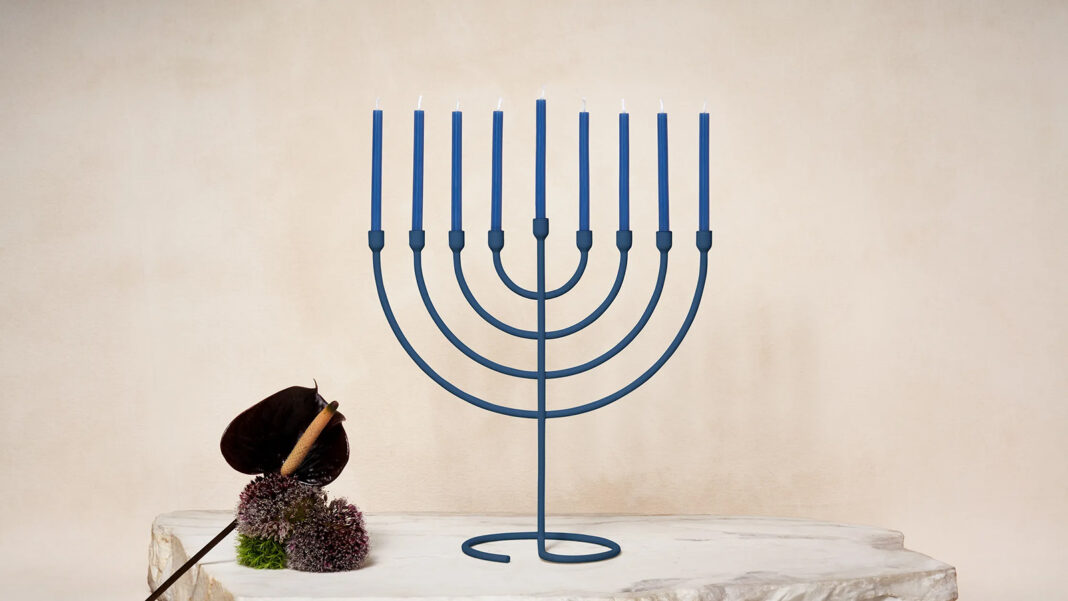
NEW YORK (RNS) — For generations, Judaica referred primarily to traditional ritual objects: menorahs, Kiddush cups, Shabbat candlesticks, tallits, mezuzah cases and Passover Seder plates. These objects are often made of precious metals and fabrics embodying the tradition of “hiddur mitzvah” — beautifying Jewish practice through artistry.
Today, a growing cohort of Jewish artists and curators say they want to honor the design specifications of traditional Jewish law while playing around and expanding non-traditional design in Judaica — from minimalist and geometric to playful and whimsical, to objects and garments inspired by secular high fashion and streetwear. Their vision comes at a moment when Jewish communities worldwide report an increased desire to engage in Jewish community, ritual or religious life in the years since the Oct. 7, 2023, Hamas attack on Israel.
For some consumers seeking connection outside traditional institutional frameworks, contemporary Judaica has become an entry point into Jewish culture, spirituality and community.
Dana Holler Schwartz, artist and founder of the New York-based brand Via Maris, said she began designing Judaica about five years ago after struggling to find objects that fit the aesthetic of a contemporary home. Her work aimed to close this gap with pared-down designs that utilized high-end materials, bright colors, geometric precision and simple, clean lines.
“I’ve seen much more emerge over the last few years — a testament to growing engagement with Judaism in this moment — but at the time I started the brand, it felt like I was the only one,” Schwartz told RNS.
She increasingly sees contemporary Judaica functioning as a bridge between aesthetics and spiritual practice, particularly for many younger Jews who may not have grown up with strong religious observance but are interested in exploring Jewish traditions on their own terms.
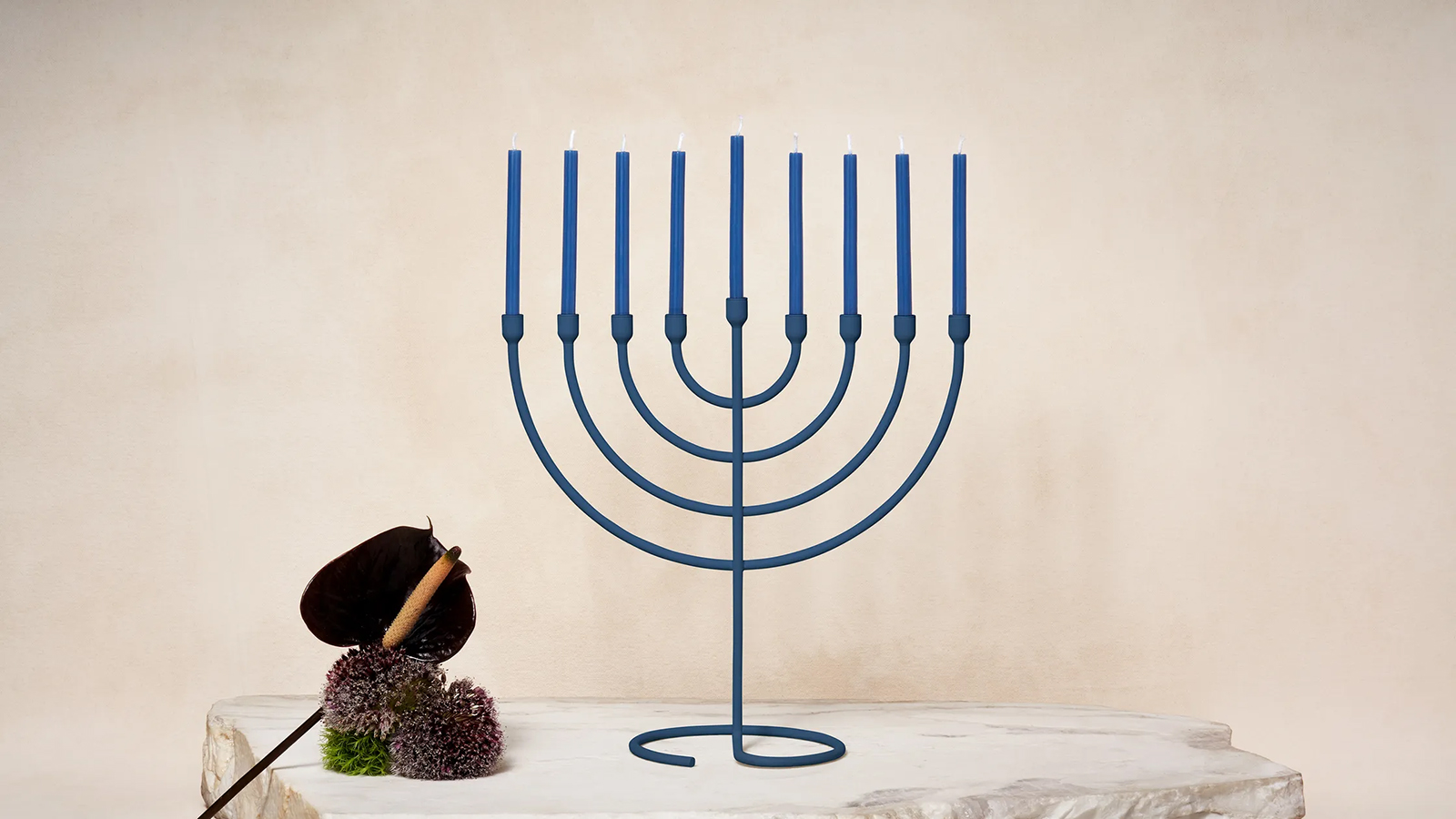

“More and more people are lighting candles every Friday,” she said, pointing to increased customer engagement over the past three years and warm messages she regularly receives from clients through social media.
According to the Jewish Federations of North America, an unprecedented 43% of respondents across all levels of previous Jewish involvement “were seeking to or engaging more in Jewish communal or religious life,” especially college students and recent graduates. This aligns with reports from laypeople, rabbis and organizations across the political and denominational spectrum who say there is a marked increase in synagogue attendance, community engagement and conversions into Judaism since 2023. Outreach organizations like Chabad-Lubavitch also report a marked increase in interest of unaffiliated Jews looking for greater observance. Elsewhere, synagogues have experienced some of the same polarization and political fractures, echoing broader trends across the country.
Amid these conditions, artists are rethinking Jewish visual culture itself. Their work reflects a wider conversation taking place throughout the Jewish community about what Jewish belonging looks like in the 21st century.
Channan Tzvi “Kenny” Zablotsky of New Haven, Connecticut, reimagines Judaica through what he calls “Jewish joy” — a visual language rooted in cultural symbolism and everyday life rather than formal ritual observance.


“I grew up modern Orthodox but unfortunately dealt with abuse in the school system, so I really needed to distance myself from religion because of that trauma,” he said. “When I left I really missed the culture and connection I was raised with. But through my art, I found a way to reconnect to that Jewish joy.”
Zablotsky said his work is intentionally centered on cultural expression rather than religious obligation.
Zablotsky’s mosaics and sculptural objects incorporate ancient Jewish symbols, such as the Star of David, the seven agricultural species of the Land of Israel, the hamsa and the evil eye, often rendered in gold- and silver-plated charms. These motifs are traditional and can be found in 2,000-year-old archaeology and silver work. Zablotsky applies these motifs to ordinary household objects unrelated to ritual observance: tissue box cases, backpacks and pool towels, flower pots, clocks and even an “interfaith Christmas stocking.” While he does create some ritual items like mezuzah cases or kiddish cups, most of his work focuses on decorative and functional home objects intended to bring Jewish symbolism into everyday spaces.
For Zablotsky, the work is about belonging.
“Everyone has their own journey, but you’re also part of the bigger group,” he said.
He added that his audience extends far beyond major Jewish population centers, reaching customers in the Midwest and Southern United States as well as coastal cities with larger legacy communities. Social media, he said, has been central to that reach.
One interaction, he said, stood out: A customer who is transgender and was purchasing their first kippah as a religious symbol of euphoria in their gender identity journey reached out to thank him for creating an accessible space for Jewish expression.
For Zablotsky, such moments reflect the broader purpose of his work: creating entry points into Jewish identity through joy.


Creating joyful entry points into Judaism also inspired Los Angeles-based ceramic artist Shana Ostrowiecki to create her own unique style of Judaica, where she incorporates playful, organic forms into ritual objects. She’s made pickle-shaped mezuzah cases and a “party menorah” that sells for $1,800.
“I think that opens the door for younger or more secular Jews to connect with the pieces both aesthetically and culturally,” she said. This, she said, came at the right time, as, increasingly, numbers of Jews worldwide are looking to get more communally or spiritually involved.
The trend extends beyond the United States. Across Israel, artists and designers are similarly responding to growing interest in modern takes on Jewish tradition, as well as a heightened sense of solidarity between Israeli and diaspora Jewish communities. Some Israeli artists, like husband and wife duo Tal and Roy Yahalomi, report increased orders and warm messages of support and concern from clients across the world amid the ongoing war.
“We felt that the Jewish objects we grew up with carry so much meaning, memory and emotion, but they do not always fit the way people live and design their homes today,” said Tal.
Yahalomis Studio produces handmade and hand-glazed minimalist adaptations of traditional designs, like Seder plates, Hanukkah lamps and ceramic mezuzah cases made from basalt rocks from northern Israel. They have made work for clients ranging from individuals and families to El Al Airlines, WeWork and Google.
The Yahalomis said their customers reflect a broad desire among many Jews to maintain visible connections to heritage, memory and tradition even when they do not define themselves primarily through religious observance.


“For many customers, buying from an Israeli studio is not only about purchasing a beautiful object,” Tal said. “It is also a gesture of connection, solidarity and identity.”
Ukrainian-born designer David Roytman, who is an Orthodox Jew, described growing up amid antisemitism and poverty in the Soviet Union. His family later immigrated to Israel and lived in a lower income immigrant neighborhood. He said he had long dreamed of creating luxury Judaica as a way to showcase pride and optimism for the Jewish people — akin to high-end brands he admired, like Louis Vuitton or Versace.
“I dreamed that one day I’d wear high-class Jewish clothes, see beautiful synagogues and buildings and be surrounded by an atmosphere of luxury,” he said. “Twenty years later, I made it.”
Roytman now creates luxury Judaica and ritual garments, including kippahs, tallit bags and tefillin bags, and owns shops in New York and Israel.
“Today the Jews have their own luxury brands, something they can connect with and be proud of,” he said. “Not just a brand, it became a movement.”
Across these different approaches — functional, playful, symbolic and ritual — artists describe a shared goal: making Judaica more reflective of the diversity of contemporary Jewish life while helping people maintain connections to ancient traditions in new ways.
For Zablotsky, the throughline is simple: “People come for the joy of being Jewish,” he said.