





(RNS and NPR) — At Dharma Camp, a Buddhist sleepaway camp in Molalla, Oregon, the day starts with 20 minutes of meditation and silence through chores until after breakfast — no small feat for some of the teens and tweens who attend. “You just wanna talk and talk and talk,” said Isabell Brice, age 10. “Like, you just wanna talk about your dreams and like, ‘Oh, I saw a flying chameleon! Oh, I saw a flying whale!’”
American summer camps have long carried religious identities, beginning with the 19th century’s “muscular Christianity,” which motivated the earliest summer programs, and continuing into the 20th century’s robust network of Jewish camps, according to Leslie Paris, a University of British Columbia professor and author of “Children’s Nature: The Rise of the American Summer Camp.”
But Buddhist ones remain rare: Despite an American Buddhist population more than half the size of the Jewish one, there’s no national camp network and just a handful of camps sprinkled across the country figuring out what a Buddhist summer camp looks like.
Some camps, like the one run by the Los Angeles Buddhist Coordinating Council, are specifically for Buddhist church members, but others like Dharma Camp, run by Dharma Rain Zen Center, a Soto Zen Buddhist community, are open to kids and families that only have a light association with Buddhism.
Dharma Camp has spent over 30 years trying to give kids ages 9 through 18 a visceral understanding of Buddhist practice. It isn’t a silent retreat, but the campers sit in meditation for 20 minutes, finishing with a Buddhist chanting ceremony. They then move onto silent work detail — sweeping up the sports pavilion, organizing stray UNO cards, colored chalk and other craft detritus. It’s not until after breakfast is eaten that the two-hour silence is broken.
Sixteen-year-old Cyrus Boyd is attending Dharma Camp for his third summer. He finds it an adjustment, at first. “Honestly, my first day at camp, I’m always like, ‘Oof, I have to sit for 20 minutes.’ But it kind of grows on you. If you really clear your mind, and just kind of, like, fall into the sit, it’s, it’s nice. It’s just like a little time in the morning where you can kind of clear your mind.”
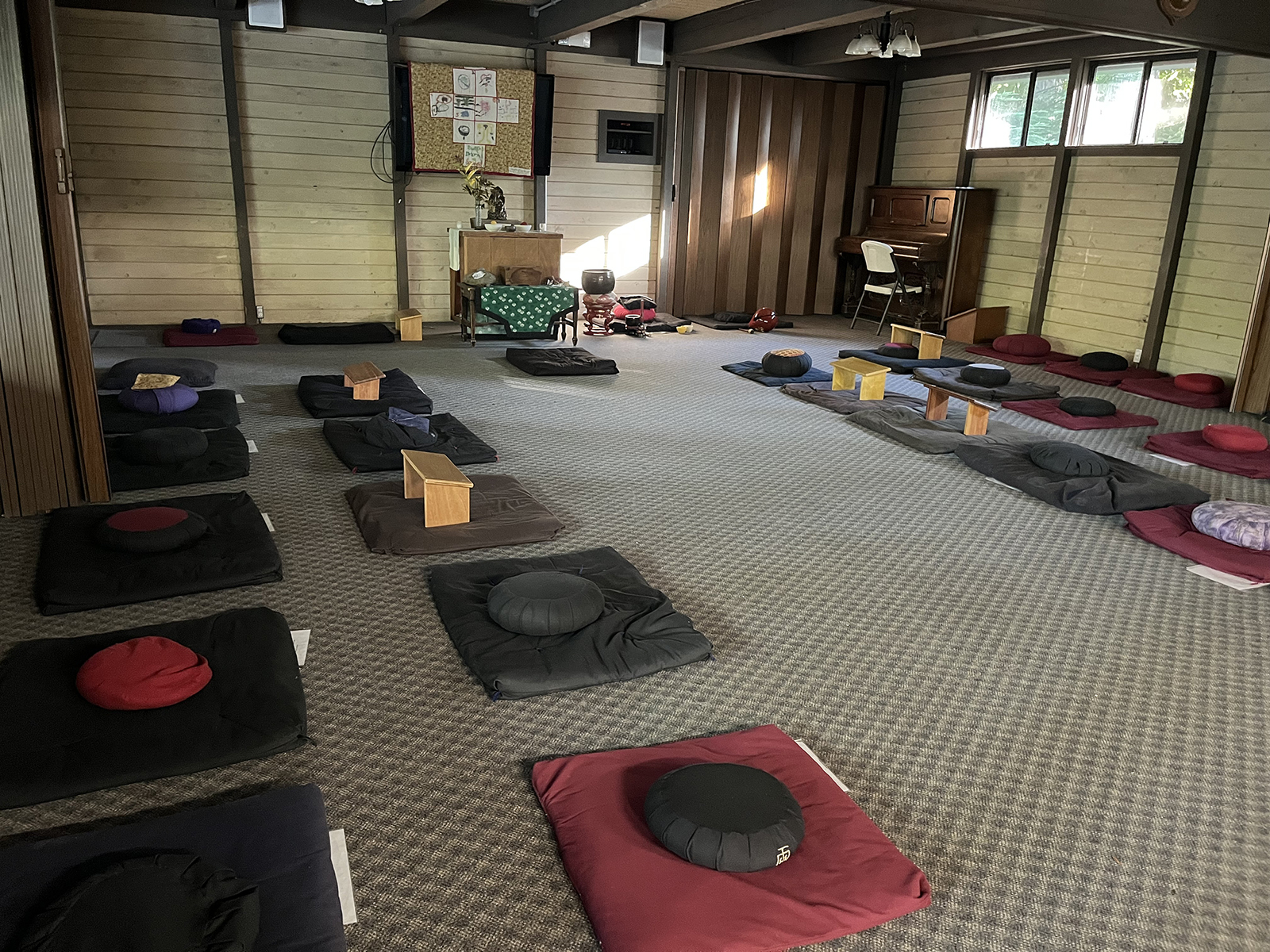
Buddhist priests and monks staff the Dharma Camp, and campers play games designed to provide fun — while also transmitting Buddhist practice. “It’s just kind of sprinkled throughout the entire day. And most of it is summer camp. Most of it feels like playtime,” said Kakumyo Lowe, abbot of Dharma Rain Zen Center in Portland, Oregon, who has spent 27 summers at Dharma Camp. There are the usual camp staples of water fights, friendship bracelets and ball games, but when the camp stages color war, each team competes on behalf of a particular bodhisattva, or enlightened figure from the Buddhist lineage. They go through various challenges, judged on their cooperation, inclusiveness, teamwork, kindness and calm.
Kids also spend an afternoon playing hunt-a-monk, a sort of hide-and-seek with monastics.
“A lot of people think of Buddhism as just being meditation and Buddhist teachings,” said the Rev. Sumi Loundon Kim, Buddhist chaplain at Yale University and the author of books about cultivating Buddhist practice in kids and young adults. “If you’re an eight-year-old, you have roughly zero interest in either of those.”
Kim said that Buddhist camps can provide children with a “strong sense” of the spiritual practice by engaging in their five senses. Buddhist summer camps also can have the potential bonus of offering a pathway to spiritual practice for people from a variety of backgrounds and traditions, she added. “Because it’s a faith tradition that doesn’t center the salvific ends on God or a God figure, it can be atheistic or agnostic regarding that,” said Kim.

Whether Buddhist camp inspires the children to adopt Buddhist practices is unclear. There are no studies, though the National Study of Youth and Religion, which looked at religious summer camps across a variety of faith traditions, found a correlation between teens’ attendance at religious camps and the strength of their religious faith.
Still, for some camp parents, religious identity is not the only point. “It’s not so much that I necessarily want (my son) to become a Buddhist as that I just want him to have that experience of being around people whose hearts are open,” said Sarah Konen Clark, a “lay disciple” at Dharma Rain Zen Center who sent her son to Dharma Camp for three years.
Some campers, such as Evie Phillips, 12, said they want to bring practices home with them. “ I’m definitely gonna meditate a lot more after this, ’cause it just calms you down and stuff,” said Phillips.
Nineteen-year-old Violet O’Herron, who has gone from camper to counselor at Dharma Camp, said her mom tells her that she seems to have a glow when she comes back from camp.
“I have this profound sense of self that I always find here, and then can take with me wherever else I go,” said O’Herron.
One of the Buddha’s core teachings is that everything is impermanent. The kids at Dharma Camp — and other Buddhist camps — learn the Buddhist practice of being still in the middle of all that flux and listening to what’s true. That eventually, campfires will burn out. That summer will end, and all of these kids will become adults. And maybe they’ll take a piece of this camp with them.
Deena Prichep is an award-winning audio producer, writer and editor based in Portland, Oregon. This story was produced through a collaboration between NPR and RNS. Listen to the radio version of the story.


