











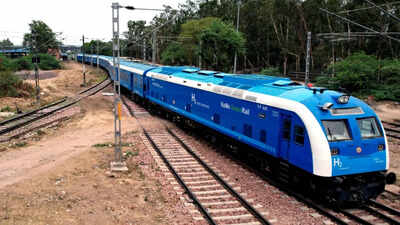
India’s first hydrogen-powered passenger train has begun running on the Jind-Sonipat route. Its promise lies not in burning a new fuel, but in using hydrogen to generate electricity onboard — with water vapour as the only direct emission.A hydrogen train is, in effect, an electric train that carries its own power plant. Unlike a diesel locomotive, it does not burn hydrogen inside an engine. Hydrogen stored in high-pressure cylinders is fed into a Proton Exchange Membrane, or PEM, fuel cell. Oxygen is drawn from the surrounding air. Inside the fuel cell, hydrogen molecules are split into protons and electrons.The protons pass through a membrane, while the electrons are forced through an external circuit. That flow of electrons creates electricity, which powers the train’s traction motors. On the other side of the fuel cell, the protons, electrons and oxygen recombine to form water and release heat.The direct output is electricity, water vapour and heat. There is no smoke and no carbon dioxide released from the train while it is moving. But that is only half the environmental story.
Where does the hydrogen come from?
On Earth, hydrogen is usually bound to other elements. It is present in water, natural gas and biomass and must be separated before use.One route is electrolysis. An electrolyser uses electricity to split water into hydrogen and oxygen. If the electricity comes from renewable sources such as solar or wind power, the resulting fuel is called green hydrogen.If the electricity comes from coal or gas, or if hydrogen is extracted from natural gas without capturing the resulting carbon, the fuel may still have a large climate footprint.That is why a hydrogen train is best described as having zero direct, or “tailpipe”, emissions. Its total emissions depend on how the hydrogen is produced, compressed, transported and stored.There is also an efficiency tradeoff. Electricity can be sent directly through overhead wires to power an electric train. With hydrogen, electricity may first be used to make the fuel, which is then compressed, stored and converted back into electricity onboard. Energy is lost at each stage.
So why use it?

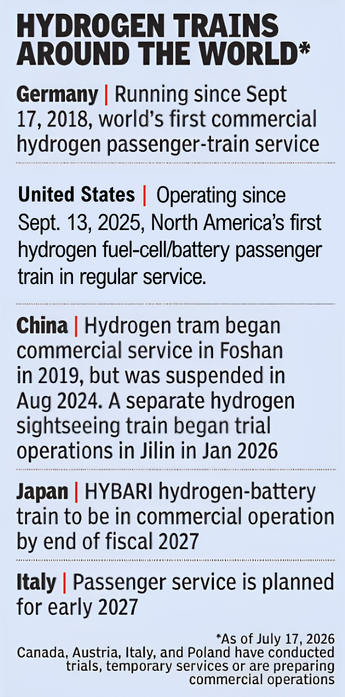
Operational hydrogen trains around the world
A hydrogen train can operate on existing tracks without continuous overhead wires. That could make it useful on remote, heritage, hill or lightly used routes where installing and maintaining electrical infrastructure may not be economical.This is also why hydrogen trains are unlikely to replace conventional electric trains across India. More than 99% of the country’s broad-gauge network has already been electrified. Hydrogen’s role is more likely to be as a substitute for diesel on the few sections that remain difficult to electrify.
How does the Indian train use energy?
The 10-coach train has eight passenger coaches and two hydrogen-powered Driving Power Cars, one at each end. Together, they produce 2,400 kW.Hydrogen is stored in specially designed cylinders at a pressure of 350 bar. The fuel cells supply electricity, supported by lithium iron phosphate batteries. The batteries respond to rapid changes in demand and allow the fuel-cell system to operate steadily.
Why is storage difficult?
Hydrogen contains a large amount of energy by weight, but very little by volume at normal pressure. To carry enough fuel, it must be compressed, liquefied at extremely low temperatures or stored through other specialised methods.India’s train uses compressed hydrogen. That requires strong cylinders, specialised valves and pipelines, controlled refuelling and continuous monitoring.Hydrogen is highly flammable, colourless and odourless. Its flame can be pale and difficult to see. A leak in an enclosed space can create a serious fire risk.Indian Railways says the train has leak detectors, flame and smoke sensors, ventilation, automatic shutdown systems and fire-protection equipment. Production, storage and refuelling must be handled by trained personnel.
The science extends beyond the train

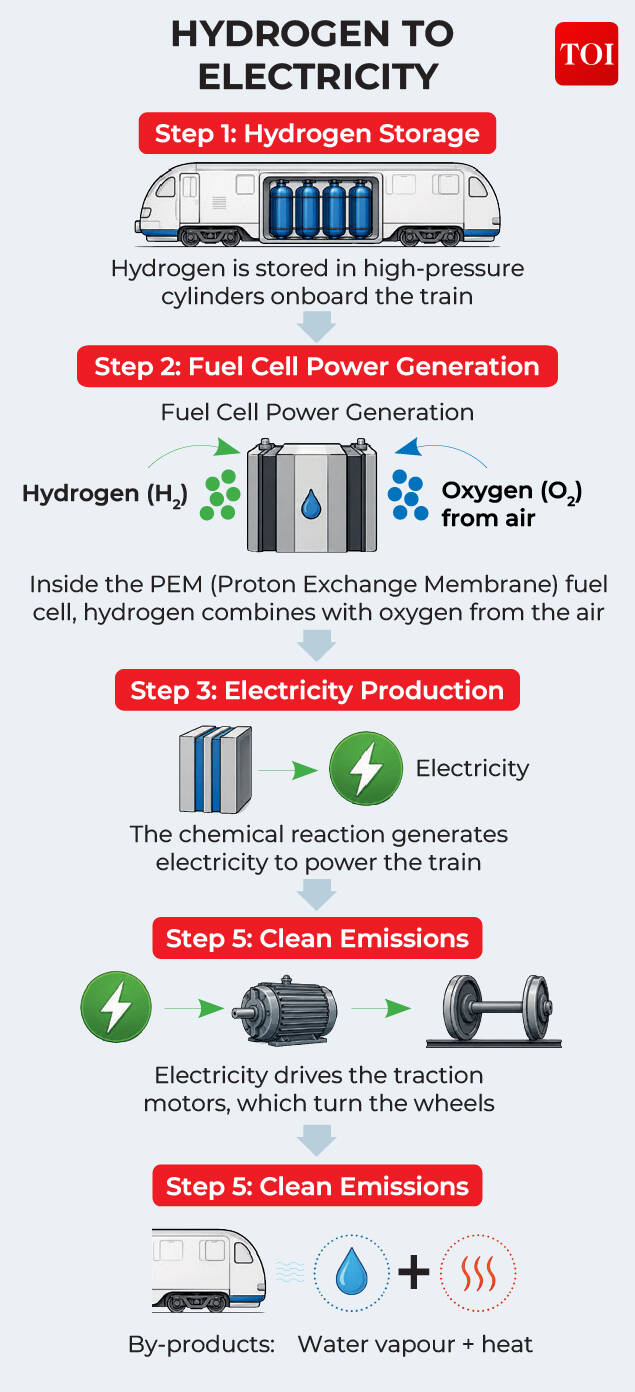
How hydrogen is used to generate electricity.
At Jind, Indian Railways has built an entire hydrogen chain: electrolysis, compression, storage and dispensing. The facility can store nearly 3,000 kg of hydrogen and has been licensed to handle compressed hydrogen gas.This infrastructure is essential because a hydrogen train cannot operate merely by replacing a diesel engine with a fuel-cell unit. It needs a dependable hydrogen supply, safe storage, compressors, dispensers and trained staff.That is also what makes the technology expensive. In 2023, the government estimated a cost of about Rs 80 crore for each train and around Rs 70 crore for infrastructure on each route. The Jind–Sonipat project, including the train and its facilities, has been reported to cost about Rs 136 crore.The larger question is therefore not whether hydrogen can move a train. The chemistry is well established. The test is whether green hydrogen can be produced cheaply enough, supplied safely enough and used efficiently enough to justify deployment on selected routes.For Indian Railways, the JindSonipat service is as much an experiment in energy systems as it is a new train.Research: Rajesh Sharma and Bansri Shah