











(RNS) — The Stones put it this way: It’s only rock ’n’ roll, but I like it.
And I do — the Beatles, the Stones, David Bowie.
But there are some things I don’t like about it. Author and musician Daniel Rachel has written a new, disturbing and quite overdue book, “This Ain’t Rock ’n’ Roll: Pop Music, the Swastika and the Third Reich.” And I interviewed him about it for my podcast.
The book documents something that has been hiding in plain sight for more than 60 years. As Rachel writes:
For over seventy-five years, musicians have been drawn to the language and provocative imagery of Nazism, fascinated by its power, menace and underlying sexuality. They have flirted with the theatrical spectacle of the Third Reich, displayed the swastika, flaunted memorabilia, worn Nazi uniforms and marveled at the grandiose rallies of 1930s Germany.
Decades ago, Woody Guthrie had a guitar with the words inscribed on it: “This machine kills fascists.” We never thought that future rock stars might have guitars that could say they celebrate fascists.
The worst part is the rock music industrial complex industry spent seven decades simply looking the other way. And so did the audiences, including me. However, “This Ain’t Rock ’n’ Roll” makes the fascist connection very clear.
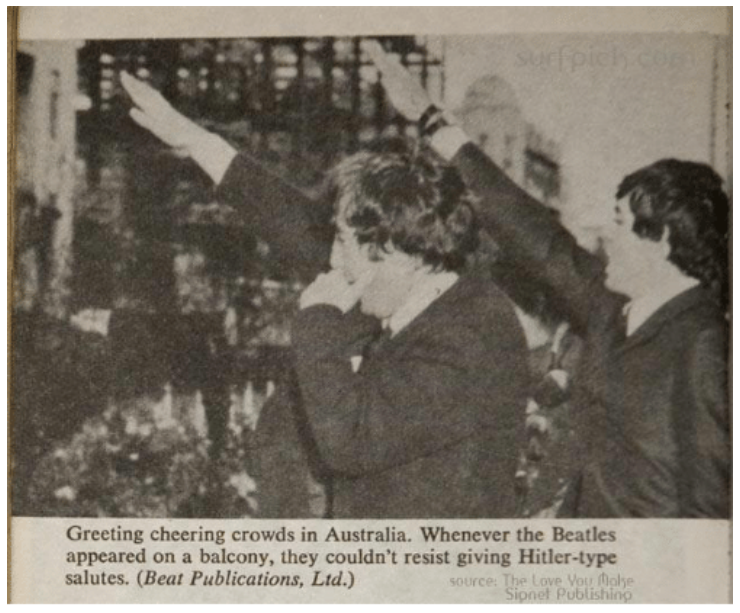
(News clipping)
Let’s start with the Beatles, particularly John Lennon. As his half-sister wrote, according to Rachel’s book:
John was absolutely fascinated by Adolf Hitler. As a boy, he used to collect and swap Nazi badges, medals, daggers, and things. He used to call himself John ‘Adolf’ Lennon, instead of Winston. I can remember him telling me that Hitler was like a modern-day Jesus Christ figure and how he took on the world … and nearly won.
When you consider that Lennon was born during the Blitzkrieg, it is beyond disturbing.

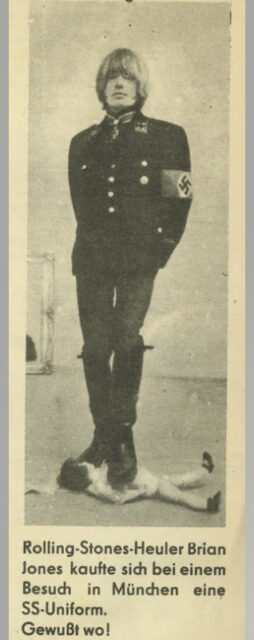
Brian Jones in a German SS uniform. (News clipping)
Brian Epstein, The Beatles’ manager, came from a prominent Jewish family in Liverpool. Lennon teased Epstein relentlessly — about being gay, about being Jewish — and the people around him laughed, the book describes.
Then, there are the Rolling Stones. In 1966, their guitarist Brian Jones donned a full SS uniform, complete with an Iron Cross and a swastika armband, for a photo shoot.
And then, the Who. Their late drummer, Keith Moon, dressed in full Nazi regalia, hired an open-top Mercedes to drive through the London neighborhood of Golders Green, where many Holocaust survivors lived, the book describes. A shopkeeper, wielding a meat ax, chased him through the street. Apparently, he did not find it very funny.
Then, there is David Bowie. In 1975, Bowie said, per the book:
Rock stars are fascists. Adolf Hitler was one of the first rock stars. Look at some of his films and see how he moved. I think he was quite as good as Jagger. And boy, when he hit that stage, he worked an audience. Good God!
Bowie called for an “extreme right front” to come and sweep Britain clean. He told journalists that Britain was “ready for a new Hitler.”
And Eric Clapton? In 1976, at a concert in Birmingham, Clapton declared: “Do we have any foreigners in the audience tonight? Wogs, I mean, I’m looking at you … leave our country. I don’t want you here, in the room or in my country,” as reported in Rachel’s book.
Meanwhile, punk rock was deliberately provocative — to the point of embracing Nazi imagery. The Sex Pistols recorded a song called “Belsen Was a Gas.” Rock critic Lester Bangs called it “one of the most frightening things I’ve ever heard … cheap nihilism.”
Joy Division named their band after the forced prostitution units in Nazi concentration camps — between 300 and 400 women trafficked and subjected to what Rachel rightly calls “legalized rape.”
That’s the British rock scene, you might say. What about in America?
Consider the Ramones. Joey Ramone (born Jeffrey Ross Hyman) was Jewish. Tommy Ramone was Jewish — born Tamás Erdélyi in Budapest. His parents survived the Holocaust, but his extended family did not.
And yet, Ramones lyrics included lines like: “I’m a Nazi Schätze, you know I fight for fatherland.”
That’s punk rock, you might say. What about more middle-of-the-road stuff?
It did not need the Nazi imagery. It could go straight to antisemitism — as did Michael Jackson. when he sang: “Jew me, sue me, everybody do me, kick me, kike me …”
There is a current debate on whether there is a necessary connection between anti-Israelism and antisemitism. Roger Waters, the Pink Floyd co-founder, is Exhibit A.


A variety of the questionable imagery in a Roger Waters concert in Berlin, Germany, in 2023. (Video screen grabs)
Let’s talk about the concert in which he floated an inflatable pig, adorned with a Star of David. Or his choice of stage costume — an outfit that resembled an SS officer’s uniform, as the name of Anne Frank was projected on stage.
Consider the assessment of Polly Samson, the wife of Pink Floyd guitarist David Gilmour. Her father came to London in 1938, on the Kindertransport. She wrote to Waters on X: “Sadly you are antisemitic to your rotten core. … Enough of your nonsense.’
But her pushback was a minority response. Most of the time, it was the sounds of silence.
Notice that as Rachel points out, rock musicians do not celebrate the work of the Ku Klux Klan or admire the clothing of a slave overseer. But they do flaunt Nazi regalia. Similarly, there was the Rock Against Racism movement. But there is no Rock Against Antisemitism.
On the one hand, this book is about rock music and Nazism. It is a cultural history of arrogance, born of artistic privilege and willful tone-deafness. Who can say how many young people were exposed to this and how much damage it did?
But its real theme is something deeper: complicity and acquiescence. That is what allowed Kanye West, the rapper who now goes by Ye, to praise Hitler, to release a song titled “Heil Hitler,” to share his admiration of “Mein Kampf,” to post a swastika inside a Star of David and to sell a $20 swastika shirt during a Super Bowl commercial break — the most-watched television broadcast in America.

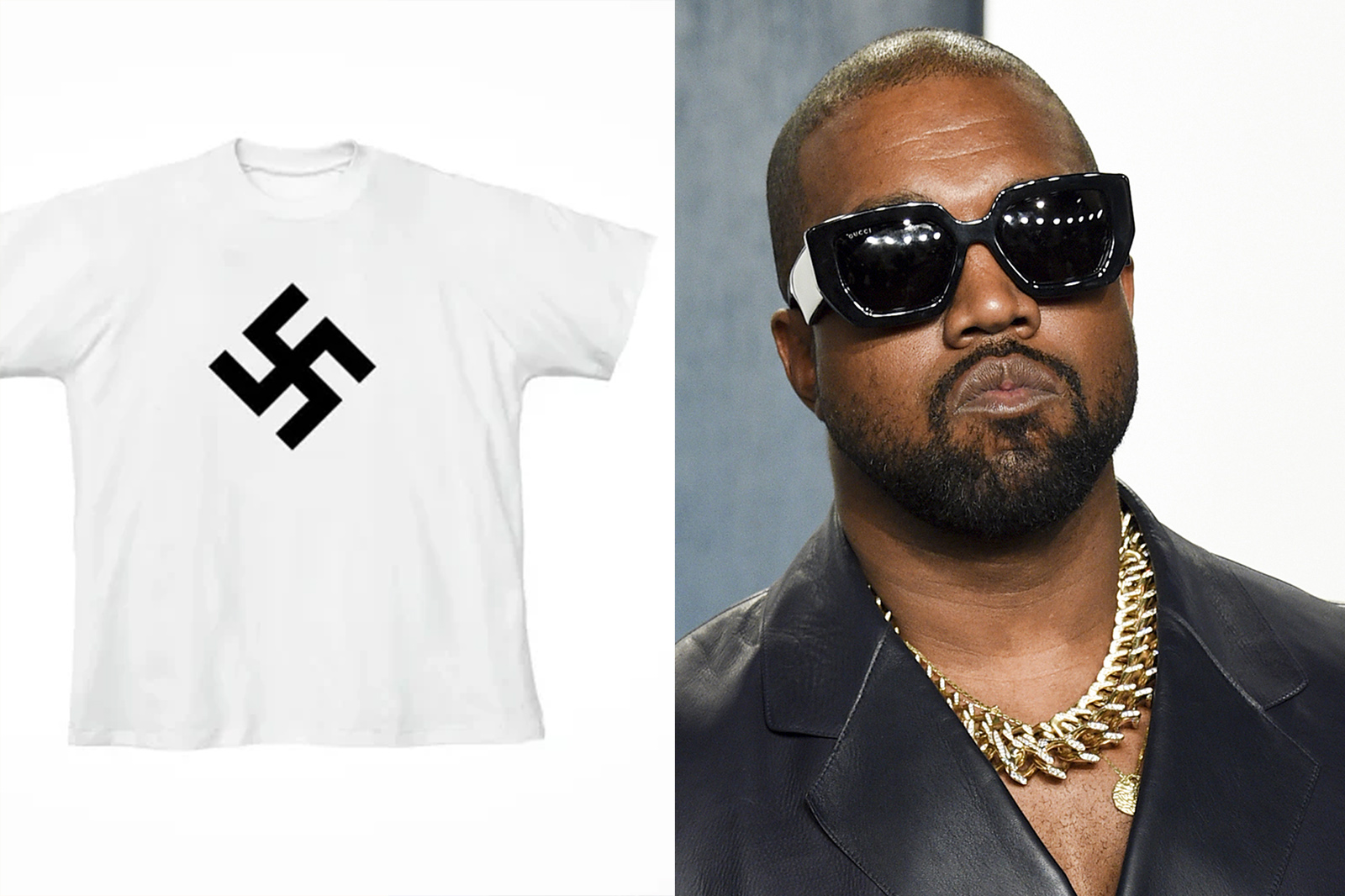
Kanye West, right, in February 2020, in Beverly Hills, Calif., and a swastika shirt he sold, left. (West photo by Evan Agostini/Invision/AP, File)
This ain’t rock ’n’ roll. This is a reckoning. And it’s about 75 years overdue.