








(RNS) — When Andy Burnham began his term as the United Kingdom’s 59th prime minister on Monday (July 20), he made history — not only for taking office in an unusual way after the resignation of his unpopular predecessor, Sir Keir Starmer, but also for becoming Britain’s first Catholic-born prime minister.
Hundreds of years of restrictions following the English Reformation and institutional bias meant Catholics did not achieve high political offices until relatively recently, and Burnham’s move into the role marks a major shift.
Some may argue former Prime Ministers Tony Blair and Boris Johnson beat Burnham to this spot in history. But Blair converted to Roman Catholicism, the faith of his wife and children, after he left office. Many observers speculated that he did not do so earlier because it might have affected delicate negotiations over the Good Friday Agreement in Northern Ireland. Johnson, baptized a Catholic, had left the church for the Church of England.
Burnham has said on several occasions that his values were shaped by his faith, though in 2015, he said he’s “not particularly religious now.” Back in 2009, he recalled that important influences on him were, in order: the Everton FC soccer team, the Labour Party and the Catholic Church.
Constitutionally, his Catholicism matters, too.
The law still decrees those “who professe the Popish religion” cannot “possess or enjoy the Crown and Government of this Realm,” stemming from England’s split from Rome during the reign of Henry VIII, leading to the creation of the Church of England. After a brief interlude with Catholic Mary I, who appointed a Catholic to the role of chief minister to the crown — as the country’s top job was then called, over 500 years ago — the Church of England became fully rooted in the life of the country as the established church under Elizabeth I.
Today, the monarch still pledges to uphold the Protestant religion at his coronation. And according to a UK Parliament research briefing, if the prime minister is Catholic, some jobs related to Church of England appointments may have to be delegated to another government minister who is part of that church.
Burnham, 56, has said he was shaped by the Catholic Church. Last year, he spoke of its influence during his lecture for the religion-meets-politics think tank, Theos. He told the audience there is a need to move from a crisis of trust to “a culture of encounter,” a phrase he attributed to the late Pope Francis, whom he met at the Vatican two years earlier.
Born in 1970, Burnham grew up with a Catholic mother and attended Catholic school. He grew up between Manchester and Liverpool, where many families stayed loyal to Catholicism despite persecution during the Reformation. Many residents there also descended from Catholic Irish migrants who crossed the Irish Sea looking for work.
He grew up in the years after the Second Vatican Council, when lay Catholics were increasingly encouraged to take roles in church life. His school years also coincided with tough times in the North West, with growing unemployment in traditional industries.
Among the most powerful voices concerned about the impact of government policies of then-Prime Minister Margaret Thatcher was the Roman Catholic Archbishop of Liverpool, Derek Worlock. The archbishop often spoke about the Catholic social gospel and how people must stand in solidarity with the poorest in society.
“As an altar boy, he would have heard messages from Derek Worlock criticizing the way central government was failing parts of the North West,” said Francis Davis, a social scientist and visiting fellow at Kellogg College, Oxford. “Worlock would deliver his message to his parishes by cassette, and Burnham, the altar boy, would press the button to play the cassette.”

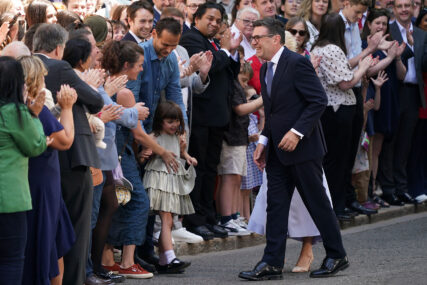
Britain’s new prime minister, Andy Burnham, arrives at 10 Downing Street in London, Monday, July 20, 2026.(AP Photo/Alberto Pezzali)
During his first campaign to secure the Labour leadership in 2010 — he lost to Ed Miliband — Burnham was interviewed by The Tablet, the Catholic weekly. “My mother was not religious in any showy way,” he told The Tablet. “I am like her in that, to use a Scouse (Liverpudlian) phrase, we don’t lick the altar steps.”
But what has clearly profoundly affected Burnham is the body of theology known as Catholic social teaching. Acknowledging the importance of individual responsibility, Catholic social teaching focuses on the importance of the common good and people working together toward it.
“It is about what we do together to build society,” Davis said.
That influence seemed apparent in a recent Burnham speech, as he talked about “taking power out of the center and putting it in the hands of the people and places who can use it best.”
Burnham, who previously served as a government minister, has spent the past nine years as mayor of Manchester, where he stressed the importance of transferring power to regions and local communities. These efforts led Burnham to work closely with different faith leaders and to travel for a week to Rome in 2023 to meet Pope Francis. He was accompanied by his mother, Eileen, who, he told The Times in an interview published Monday, “will be wearing her rosary beads out” as he enters 10 Downing Street, the prime minister’s official residence.
Burnham’s father, Roy, who has dementia and is being cared for in a Catholic care home, according to The Times, is not Catholic himself. But one of his brothers, Nick Burnham, runs Cardinal Newman College in Preston, Lancashire — one of the largest Catholic sixth form colleges in the North West. The prime minister also sent his own children to a Catholic school.
Burnham has also indicated he has difficulties with some aspects of Catholic teaching, particularly personal sexual morality. In 2015, in an interview with Premier Christian News, he said he had issues with its teaching on contraception and homosexuality, describing it as developing “a more judgmental mode” under Pope Benedict XVI. But he went on to say that “Catholic social teaching underpins my politics.”
Catholic leaders will no doubt watch how the new prime minister might deal with contentious issues such as assisted dying, considered anathema to the Catholic Church, or funding for faith schools.
The leading Catholic cleric in England and Wales, the archbishop of Westminster, Richard Moth, told the BBC earlier this month that being a Catholic and Christian as Burnham is, “informs conscience, the way you think about things.”
Under Burnham, he said he hoped “we are going to see that real concern for humanity, not just on the grand scale but for the needs of families and the homeless.” And outside Downing Street on Monday, Burnham said his first task as prime minister is to end “rough sleeping in our country,” referring to unhoused people sleeping on the street.
Moth told the BBC he hoped to have a meeting with Burnham soon.
Burnham will soon meet with international leaders, too. If they include U.S. Vice President JD Vance, a Catholic convert, he will meet a fellow believer who has also acknowledged the importance of Catholic social teaching, but which has led him to different political conclusions. Another contender for a Burnham encounter is the pope. Leo XIV chose his papal name in homage to Leo XIII, the writer of the first Catholic social teaching encyclical, “Rerum Novarum.” Pope Leo XIV added to that body of teaching with his own first encyclical, “Magnifica Humanitas,” published in May, on artificial intelligence.
Last week, the papal representative to the UK, Archbishop Miguel Maury Buendia, told a Spanish TV service that a visit from Pope Leo to the UK is “likely, desirable and I would say even unavoidable.” The nuncio was referring to the protocol that means that the UK would invite the pope for a reciprocal visit, after King Charles III visited Pope Leo at the Vatican last year. But given Britain now has its first Catholic chief minister and will mark the bicentennial of Catholic emancipation, which gave Catholics full English citizenship again, in 2029, it could be a particularly timely visit.