








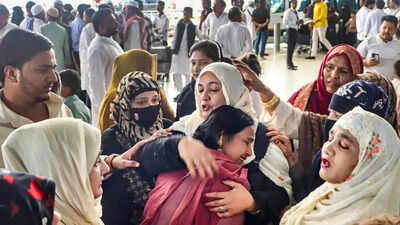
NEW DELHI: A last-minute Rs 10,000 differential airfare demand hit roughly 1.25 lakh Indian Haj pilgrims after airlines sought a fare revision because aviation turbine fuel (ATF), commonly known as jet fuel, rose during the Middle East crisis, weeks before scheduled departures from several Indian embarkation points. The April 28 circular directed them to pay by May 15, despite authorities having fixed the earlier airfare package between Rs 90,000 and Rs 1.65 lakh, depending on the city of departure.Mohd Ilyas, in his 60s, a security guard in Shaheen Bagh, said the timing had upset years of careful planning. He had spent most of his working life saving for Haj and had even skipped family milestones to build a modest corpus. “I had budgeted every single paisa for Haj 2026 — now this sudden Rs 10,000 demand has left me reeling,” he told TOI.For Ilyas, the additional cost was not trivial. Many elderly applicants and low-income families planned Haj expenses, often exceeding Rs 4 lakh even under govt route, over decades or entire lifetimes. The predictability of going through govt route had historically made it the preferred option, especially for first-time and elderly pilgrims, but the additional demand disrupted carefully calibrated budgets.The Haj Committee of India order applied to roughly 1.25 lakh selected pilgrims. Officials said the revision followed airline demands for a steep fare increase after fuel costs rose during geopolitical instability in the Middle East. They added that airlines initially sought a hike of more than USD 400 per passenger.After negotiations, ministry of minority affairs capped the increase at USD 100, roughly Rs 10,000, and shifted that burden onto pilgrims. Govt presented the decision as a containment measure and said it had prevented a far sharper spike. Officials added that aviation regulators and authorities had closely monitored fare trends and took the decision in “good faith” to ensure continuity of this year’s Haj operations despite volatile fuel markets.For millions of Indian Muslims, families treated Haj not as discretionary spending but as a deeply held religious obligation. The hike triggered political backlash, and All India Majlis-e-Ittehadul Muslimeen (AIMIM) chief Asaduddin Owaisi called it “exploitation”, saying the move penalised pilgrims despite their earlier payments. “Are pilgrims being punished for going through the Haj Committee?” he asked. “Most pilgrims are not wealthy. They save money for years. This is not a luxury.”Congress MP Imran Pratapgarhi criticised the move and called the surcharge “utter injustice”. He questioned why authorities revised a fixed fare so close to departure schedules.Ministry of minority affairs maintained that the revision was “transparent and necessary”, and said private tour operators had raised fares by even higher margins while govt intervention had prevented a more severe financial hit. “Various concerns and comments have been observed in several media platforms regarding the increase of Rs 10,000 on Haj airfare. We share the concerns for every pilgrim who saves for years to perform Haj. That is precisely why the Haj Committee negotiated hard on their behalf,” ministry said.Union minister Kiren Rijiju said officials understood the emotional significance of Haj, but the system could not avoid global cost pressures. “For countless families, Haj is a once-in-a-lifetime dream nurtured over years. I deeply respect that sentiment… We also can’t blame airlines… Through negotiations, we ensured the increase was restricted to just USD 100, saving each pilgrim a significant amount. The decision was taken transparently, in good faith, to ensure no disruption,” he said.Delhi Haj Committee chairperson Kausar Jahan told TOI that govt had worked to contain costs amid a difficult global environment. “Govt negotiated hard to prevent a much larger increase of Rs 30,000-40,000,” she said, adding that for pilgrims paying a total package of roughly Rs 4 lakh, the additional amount represented a small fraction of the overall cost.Govt abolished Haj airfare subsidy in 2018 and shifted the full cost burden onto pilgrims. While some states offered limited assistance, the system largely operated on a cost-recovery basis and remained vulnerable to geopolitical instability, fuel-price volatility and late airline cost revisions.The first batch of pilgrims from India had already departed on April 18. Others were preparing to leave in the coming weeks as one of the world’s largest religious mobilisations gathered pace. Pilgrims have to make the additional payment through the Haj portal, the Haj Suvidha app or designated bank branches by May 15.