











NAIROBI, Kenya (RNS) — On a recent Friday morning, groups of young men on motorbikes roared around the grounds of the All Saints Cathedral in Nairobi to disrupt and scare those gathered for a civil meeting about the country’s proposed national budget reforms.
Police officers initially repelled the estimated 50 bikers, who then spread panic into nearby streets by reportedly mugging passersby. But they returned on foot half an hour later and managed to storm into the historic Anglican church, attempting to rob clergy, civil society leaders, lawyers and members of the public.
“Initially, we thought probably it was a politician who had come here to do something, then we realized they were rowdy … In one minute processing, I knew we were under attack,” the Rev. Canon Evans Omollo, provost of the cathedral, told RNS. “I think the person who mobilized the goons wanted to silence our prophetic voice.”
The June 12 attack is the latest underscoring of a rising culture of “goonism” in Kenya, referring to young men from poor neighborhoods believed to be hired by politicians and influential businessmen to attack or intimidate individuals and disrupt meetings associated with political activities the gangs’ bosses oppose. The African nation is grappling with rising costs of living amid subsequent protests against proposals to raise income taxes.
Kenyan President William Ruto on Tuesday (June 23) signed the 2026 Finance Act into law, which he said was the result of extensive public engagement and will not raise new taxes. Ruto campaigned on a promise to inject Christian values in the 85% Christian country and is running for a second term. He has condemned the rising use of “goons” or gangs to intimidate political opponents and vowed to restore order.
But critics accuse politicians in Ruto’s administration of hiring and protecting thugs to attack and intimidate their opponents. They also allege that the administration is pressuring police to allow the gangs to suppress dissent.

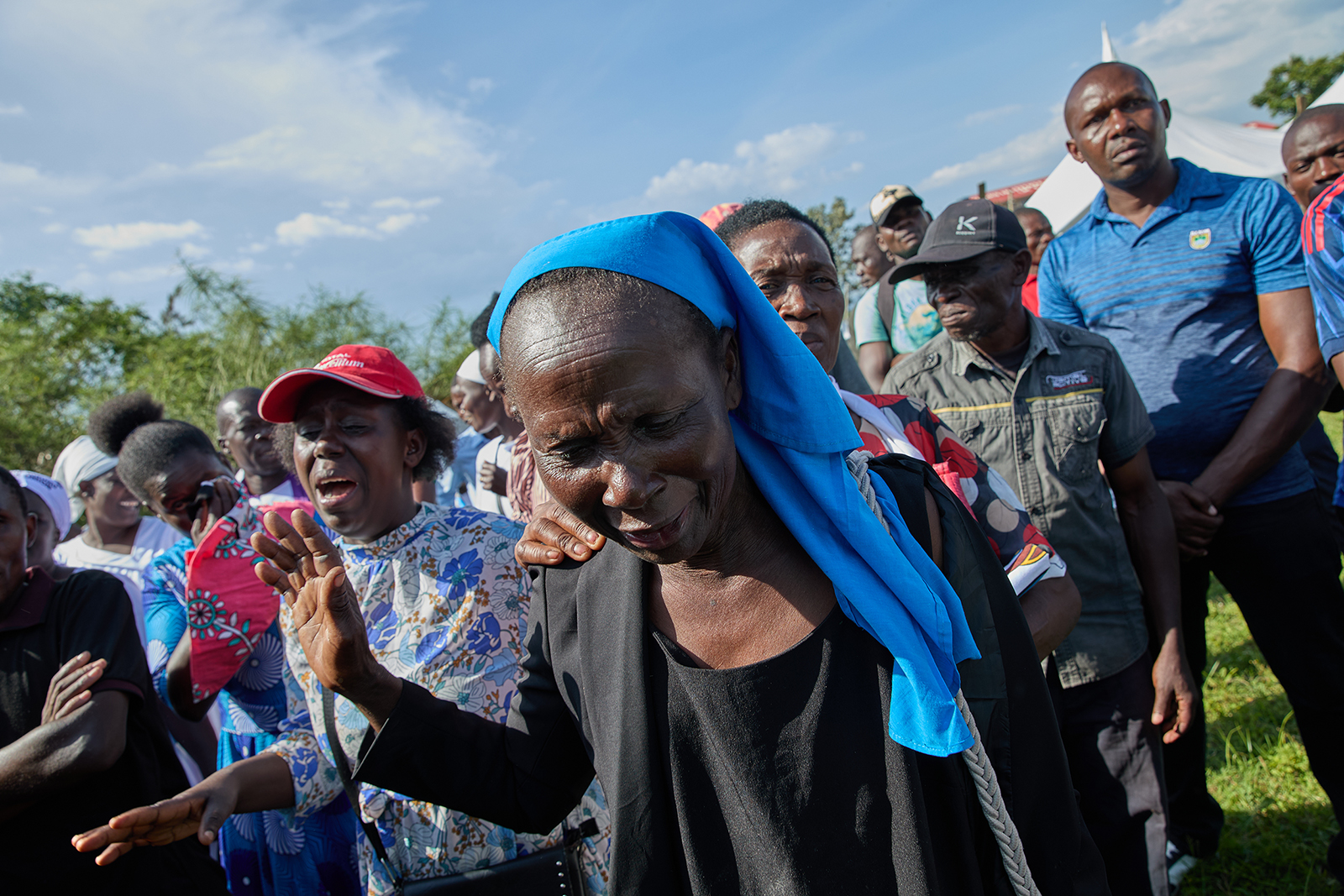
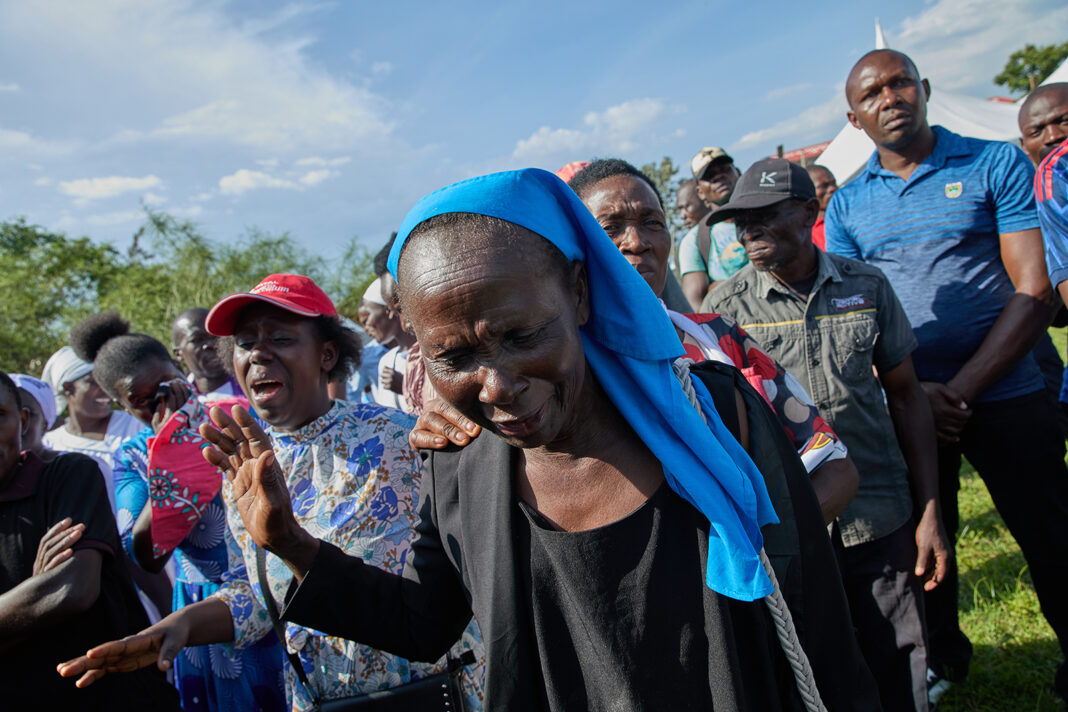
Mourners grieve alongside family members and friends of the deceased during a funeral on the outskirts of Kisumu, Kenya, March 13, 2026. (AP Photo/Asa Wallin)
Churches and church meetings are becoming targets of the violence, clergy told RNS, because they often host independent forums, debates and human rights defenders who teach people about their rights.
“We are afraid there is a growing concern that ‘goonism’ is having an official support,” said Archbishop Maurice Muhatia Makumba of Kisumu in a statement Tuesday. Makumba, who is chairman of the Kenya Conference of Catholic Bishops, pointed to how the attackers at All Saints did not seem to fear the police presence. “Can Government dispel this suspicion from the minds of citizens? Is there political will to deal with the menace of ‘goonism’ or is it in the interest of the political elite?”
Makumba warned that “the increasingly visible weaponization of goons to disrupt lawful public gatherings, including in worship places, and intimidation of citizens seeking to participate in democratic dialogue, also poses a grave threat to the rule of law and the fundamental freedoms guaranteed by our Constitution.”
An attack on Jan. 25 targeted a Sunday service at the Rev. Joseph Njakai’s home church, St. Peter’s Witima Anglican Church in Othaya, Nyeri County. Thugs disrupted the service with guns and tear gas, trapping and choking worshippers, including babies and children.
“I remember my grandchild, 3 years old, saying he cannot go to that church again because he was in that service that day,” Njakai said. Members of the church are still traumatized, and some are considering how to seek compensation from the government.
“The church is the voice of the people and a government watchdog,” Njakai added.
While the thugs’ bosses give them money directly, they also engage in looting, sometimes stealing mobile phones, electronics and cash. In the attack on All Saints, participants reportedly lost their phones, bags and other items.


Police fire water canons during a protest in Nairobi, Kenya, July 16, 2024. (AP Photo/Ed Ram)
In 2024, young Kenyans organized mass protests against proposed tax hikes in an earlier finance bill, which culminated in the storming of Parliament and the deaths of at least 60 people in the following months of unrest. A memorial for those who died is scheduled for Thursday.
“Knowing that we are in a politically charged context — that is, looking forward to the Gen Z two-year memorial — I think somebody felt this scare would contribute to silencing the All Saints Cathedral,” Omollo said.
The Rev. Elias Otieno Agola, a Presbyterian Church of East Africa cleric and the chairman of the National Council of Churches, said the All Saints meeting was attacked because it was meant to educate people about the debt crisis.
With Kenya’s debt surpassing Kenya shilling 12 trillion ($92.7 billion), activists and ordinary citizens accuse the government of excessive borrowing.
“Kenyans are paying 12.4 billion shillings per year to debt,” Agola said. “If you quantify this, you’ll realize that this is a lot of money and therefore the common Mwananchi (citizens) have to be told the effect and the impact of this finance bill on the country.”
He warned that the violence might be tribal or regional at the moment but could grow into a bigger conflict.
“This is taking us back to similar moments in the late 1980s and early ’90s,” he said, referring to Kenyan state police who stormed into the All Saints sanctuary in 1992 shooting bullets and tear gas at protesters.
At least 13 churches in the national council were attacked last year by gang members, according to Agola. The gangs had either followed politicians into churches to disrupt services or support their presences there.
“They are attacked because somebody somewhere thinks the (council) is not supportive enough,” he said, while pointing at the Presbyterian Church of East Africa church attacks in Kariobangi North on Nov. 30, 2025, and Mwiki, Kasarani, on April 6, 2025, both in parishes in Nairobi.
Bishop Lambert Mbela, a Redeemed Gospel Church leader in Mikindani, Mombasa city, said the attacks are also spiritual, and disrespect for churches starts at the top of the country’s leadership.
“It is not a secret that from the top there is a disdain and a disrespect for the places of worship, then because these things are spiritual, the same spirit flows down and you find people just being driven to disrespect these places,” Mbela said. “When the head is sick, the whole body is also sick.”
Mbela is calling for religious groups to unite and demand an apology and repentance.