











(RNS) — Thirteen years ago, Jeff Strong received an email from his son who had just left to serve a mission for The Church of Jesus Christ of Latter-day Saints. This son had entered the church’s Missionary Training Center only days earlier, but he’d already decided to come home.
“As I read the email, it became very evident to me, just from the tone and the words that he used, that it was much bigger than just leaving the MTC,” Strong told RNS. “He was going to leave the church.”
Strong “immediately went into fix-it mode,” he said, as he and his wife dealt with their shock and grief about their son’s decision. They saw it as a wrong move that could potentially damage the rest of his life — and their whole family’s eternity. They weren’t sure how to talk to him about it.
“In our community, we literally believe that these conversations have eternal consequences. There’s the idea of ‘sad heaven’ or empty chairs at the dinner table in the Celestial Kingdom,” he said.
A bedrock part of Latter-day Saint theology is that families can be together forever — but only if everyone remains in the church’s fold.
“So, when somebody steps away, members immediately put their brain into that space of, ‘Oh, this is the eternal end of my child or my friend,’” Strong said.
Today, however, Strong said he has a “great relationship” with this son — and with the two other of his five adult children who’ve also left Mormonism. He and his wife remain very involved in the church, in which he’s served many volunteer callings, including as a bishop and mission president.
Through that service, he began to see that his children’s decisions to leave the church weren’t aberrations. This was the new normal.
“Disaffiliation became so personal to me because as a bishop, I was losing members in my ward, and I had former missionaries that were leaving,” Strong said.
He wanted to find out why and has spent much of the last several years teaming up with social science researchers — including me — to learn more. That research is summed up in Strong’s new book, “Torn: Why People We Love Are Leaving the Church and What We Can Learn From Them,” based on personal experiences and also on survey data about people who leave the LDS church.
One of the lead researchers, Jeff Dotson of The Ohio State University, helped Strong field a survey of current and former Latter-day Saints. It’s not necessarily representative because it was fielded using social media, email lists and snowball sampling referrals, but it was massive. About 15,000 people at least started the survey, and 11,000 finished it — even though it took them an hour to do so, on average.
Dotson was “amazed” by how long people were willing to spend on it, he said. As someone who does a lot of survey research, he generally tries to keep surveys under five minutes. An hour is unheard of.
About 60% of survey takers were current LDS church members, and 40% were people who had left. The survey’s current members skewed active, meaning they were more likely than average members to attend church regularly and consider themselves devout.
The data showed that it’s the most devout members who have the hardest time understanding and relating to family members and friends who have left.
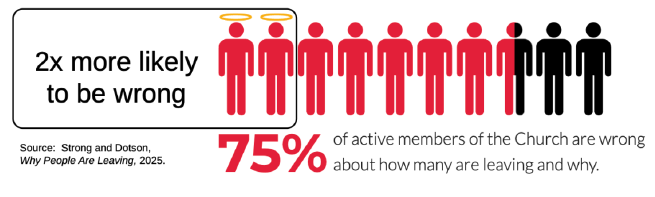
“People who self-identified as more devout picked the wrong answer twice as often,” Strong said.
For example, 75% of devout respondents greatly underestimated how many people are actually leaving, with most choosing the “zero to 25%” option when the correct answer is more likely in the “50% to 75%” range.

Most devout Latter-day Saints underestimate how many people are leaving the church. (Strong and Dotson, “Why People Are Leaving” survey)
Devout members also tended to attribute disaffiliation to personal inadequacies or religious failings. “They chose answers like ‘They sinned and lost the Spirit’ or ‘They were led away by the things of the world,’” Strong said.
The reasons provided by actual people who had left were quite different. The most common reasons they indicated were: “I didn’t feel a sense of belonging” and “I encountered information about the church’s history that was troubling enough for me that I didn’t want to participate anymore.”
That suggested to Strong that the most active members of the church “have a blind spot,” he said.
That gap in understanding makes it all the more difficult to have honest and productive conversations across the divide. Most people who leave do tell a church member about their faith crisis or faith deconstruction — 83%, according to the research. But some of these conversations go better than others.


More than 4 in 5 people experiencing a faith crisis spoke to someone in the church about it. (Strong and Dotson, “Why People Are Leaving the Church” survey)
People who had left the church reported that their most helpful conversations were with their peers, like spouses and friends. More than half said those conversations were helpful and supportive.
Far down the list were conversations with parents (14% positive) and Relief Society presidents (10% positive). Worst of all were discussions with LDS bishops and stake presidents — only 5% of leavers said those exchanges were helpful.


Conversations with local church leaders were the least helpful, and exchanges with friends and spouses the most helpful. (Strong and Dotson, “Why People Are Leaving the Church” survey)
Relevant to all these conversations is how thoughtfully people approach them.
“In high-stakes conversations, principle No. 1 is don’t talk under the influence,” Strong said. By this, he didn’t mean being under the influence of alcohol or drugs, which Latter-day Saints avoid as a part of their religion, but reacting out of fear, anger and frustration.
“Step away and take a breather,” he advised.
He said it’s fine for devout Mormons to tell their loved ones who are talking about leaving, “Hey, I’m just not in a good place to have this conversation yet. I love you, and this is really important, and I want to show up the right way for you and for me. I just need some time to get my head and heart in the right place.” And members of the church need to admit it if they feel anger or disappointment, rather than pretending everything’s great, he said.
“You’ve got to put these emotions on the table, and you’ve got to own them,” he said. “And you also need to examine the story you’re telling yourself.” Instead, sometimes church members “sort of invent narratives” about other people and why they leave — particularly that disaffiliation is a sudden, 180-degree change that comes out of nowhere, he added.


“How did your faith transition impact your relationship with God and the Church?” (Strong and Dotson, “Why People Are Leaving” survey)
Parents, in particular, may not realize that their kids have had issues with the faith for a long time but were worried about losing their family’s love and respect if they spoke up.
Strong said parents also have to recognize when they’re imposing their own dreams for checklist Latter-day Saint children. “Maybe you wanted to be that parent where all your children went on missions, got married in the temple and remained faithful. But when that doesn’t work out, you get really clear on what your own motives were for wanting that,” he said.
It’s only after taking a breather, admitting your emotions and getting clarity on your own motivations that you’re truly ready to have productive conversations with people who have left, Strong said. For that, “the right objective should be relational, not correctional. You shouldn’t be going into that conversation to fix or correct or even seek agreement. You should be building trust.
“Moments of truth can go one way or the other, but if they go in a positive direction, they can actually deepen a relationship instead of damage it,” he said.