








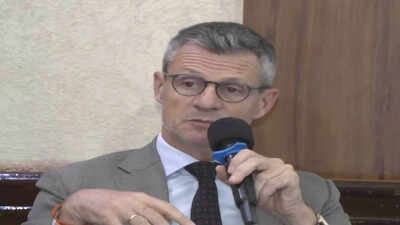
NEW DELHI: The European Union and India have adjusted and recalibrated their approach to a rapidly evolving global order shaped by multiple geopolitical and economic shocks, ambassador of the delegation of the European Union to India, Herve Delphin, said on Wednesday, as he highlighted the concept of strategic autonomy amid growing global uncertainties.Delphin made the remarks during a panel discussion on EU-India relations held at the Press Club of India, where Ireland formally launched the Irish Presidency of the Council of the European Union. Ireland will hold the rotating presidency from July 1 to December 31, 2026.Describing the moment as symbolically significant, Delphin said the launch of the Irish presidency reflected shared values between Europe and India.“I think it’s a very auspicious moment at the starting day of the Irish presidency of the Council of the EU, if only by the colours. It’s both the colours of Ireland, the colours of India, and the colours of the EU. So already the colours are auspicious,” he said.Highlighting the role of democratic values, the EU Ambassador underscored press freedom as a key pillar connecting India and the European Union, adding that while the symbolism of the event was positive, the broader global environment remained complex.“I think we are bound by democracy and certainly press and press freedom are some of the essences of democracy and we value that very much. We recognise this as a strong bond between the EU and India,” he said.“So, in a way, auspicious times, auspicious places, but definitely difficult times. And I think maybe sometimes we are too much taken by the feed of news and thinking that we are bouncing from one crisis to another,” Delphin added.He noted that the international system is undergoing a fundamental transformation, shaped by successive global shocks over the past decade, pointing to events such as China’s rise, Brexit, the COVID-19 pandemic and the Ukraine conflict.“What we are seeing is the emergence of something we have difficulties to name. An order, a disorder, but it’s certainly no more the sort of template and framework we used to describe international relations,” he said.Referring to geopolitical shifts, he said the global order is being reshaped by economic and political fragmentation, including what he described as “China shock 2.0” and a more transactional US foreign policy approach, reflecting Washington’s policy changes following the inauguration of US President Donald Trump.“We are facing an America which is more America first, more transactional, and certainly has to challenge the basic assumptions on which we have based our relationship, the transatlantic relationship,” he said.Despite turbulence, Delphin stressed that the international system continues to function, even as it evolves under pressure, while emphasising that EU-India relations are not a reaction to global instability but the result of a long-term convergence process.“The international order, I think it still works; we see the dysfunctionalities, but it’s still operating, and the question is whether we have to throw everything overboard or we actually need to adapt,” he said.“And the same way the EU-India rapprochement has been in the making for some time. I think the biggest mistake would be to think that we have adjusted as a variable to each other in view of all that happens around us,” Delphin added.Warning against reactive diplomacy, he said both sides must avoid being driven by short-term global disruptions.“The mistake would be to be driven by distraction or driven by deception. And I think both the EU and India, coming from different perspectives, different histories, and different geographies, have sort of adjusted and recalibrated to this new world,” he said.Referring to the evolving concept of strategic autonomy, Delphin said the idea–once seen as unconventional in Europe–has now become central to policy thinking and added that strategic autonomy does not imply isolation but rather flexibility in external engagement.“I happened to be in this circle of those who started to socialise the discussion on strategic autonomy about 10 years ago. And I can tell you in Europe, that was a bit anathema or very strange language,” he said.“Strategic autonomy doesn’t mean you do it all on your own. Our definition of strategic autonomy: you are cooperative whenever you can, and you have to act autonomously whenever you must,” he added.The remarks come at a time when the European Union and India are deepening engagement across trade, technology, security, and global governance, amid a rapidly evolving international environment marked by geopolitical competition and economic uncertainty.