








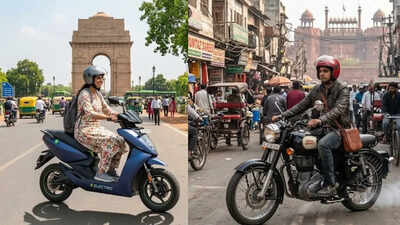
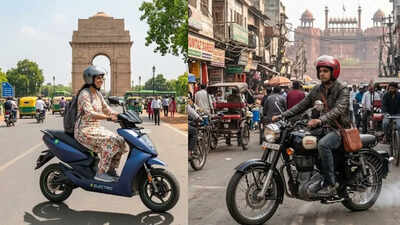
NEW DELHI: For years, the possibility of a weekend ride to Agra or Mathura barely required a second thought for Sandeep Gupta.The 52-year-old from RK Puram, who runs a confectionery business, would simply check whether his motorcycle had enough fuel and head out. The petrol bike, bought in 2007, carried him across Delhi and neighbouring cities for nearly 15 years. Distance was never part of the calculation.

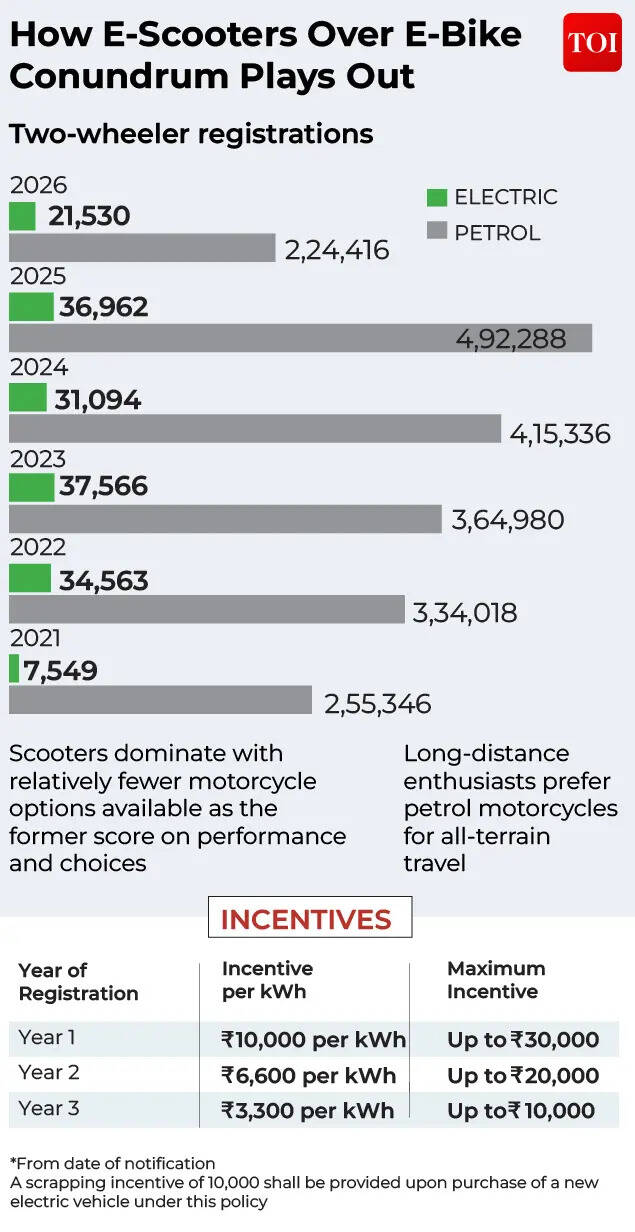
Three years ago, he switched to an electric scooter. And while the vehicle has significantly reduced his commuting costs, it has also altered the way he thinks about travel.“Inside Delhi, it works perfectly,” said Gupta. “But when someone suddenly suggests going beyond NCR, I hesitate.”His dilemma captures the larger debate unfolding in the capital as Delhi prepares for perhaps its most ambitious mobility transition yet. The Draft EV Policy 2.0, 2026-30, proposes that from April 1, 2028, only electric two-wheelers will be eligible for new registrations. Petrol and CNG motorcycles and scooters would effectively disappear from the new vehicle market. Fleet aggregators have already been barred from adding new petrol or diesel vehicles, while all existing commercial two-wheelers are expected to transition to electric by 2030.The proposal is designed to accelerate Delhi’s shift towards cleaner transport. However, it also raises a question confronting lakhs of riders: is the city ready to give up petrol-powered two-wheelers? For Gupta, the switch was driven less by environmental concerns and more by economics.“Every few months, there would be something to spend on, like PUC. Sometimes, I would forget to renew the pollution certificate and end up paying fines. Neighbours frequently borrowed the motorcycle, and rising petrol prices started affecting budget. And there would often be news that govt may ban vehicles that did not follow a particular emission norm,” he said.After buying an electric scooter in 2023, Gupta said his charging bills are much lower now. “If I charge around an hour to an hour-and-a-half, the scooter can run 100 km. The pickup is good and the noise is next to nil. For city use, it works very well.”Yet, anxieties remain when it comesto long journeys. While conventional motorcycle mechanics are available in nearly every neighbourhood market, EVs often require authorised service centres. Gupta once faced a battery malfunction during severe monsoon waterlogging. “I got the issue fixed, but mechanics are not easy to find,” he said.His concerns are reflected in the number of electric bikes being used in Delhi. Despite years of incentives since the first EV policy came out in 2020, petrol motorcycles continue to dominate the capital’s roads. So far this year, petrol and petrol-E20 motorcycles accounted for nearly 91.3% of all two-wheeler registrations while electric two-wheelers represented just 8.7%. Compared to over 2.2 lakh petrol-powered two-wheelers registered, merely 21,530 EVs were registered.

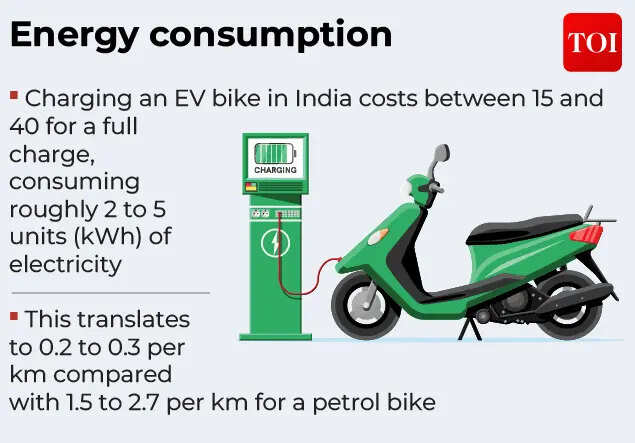
The pattern has remained consistent. In 2025, electric two-wheelers accounted for roughly 7% of registrations. The EV segment recorded its strongest performance in 2023, reaching around 9.3% market share, aided by subsidies under Delhi’s first EV policy. Registrations climbed from just 7,549 in 2021 to 37,566 in 2023, beforemoderating in subsequent years. The figures suggest that while EVs have become visible, they remain far from the mainstream.The visibility is perhaps the strongest among gig workers. Like thousands of riders powering the city’s app-based delivery economy, Mohammad Sajid spends most of his workday on an electric scooter, navigating traffic to deliver parcels. He doesn’t own the vehicle,but instead rents it for Rs 255 a day.The arrangement makes financial sense. Lower running costs allow him to complete deliveries across multiple platforms without worrying about fluctuating fuel prices. Yet, the electric scooter serves only one purpose: work. “For personal use, I still need a petrol bike,” Sajid said.His approach illustrates an emerging pattern in Delhi’s mobility transition. For many delivery riders, EVs are increasingly becoming tools of employment rather than complete replacements for conventional vehicles.According to a senior Delhi govt official, the market always follows the regulations. “The transition is still two years away. We have given enough time.”Transport minister Pankaj Singh said Delhi govt has held meetings with manufacturers and many of them are coming up with new bike models that would be seen in upcoming auto expos. “All stakeholders are positive and there is already a lotof investment by companies in the research and development of EV vehicles,” he added.Singh said govt plans to install about 8,000 new charging stations by the end of this year. “Many of these will be under PM’s e-drive scheme,” he added.According to the action plans to combat air pollution, which were submitted to CAQM earlier this year, Delhi has 8,998 EV charging points against a requirement of36,177, leaving a shortfall of 27,179.For many, the transition from petrol to electric has been smooth and without hiccups. Software engineer Jugnu Singh,who commutes daily from Sector 77 in Noida to her office in Ghaziabad’s Vaishali, recently bought an electric scooter, a decision shaped by practicality rather than ideology.“I already had a car and my husband has a bike, so getting fuel refilled in three vehicles would have been a headache,” she said. “The scooter cost about Rs 1.2 lakh, which is more than a petrol scooty, but it costs roughly Rs 12 in electricity for nearly 90 km. For the same distance, I would spend Rs 200 on a petrol vehicle.”Fast-charging facilities near her workplace and residence have further reduced anxiety. According to Singh, even a short 10-minute charge can provide a useful top-up, while a full charge takes about an hour. Unlike Gupta, who worries about long-distance travel, Singh sees the electric scooter as an ideal commuting machine.While most people are at different stages of the same transition, what connects them is that none of their decisions were driven primarily by govt targets or environmental messaging. Instead, they were shaped by everyday calculations about money, convenience and practicality.For urban professionals making predictable daily journeys, the economics are compelling. Singh’s experience also reflects a trend policymakers hope to encourage — households gradually replacing at least one conventional vehicle with an electric alternative.

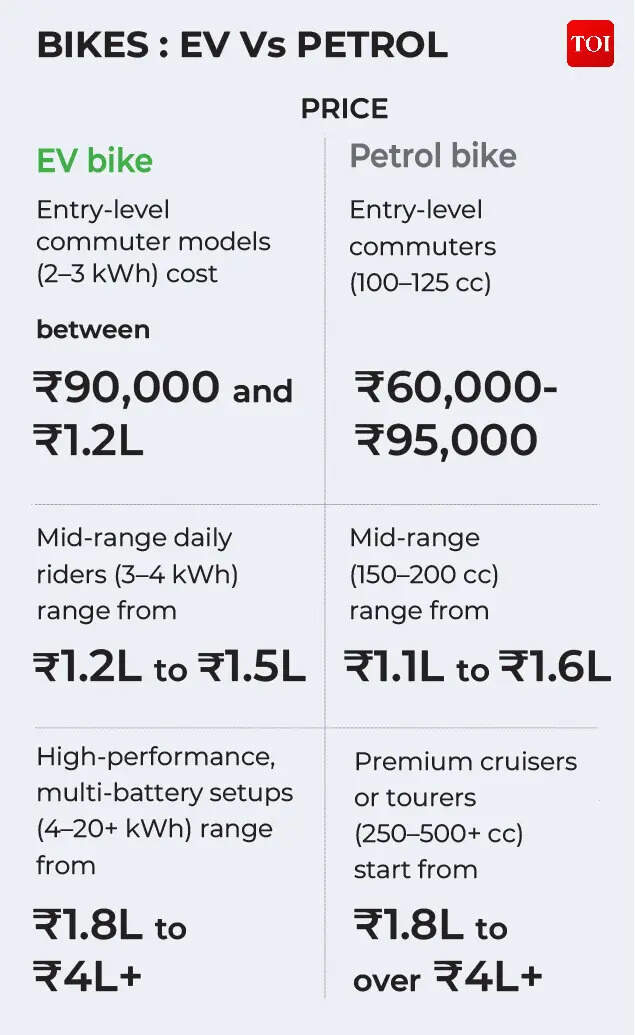
To accelerate that shift, Delhi’s draft policy proposes a fresh incentive structure. Electric two-wheelers with an ex-factory price below Rs 2.2 lakh would be eligible for subsidies ranging from Rs 10,000 per kilowatt-hour in the first year, capped at Rs 30,000, to lower incentives in subsequent years. Buyers scrapping older BS-IV and below two-wheelers could also receive an additional Rs 10,000 incentive when purchasing a new EV.Bike expert Krishanu Kona, a resident of Kondli, who undertook an epic 50,338-km ride across 25 states of India in 2015-2016, pointed out that theEV market is currently heavily tilted towards scooters, with little innovation in motorcycles, except a couple of companies. “However, the newly-biked launched bikes are largely going to be used for city commuting. If I have to go to Ladakh, I would, any day, prefer a petrol bike.”According to Shweta Chithrode, a biker who runs AutoUpshot, “When it comes to the biking community, new brands are entering the market. However, making bikes alone is not enough; it also needs to be ensured that riders do not face range anxiety.”She added: “If you are trying to sell electric superbikes, you have to work on two fronts. First, there must be adequate charging infrastructure along highways. Second, charging should be fast. If I am on a long ride and have to spend an hour charging the bike, it becomes a major dampener. I have seen some companies working in that direction. One variant also allows bikes to be charged using car charging points.”Chithrode recently completed a ride of about 300km through the Western Ghats on an electric motorcycle. “The overall experience was good because I do extensive research and planning before undertaking any ride. However, for casual riders, petrol motorcycles remain the first choice. For electric bikes to become the preferred option, greater investment is needed in highway charging infrastructure,” she said.A manufacturer, not wishing to be named, said, “Electric scooters dominate India’s EV market because their design naturally accommodates battery packs beneath the floorboard and seat, making them more practical and cost-effective than motorcycles.”Manufacturers focused their early investments on electric scooters, reducing development costs and accelerating innovation. Scooters are also ideally suited for short commutes, where EVs offer significant savings on fuel and maintenance, he said. The urban commuter segment had already turned into a market.In contrast, creating e-motorcycles that can match the speed, power delivery and long-distance capability of mid-sized petrol bikes demands far more complex engineering, battery management and higher development costs, he said, noting that some popular bike makers plan to enter the electric motorcycle segment.Delhi’s proposed 2028 deadline seeks to reshape one of India’s largest two-wheeler markets. Yet, the registration figures suggest the city still has considerable distance to travel. Nine out of 10 new two-wheelers registered run on conventional fuel. The next two years will determine whether that ratio can be reversed.