








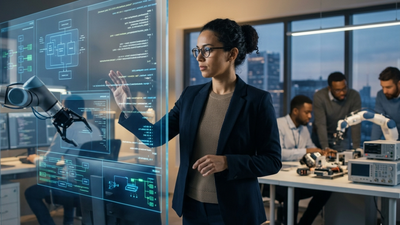
A company in the US that makes machines to cut wooden logs had a dangerous problem. Its blade rotated at 2,800 to 3,400 revolutions per minute. If an operator’s hand moved too close while pushing a log through, a split-second error could mean severe injury or loss of fingers.Ashish Khushu’s team at L&T Technology Services (LTTS) built a solution that used computer vision, AI chip processing, motor control and mechatronics. The system detected when a hand entered the danger zone, sent a signal to stop the blade, and retracted it within 18 milliseconds.For Ashish, chief technology officer at LTTS, that is the real AI story young engineers must understand. AI is not just about faster coding, automated testing or productivity gains. Those will happen, he told us on our podcast last week. AI’s bigger promise, he said, lies in solving hard engineering problems that were earlier too complex, too expensive or technologically impossible.His message to students and young professionals is clear. Do not treat AI as a magic replacement for engineering depth. Treat it as a powerful tool. The people who will benefit most are those who know a domain deeply, understand the physical or business problem, and then know where to apply AI.This is especially important in engineering services companies such as LTTS, where work spans mechanical, electrical, electronics, civil, structural and software domains. Ashish said a self-driving car, for instance, cannot be built by AI engineers alone. It needs people who understand mechanics, braking, force, power electronics, infotainment, ADAS, electrical systems and traffic behaviour.That is why he believes core engineering is coming back. Students in India have been crowding into computer science courses for years. Ashish said the demand for mechanical, electrical, physics, mathematics and other deep technical skills will rise as AI enters the physical world. AI may automate some tasks, but it will also make deep domain expertise more valuable.

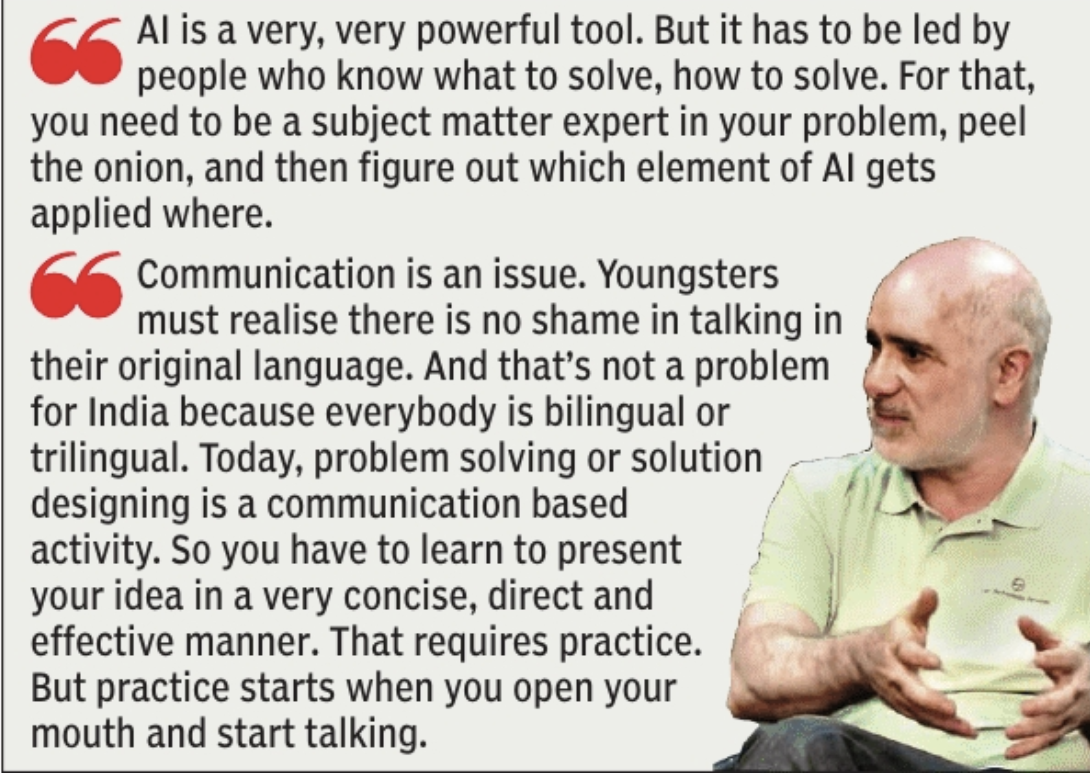
His strongest career advice is specialisation. Technology knowledge, he said, will get standardised and commoditised. Once that happens, what differentiates one engineer from another is depth.“You have to specialise. It’s a lot of effort, but there is no alternative,” Ashish said. “Specialising may not even end at postgraduate, may lead to PhDs.”LTTS hires from mechanical, electrical, civil, structural, electronics and other streams. The number of PhDs in the company, he said, has gone beyond 600 in the past few years, across areas such as fluid dynamics, maths and physics.That depth also shows up in patents. LTTS files more than 100 patents every year. Of its roughly 700 patents, around 250 are in AI. Ashish said for every patent the company files, 10 to 12 employees may submit ideas internally. That creates a culture of deeper problem-solving.We spoke to Ashish at the company’s campus in Bengaluru, on a day when LTTS was organising a hackathon across nine locations, including seven in India, and one each in the US and Germany, with more than 4,000 employees participating. The use cases were heavy in engineering complexity.Ashish said hackathons help engineers overcome hesitation. They learn to experiment, collaborate and present ideas. The company uses them to identify people with a research mindset, those who can solve customer problems, and those who can contribute to innovation.For students, he said AI awareness is no longer the main issue. Many graduates from the past two or three years are already familiar with AI tools. They use them for presentations, research and projects. This is true even in tier-2 and tier-3 colleges.The real issue is proficiency. How deeply do they know the tools? Can they use them to solve meaningful engineering problems? Can they combine them with physics, mechanics, electronics or manufacturing knowledge?Ashish said students should participate in hackathons, smart challenges, company competitions and industry projects. These help them calibrate where they stand and get their thinking muscles working.