






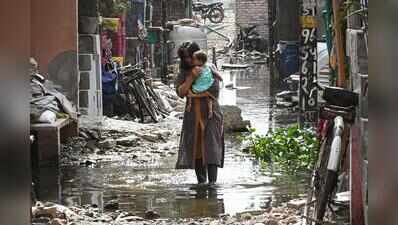
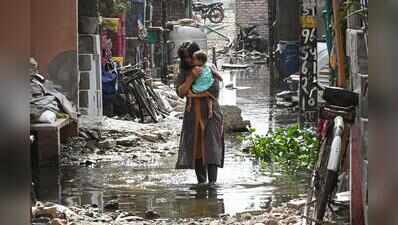
New Delhi: Nearly a week after the season’s heaviest rain lashed the city, many houses in northwest Delhi’s Kirari remain surrounded by sewage-laden water, public parks resemble filthy lakes, and children cannot attend flooded schools.“We are living in hell,” said 70-year-old Sushila, whose son, a three-year-old granddaughter and a five-year-old grandson have fallen ill. She has placed bricks across the floor of her house to create a walkway as water has inundated it. Snakes have been entering the house, forcing the family to be on its toes.TOI visited the area on Tuesday and found Sushila’s words echoing the despair that shrouds Sharma Enclave and neighbouring colonies, where black stagnant water — the result of rain and overflowing drains — continues to inundate lanes, public spaces and school campuses since monsoon arrived in the city.Built alongside landfill mounds that have buried the area’s original ground, the plight of the colony is a stark reminder of Delhi’s two realities — one the world sees, and another where residents face chronic civic neglect.Although the water has receded marginally in some stretches, pools of contaminated water, floating garbage and swarms of mosquitoes remain. For thousands living here, daily life has been reduced to navigating sewage-filled streets using makeshift brick pathways.The crisis has severely disrupted the schedule of local students. Two govt secondary schools catering to students of classes VI to XI have been shut since last Friday. The school grounds remain submerged, signboards have been put up to restrict movement through unsafe areas, and access to classrooms has been cut off by stagnant water. On the campuses, benches remain partially submerged, while playgrounds resemble ponds.When TOI visited the Govt Girls Secondary School No. 1 and Govt Boys Secondary School No. 2, it found the entrances inundated and entire courtyards under water. Knee-deep water surrounded the classrooms and the electricity supply was disconnected as a precaution. The principal, who was inside the boy’s school, declined to speak to TOI. Parents said they have not been told when the schools would reopen.A set of parents was spotted outside the school. They came from Meer Vihar to seek admission for their son, who recently passed Class X. However, they decided to leave after witnessing the flooded campus. “We will look for another option. How can we send our child here?” the parents said.About three kilometres before reaching Sharma Enclave, TOI spotted a Delhi Development Authority (DDA) park in Aman Vihar that resembled a lake. Walking tracks had disappeared beneath water, wooden benches were submerged almost to their backrests, and only parts of trees and lamp posts were still above the water level. A recreational space that once served the community was inaccessible, with ducks seen swimming in the flooded park.Maintenance staff said the park gets flooded even after light rain as water from nearby colonies flows into it. The situation worsened after last week’s rains when a portion of the park’s rear boundary wall gave away, allowing water on the road to enter it, a staffer said, adding that it rose nearly to the entire height of the boundary wall before receding a bit over the past few days.Meanwhile, at the entrance to Sharma Enclave, a police van was found stranded in water, with surrounding lanes still flooded. A grocery shop owner said locals have been facing similar conditions for years.This Jan was the wettest in four years, and the area remained waterlogged for a long time. “Many families temporarily left as they could neither sleep nor eat. Human excreta used to float inside our homes. Six months later, we are facing the same situation again,” he said. He claimed that water earlier never used to enter the schools. According to him, the situation changed owing to rampant dumping of waste near the colony.Madhav Singh, another local, said he sent his wife and child to his in-laws’ house in MP’s Jhansi because they could no longer live in such conditions. “I work here, so I have stayed back,” he said. “We have been pumping water out of the colony continuously for the past two days. Since there is no proper drainage outlet, a temporary drain has been dug across a vacant plot,” he added.Four to five pumps have been placed in each of the four flooded lanes of Sharma Enclave to drain out the stagnant water.“If this is the condition five days after the rain stopped, imagine what it was like on the day it rained and what it will be like if it rains again. This is hell. Children, women and the elderly are suffering the most. Living here has become a daily struggle, and people have been stripped of even their basic dignity,” residents said.A Municipal Corporation of Delhi (MCD) official said the area is a low-lying tract that has remained waterlogged for a considerable period and has never had an engineered outlet or a proper drainage system.Responding to their allegations of unprocessed landfill waste being dumped near the colony, the official said, “Over the years, people living in unauthorised colonies in the vicinity have indiscriminately dumped waste here. To reclaim the low-lying waterlogged area, MCD used processed inert material, which is environmentally safe, to fill up the land. No unprocessed landfill waste was used. However, the inert material subsequently got mixed with the unauthorised waste.”Authorities are constructing a permanent drainage system in the area, the official said. “Once the work is completed, the recurring problem of waterlogging is expected to be resolved. The intermixed waste will also be removed. At no stage has MCD dumped unprocessed landfill waste at this location. The inert material transported from Bhalswa landfill is periodically tested by authorised laboratories to ensure it meets environmental standards.”Regarding the flooding at the DDA park, a DDA spokesperson said its boundary wall had been breached in several places by miscreants, allowing rainwater to flow into it. “We have taken immediate precautionary measures. Security around the waterlogged area has been strengthened and electricity supply to the affected portion has been disconnected to ensure public safety. The park is situated in a low-lying area, while adjoining colonies are at a higher elevation. As a result, the excess rainwater naturally flows into the park,” the spokesperson said.A drain is under construction to divert the runoff from the adjoining colonies and prevent water from entering the park. “In addition, Delhi Jal Board is laying a sewer line in the colonies. Once it becomes operational, it is expected to permanently stop the inflow of water into the park,” the DDA official added.An education department official said Delhi govt has initiated a school audit to assess all issues plaguing the affected schools. Waterlogging has also been reported in two other schools in the area, the official said, adding that further action will be taken based on the audit’s findings.