










NAIROBI, Kenya (RNS) — For nearly two years, evangelical preacher Francis Mbombo traveled from house to house and through displacement camps in eastern Democratic Republic of the Congo, praying with families uprooted by conflict and comforting those grieving loved ones lost to years of civil war.
Then Ebola struck.
When authorities imposed restrictions on gatherings to curb the spread of the deadly virus, Mbombo was forced to suspend much of his ministry. He worried about the people he had built spiritual connections with and wondered how they would cope without prayer, counseling and the physical presence of their church community.
“When I heard about the Ebola outbreak, I was shocked,” Mbombo told RNS. “I felt like my mission had come to an end.”
The highly contagious and often fatal virus has compounded the suffering of communities still trying to recover from years of armed conflict. Families that lost relatives during the violence now fear losing loved ones to disease, while restrictions aimed at containing Ebola have made it difficult for churches to comfort the sick and accompany grieving families.
Instead of visiting congregants, Mbombo now relies on phone calls and text messages to encourage them. Last week, he prayed over the phone with a church member whose child was gravely ill. The family was still mourning another child who had died during the conflict in Goma a year earlier.
“I have to make sure they hear the word of God and know they are not alone,” he said. “But making calls every day is expensive, especially for people who cannot read messages.”


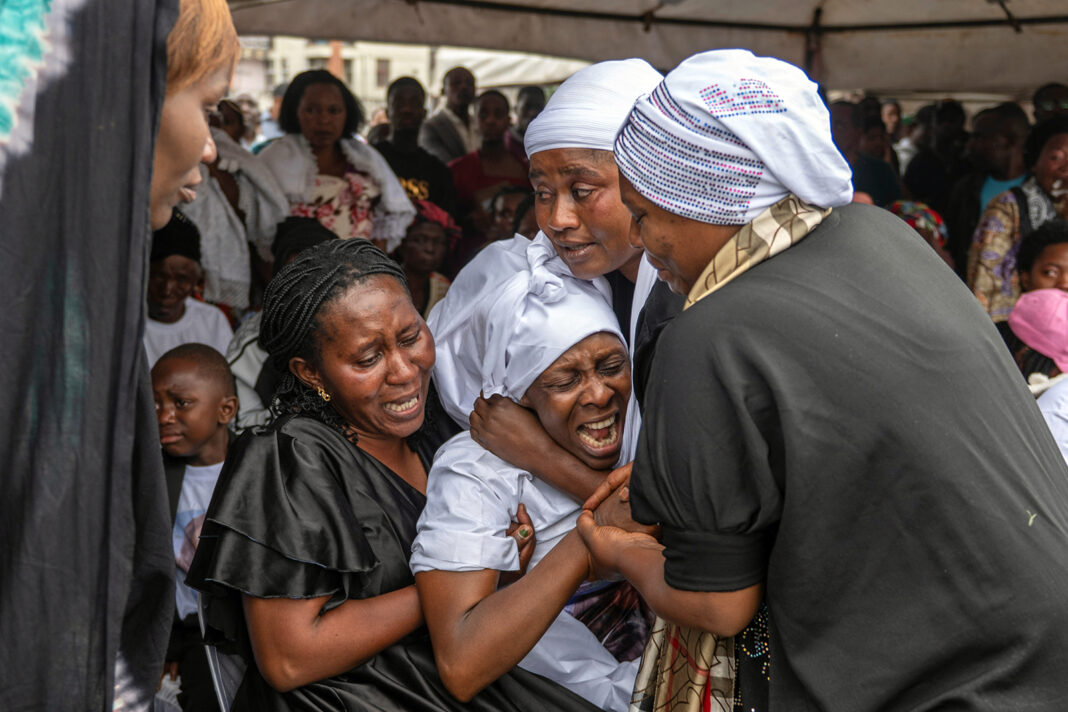
The families of victims mourn at the funeral service for civilians killed in a drone strike in Goma, Congo, Jan. 8, 2026. (AP Photo/Moses Sawasawa)
Eastern Congo has endured years of violence between government forces and armed groups, including the AFC-M23 rebel alliance, leaving thousands dead and forcing millions from their homes. Cities such as Goma and Bukavu have become refuges for displaced families. Many depend on churches and faith communities for shelter, emotional support and financial stability.
Congolese authorities declared the latest Ebola outbreak on May 15, and health officials say it has spread rapidly across the country. As of Tuesday (June 23), 1,048 confirmed cases and 267 deaths had been reported, making it “the largest number of confirmed cases in the first month of an Ebola disease outbreak in Africa,” according to Dr. Abdirahman Mahamud, director of Health Emergency Alert and Response Operations at the World Health Organization, who recently returned from a monthlong mission in the DRC.
The outbreak is centered in Ituri province but has spread to neighboring North Kivu and South Kivu, regions already struggling with conflict and mass displacement. Cases linked to the outbreak have also been detected across the border in Uganda, prompting regional health authorities to strengthen surveillance and screening efforts.
Unlike the more common Zaire strain of Ebola, the current Bundibugyo strain has no licensed vaccine or approved therapeutic treatment. International agencies, including the World Health Organization and Doctors Without Borders, have expanded surveillance, treatment and community awareness efforts, but insecurity, population displacement and funding shortages continue to complicate the response.

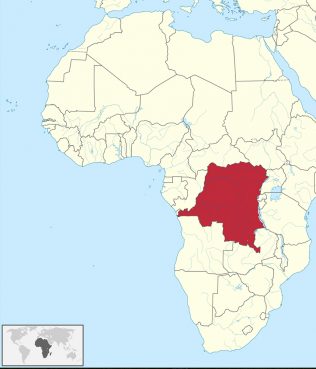
The Democratic Republic of the Congo in central Africa. (Map courtesy of Wikimedia/Creative Commons)
Pastor Albert Nswadi of Goma International Pentecostal Church said the outbreak has forced churches to suspend services and midweek fellowship meetings, where members gathered in one another’s homes to pray and encourage each other.
“Everything has been suspended, and this has affected our faith community,” Nswadi said.
The changes have been especially painful during times of mourning. Nswadi recalled that one of his congregants was suspected of dying from Ebola in late May, but many church members were afraid to attend the burial because of the risk of infection.
“It was very painful as a church not to go and bury one of us,” he said. “Some people took the risk, and we thank God they were not infected. We pray that God continues protecting our people and having mercy on eastern Congo, where people are already facing another tragedy after years of war.”
The outbreak has also created unexpected pastoral challenges as religious leaders try to balance faith with public health advice.
According to Nswadi, many believers initially struggled to understand the disease.
“Some people think Ebola is the work of the devil and believe they can simply pray over it and continue interacting freely because God protected them during the war,” he said. “We are trying to create awareness and help people understand the danger.”
The Catholic Church has also urged Christians to take the outbreak seriously.
In a pastoral exhortation shared with RNS, Archbishop Xavier Maroy Rusengo of Bukavu called on the faithful to strictly observe Ebola prevention measures recommended by health authorities and encouraged pastoral workers to implement them during Eucharistic celebrations and other church gatherings.

Family members of an Ebola victim mourn as the coffin is taken away for burial, at Sofepadi Hospital in Bunia, Congo, May 23, 2026. (AP Photo/Moses Sawasawa)
The archbishop also urged church-run schools and health facilities to enforce the measures while offering prayers and pastoral support to those affected by the epidemic and to the health workers risking their lives to care for patients. He encouraged Christians not to lose hope despite the combined challenges of insecurity and disease.
“Let us not lose courage,” the archbishop wrote. “Let us place our full trust in God … and not give in to fear.”
For Mbombo, however, the greatest challenge is finding new ways to minister to people carrying the burdens of both war and disease.
His calling has always been to walk alongside families in their darkest moments, praying with them in their homes and offering hope to those struggling with loss. Today, much of that ministry happens over the phone.
He believes the people of eastern Congo need spiritual support now more than ever as they confront yet another crisis.
“Our people have suffered because of war, and now they are facing Ebola,” Mbombo said. “They need hope now more than ever.”