



SÃO PAULO, Brazil (RNS) — As Argentina’s national team advanced in the World Cup, spiritual beliefs have become increasing visible among many soccer fans in the South American nation. Now that the team is just one match away from the championship — it will face Spain in the final on Sunday (July 19) — faith appears to be playing a central role in the way people have been cheering for the national squad.
Catholicism, the dominant religion in the country, has steadily declined. It was the faith of an estimated 90% of the population in 1960, and now about 60% of Argentines identify as Catholic. But symbols and practices associated with Catholicism continue to play a fundamental role in the world of soccer.
Some priests see a missionary opportunity in the team’s success.
“Many players on the national team openly express their Christian faith,” Father Andrés Rodríguez of the Archdiocese of Córdoba told Religion News Service. “(Lionel) Messi, for instance, constantly makes the sign of the cross and says he has received everything from God.”
A video posted by Rodríguez on social media became popular in Argentina during the tournament’s final week. Speaking directly to the camera, he said he knew viewers have “prayed for the national team,” many of them with an image of the Virgin Mary next to their TV and a rosary in their hands. He then urged them to go to Mass.
“Come to Mass. Come. It only takes a little while. Come to Mass and give thanks for everything God has given you. God is listening to you. Pray for Argentina, for those most in need, for the sick. Come to Mass,” he said in a playful tone.
Rodríguez, a member of the Piarist order dedicated primarily to education, came up with the idea of recording the clip after Argentina defeated Egypt on July 7. The team was down 2-0 before scoring three goals to win the match. Messi said afterward: “God had something prepared for me.”
“That phrase inspired me to make the video,” the priest explained. “That’s life: God always has something prepared for us. Then I decided to record something for my friends, with humor, inviting them to pray.”
In his opinion, expressions of faith have been more visible in Argentina now than during previous World Cups. The players brought an image of Our Lady of Luján — Argentina’s patroness — to the tournament. Several players have tattoos of rosaries and other religious symbols, and many publicly have thanked God for their success.
“When a soccer idol gives glory to God — as Enzo Fernández often does — it has an enormous impact on children and teenagers,” Rodríguez said.
For the Catholic Church, he argued, this is the moment to bring more people back into the faith.
Father Luis Luján, who also ministers in Córdoba, agreed. Known as Padre Lucho, he is an avid soccer fan and posted videos on social media showing that he was wearing Argentina’s national team jersey beneath his cassock.
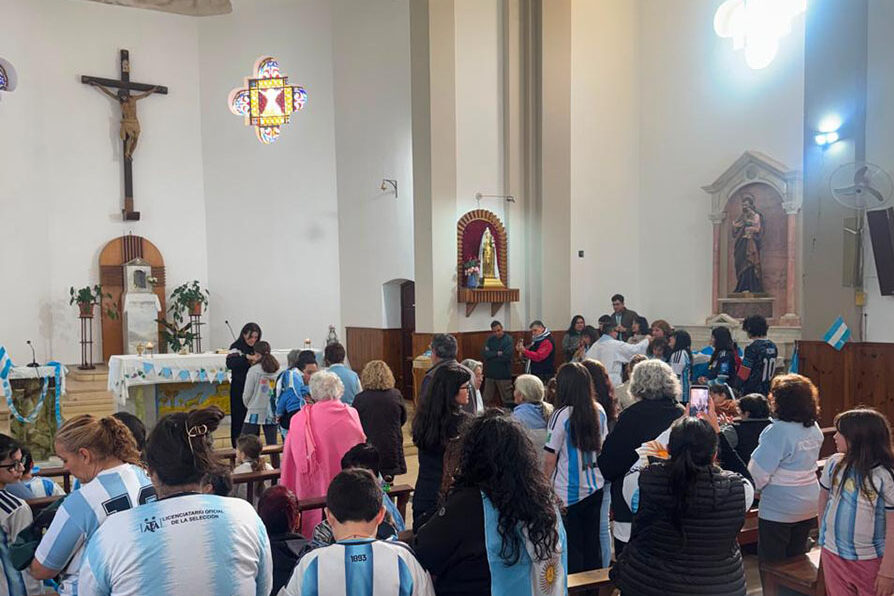
Before Argentina faced England in the semifinal on July 15, Padre Lucho celebrated a “misa mundialera,” or a World Cup Mass. Everyone in attendance, including the priest, wore the Argentine jersey and waved flags. The video went viral across Latin America.
“We thought it was the perfect moment to stay close to people and promote the values of the gospel. The national team is perfect for that,” Padre Lucho told RNS.
He said that, despite having Messi as the team’s star, the Argentine squad is unified, with each player helping the others pursue a common goal.
“Together, we can work toward very positive goals — that’s something we can experience during the World Cup, and it makes more sense to many people than abstract dogmatic teachings,” Padre Lucho said.
He recalled the late Pope Francis also had a deep connection with soccer and frequently used sports metaphors. “Curiously, when he was elected pope, his team, San Lorenzo, became champion,” he said with a laugh.
Gustavo Vera, an Argentine human rights activist and friend of Pope Francis, told RNS that the late pontiff would probably have celebrated the national team’s style of play in this World Cup.
“He would have appreciated their solidarity and the way they help one another on the field,” Vera said.
He emphasized that most players “look up to the sky either in victory or in defeat and never forget to thank God.”
Father Lorenzo de Vedia, known as Padre Toto and one of Buenos Aires’ best-known “curas villeros,” or priests who pastor to those in slums, has been a soccer fan since childhood. His WhatsApp “about” section reads: “I hope there’s soccer in heaven.”
Inspired by Father Carlos Mugica, the pioneer of the curas villeros movement who was killed by fascists in 1974, Padre Toto has combined soccer with his pastoral work among the poor.
“In our parishes, we regularly play soccer and watch the matches together,” he told RNS.
Padre Toto lives in Villa 21-24, one of the largest slums in Buenos Aires. Some of Argentina’s matches were screened in the church courtyard. “Popular faith is like that: People pray for victory for their team. They don’t separate the concrete realities of daily life from their spirituality,” he said.
Many Argentines also have devotional connections to folk saints, who have never been officially recognized by the Catholic Church. The best known is Gauchito Gil, a figure who originated in the northern province of Corrientes in the 19th century. Gauchito Gil is regarded as a miracle-working saint to whom people turn when they are in need.
Luz Norman, a devotee of Gauchito Gil, has maintained a sanctuary in his honor in Buenos Aires for the past nine years. People visit it to pray and ask Gauchito Gil for favors.
“Many people have been praying for victories for our national team,” she told RNS. “I already knew we would defeat England.” In her opinion, people have become more connected to the folk saint lately.
Argentina’s dramatic comebacks against Egypt and England have led many across the country to believe that something supernatural may indeed be happening with the national team.
For followers of the Maradonian Church, a parody religion organized around the cult of late soccer legend Diego Armando Maradona, who died in 2020, the divine help received by Messi and his teammates may have come from D10S — a play on the Spanish word “Dios” (God) and Maradona’s No. 10 jersey — the nickname by which Maradona himself was known.
“I think many Argentines felt at some point that there had been some kind of celestial, divine or Maradonian help for Messi, making him appear almost like the greatest soccer player in history, Diego Armando Maradona,” Alejandro Veron, one of the founders of the Maradonian Church, told RNS.