








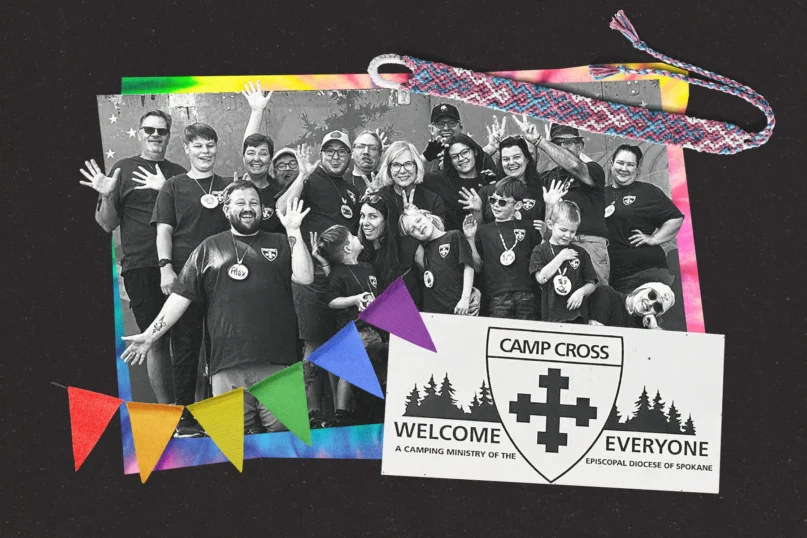
(FāVS News) — The Episcopal Diocese of Spokane, Washington, has maintained Camp Cross — a 130-acre property on the west side of Lake Coeur d’Alene, Idaho — for more than a century. Each week throughout summer, the church hosts themed retreats, from Arts and Music Camp to Clergy Camp.
One of those retreats is Queer Camp, a session for LGBTQ+ people and allies of all ages that the church has hosted since 2024. Its third year will run Aug. 28-31.
“My hope is folks can know there is a place where they can be Christian and be their full self,” said camp director Alex Flannagan. “It’s not conditional, no one’s trying to change you, you’re fully welcome.”
Idaho ranks low compared with other states in legal protections for LGBTQ+ people, according to Equaldex data, but the Episcopal Church in the region has marked its history differently. The Episcopal Church has historically supported LGBTQ+ expression in the Inland Northwest region. In 2025, under the direction of Bishop Gretchen Rehberg, the diocese became a major sponsor of Spokane Pride.
Flannagan joined the Diocese of Spokane and Camp Cross in 2024, after 10 years running camps for the Diocese of Olympia. Rehberg immediately supported Flannagan’s idea to start Queer Camp when he pitched it, Flannagan said.
The first session of Queer Camp hosted 25 campers, while 21 attended last year. All camp sessions, including Queer Camp, are open to campers outside the church.
“We have people who go to church every Sunday, then people who never go at all, then people from other denominations,” said Andy Hartwig, a program director. “Queer Camp has opened up our reach more because it’s more unique.”
Intergenerational friendships
Activities at Queer Camp are similar to those at Camp Cross’ other sessions, from prayer services to traditional camp activities like crafts and canoeing. A major highlight, according to several participants, is the time set aside for intentional conversations about faith, identity and emotions across different generations.
Rachel Wickham, an active member of the Episcopal community in Lake Coeur d’Alene, has been attending the camp with her husband and children since its first year.
“You get a view into everyone’s life journey, and just to see others’ hopes and dreams and experience their needs together is pretty powerful,” Wickham said. “It’s a very eye-opening experience from a child’s point of view to see adults being vulnerable with their pain, with their struggles with God and the church community, and that those are very human real things.”
During a conversation last summer, the cohort was divided into two groups: one for queer youth and adults, and one for family members and allies. In the former, participants’ ages ranged up to the 50s and 60s.
Hartwig said this gave young queer people, including a young transgender camper who met a trans man in his 30s, an opportunity to see themselves represented in their community.
“He shared that it was so nice to see older trans people,” Hartwig said. “He said he didn’t realize we could live that long. And that really hit me. To just be in a group where you can meet other people like you of all different ages, that can be really powerful in shaping your confidence in yourself.”
Allies and family members of LGBTQ+ youth, particularly transgender youth, said they also appreciated the opportunity to connect with one another.
“This a space where they can be a bit clumsy, they can be candid about whatever is on their hearts, if they have feelings of guilt or shame about their ability to accept their child,” Flannagan said. “Then they can get back to loving their child or loved one fully for who they are.”
Aaron Loeffelbein, the music director for St. John’s Episcopal Church in Ephrata, Washington, has attended Queer Camp with his partner since 2024 and plans to go again this summer. He said the diocese has always embraced LGBTQ+ members and encouraged them to take on active roles in the church.
The Episcopal Church’s openness was a factor in joining it in 2017, he said.
“Growing up in a rather conservative fundamentalist community, I’ve always felt like the outsider looking in,” Loeffelbein said. “But I always felt in my heart, I know that I’m OK with God. And I want that for other people.”
Since the first session, more church members have been involved in leadership and planning. With many campers repeating attendance, some said the second summer felt like a family reunion.
“This camp is a natural outflowing of … reaching queer families in our diocese that need time together,” Loeffelbein said. “Some people just need to see other queer folks being spiritual to know that it’s OK. And spiritual folk need to see queer folk being queer and know that that’s OK.”
Creating a safe space
For this year’s session, Flannagan said he’s preparing to hold emotional space during a “heavy time” for the LGBTQ+ community. He hopes to show participants that Christianity can be inclusive and accepting.
Idaho’s openly LGBTQ+ community is small, representing about 2.8% of the population, according to the state’s ACLU chapter. Lawmakers introduced 27 anti-LGBTQ+ bills in 2025, including 19 that targeted transgender people.
Conservative Christian organizations such as the Idaho Family Policy Center have introduced and lobbied for many of these bills, including one to remove local protections against LGBTQ+ discrimination.
The Episcopal Church, however, has officially affirmed LGBTQ+ members since 1976.
“I’ve run, time and time again, into people who are shocked that my church is so supportive,” Hartwig said. “How do we show people that we’re actually a supportive church? A message that has guided me a lot is, you can just be welcoming, you don’t have to say it. Be a happy faithful queer person and be part of the Episcopal Church.”
For campers, an affirming space with other LGBTQ+ people can provide a break from the fear of discrimination.
“You walk around all day, carrying this heavy thing, and sometimes you’re judged for it, and having to explain that part of who you are is tiring,” Flannagan said. “It’s nice to have a space where everyone there is already in the loop. You have the shared language, the shared experience, you don’t have to explain who you are and who you love.”
Wickham and other parents said their faith is a source of love for all people.
“I feel like there’s so many people in the LGBTQ+ community who have such severe religious trauma, and it’s the people, and not God, that is the issue,” Wickham said. “As a Christian, it’s my responsibility to be that light of God, to be the person that’s willing to step up and say, ‘I love you.’”
This story was published in partnership with The 19th, a nonprofit newsroom reporting on gender, politics, policy and power.