



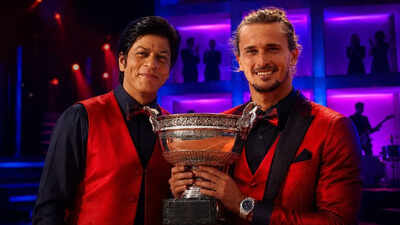
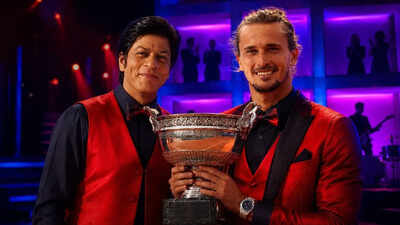
If Shah Rukh Khan fans were being objective, a hard ask given they are SRK fans and think Pathaan was a great movie, they would admit that Om Shanti Om was the last time King Khan was on top of his game. The movie was both a Bollywood classic and revolutionary in the sense that it had the first crossover of Bollywood stars long before Avengers existed and even prophesised desis taking over the five Dard-e-Disco cities (of which desis have two). In the movie, Shah Rukh Khan’s character states: “Kehte hain agar kisi cheez ko dil se chaho, toh poori kainaat usse tumse milane ki koshish mein lag jaati hai” (“They say that if you desire something with all your heart, the entire universe tries to bring it to you”). It’s the same philosophical leitmotif of Paulo Coelho’s The Alchemist: “When you want something, the universe conspires to ensure you get it.” And the universe finally conspired to hand Alexander Zverev his first Grand Slam title as he triumphed over Flavio Cobolli in the 2026 French Open.Zverev’s nickname is Sascha, a Russian-language diminutive for Alexander, and he might have wondered if he was suffering from some sort of reverse nomen omen. In his prime, Alexander conquered much of the landmass known to ancient Greeks, which was still only 3-4% of the actual landmass of the world, and supposedly wept that there was no land left to conquer. His namesake, on the other hand, had another reason to weep: his inability to conquer the one territory that had kept defeating him, a Grand Slam.
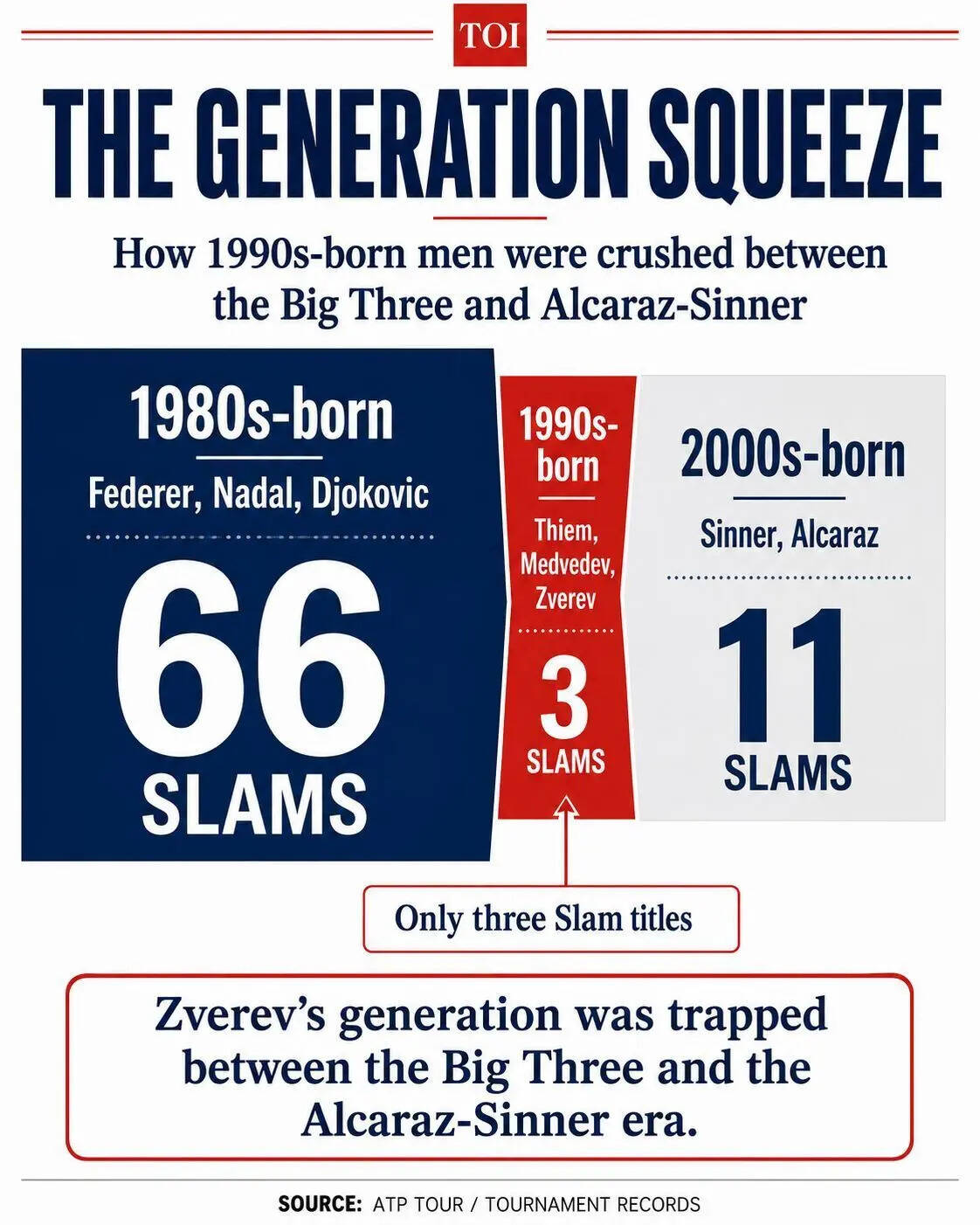
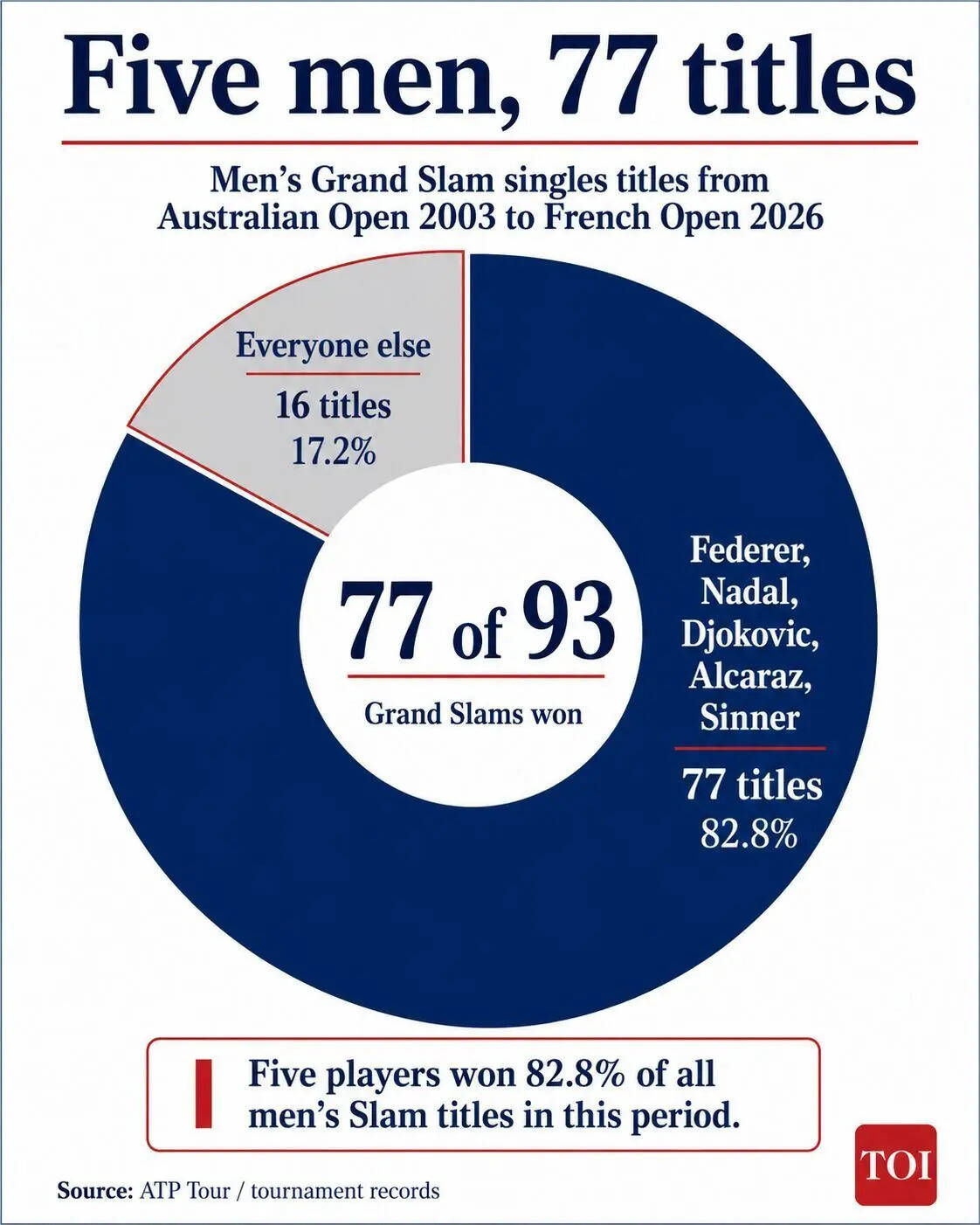
Of course, any footnote on major singles titles needs a Jupiter-sized asterisk. 90s kids were the ones who had to navigate from an analogue to a digital world, from landlines to smartphones. Tennis players born in the 90s, on the other hand, first had to navigate the 80s-born era of Federer-Nadal-Djokovic domination before coming up against the noughties-born freaks of nature that are Carlos Alcaraz and Jannik Sinner.Between the five of them, they won 77 of the 93 men’s Grand Slam titles from 2003 to the 2026 French Open. From 2003 to the 2026 French Open, there have been only 17 different winners. In the earlier period from 1978 to 2002, there were 99 Grand Slam titles, which produced 31 major winners.Of those 17 winners, five were Messrs Federer, Nadal, Djokovic, Alcaraz and Sinner. And Zverev is the 17th. In other words, becoming a new male Slam winner in this era has been less a career milestone and more a breach of a gated community.
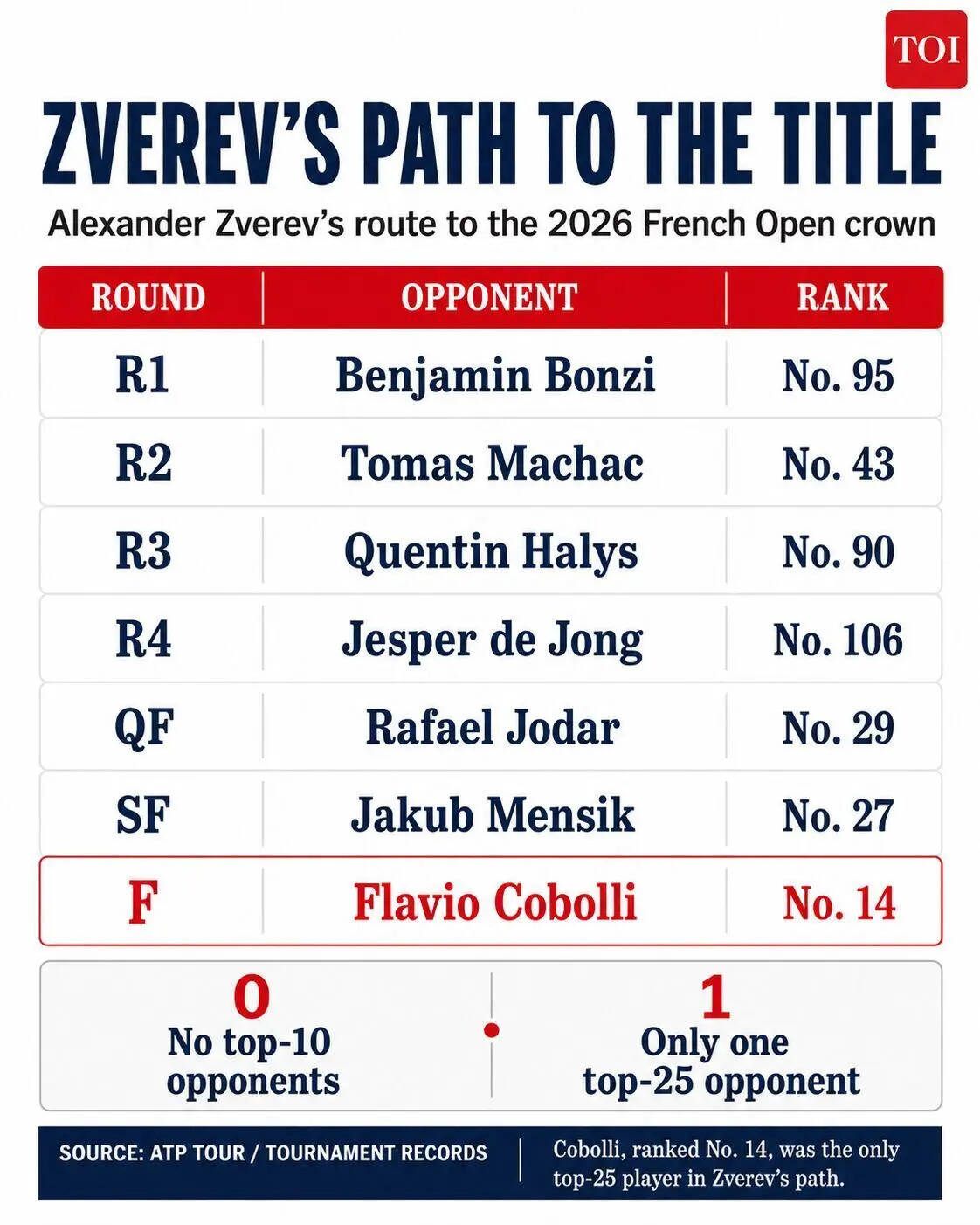
Only three men born in the 90s have won Grand Slam singles titles: Dominic Thiem, Daniil Medvedev and Zverev.Zverev, unlike Harvey Specter from Suits, is not a natural closer, so the universe had to conspire to help him close.Zverev’s Karna-like stumbles, where talent and destiny keep missing their appointment, only come in the Grand Slams though. He has won at every other level: triumphing in Masters 1000 events and twice at the ATP Finals. He has won an Olympic gold medal in Tokyo 2020. But the Grand Slam still evaded him.In How I Met Your Mother, Ted Mosby’s love life is dependent on signs from the universe. And there were ample signs from the universe that this was Zverev’s year. The first one was Carlos Alcaraz missing through injury. Alcaraz, famously, beat Zverev in the 2024 French Open final.Then Jannik Sinner, who was everyone’s favourite to win at a canter even if he played with one arm tied behind his back, collapsed in the second round against Juan Manuel Cerundolo, falling like Lucifer exhibiting free will in heaven after being two sets up.Finally, Novak Djokovic, the man who smashed the Federer-Nadal duopoly and continues to be a thorn for Messrs Alcaraz and Sinner, also had to lose.En route to the final, it was as if Zverev had consumed Felix Felicis, the good luck potion from the Harry Potter universe, where he beat world No. 95 Benjamin Bonzi, world No. 43 Tomas Machac, world No. 90 Quentin Halys, world No. 106 Jesper de Jong, world No. 29 Rafael Jodar and world No. 27 Jakub Mensik before facing world No. 14 Flavio Cobolli, the only top-25 player in his path.Of course, none of this takes away from the fact that Zverev has won a Grand Slam. There are no fake Grand Slams handed over by Khap Panchayats. But it’s a bit like Greece winning Euro 2004: entirely legitimate, historically permanent, and still remembered mostly for how strange the route felt.And yet, because this was Zverev, even the universe had to work overtime in Paris.
He won the opening set 6-1, but his familiar problems returned. His forehand started faltering as the philosophical crisis that afflicts him in every final returned. Cobolli regrouped, Zverev double-faulted twice at 3-3 in the second set, and it started to resemble one of those curious Zverev afternoons where tennis is less sport and more self-sabotage.On the other side, Cobolli struggled as well, both men blinking at the same time, but the Italian still managed to win the fourth-set tie-break. For a moment, it looked like Zverev was about to add another chapter to the most Zverevian of sagas: the great player who could win everything except the thing that mattered most.But then Cobolli ran out of energy in the fifth set, and Zverev won it 6-1.Perhaps it’s harsh to call it a gift from the universe. But the stars certainly aligned to remove Alcaraz, Sinner, Djokovic and every other top-10 player from his path. It gave him a finalist who had never been to a Grand Slam final. And in the final, it conspired to ensure that he would finally cross the line.None of that makes winning a Grand Slam easy. It’s a Herculean task. The International Tennis Federation’s 2024 Global Tennis Report states that there are 106 million tennis players worldwide. Only 59 men have won Grand Slam singles titles in the Open Era. Even using the current global tennis-playing population as a rough denominator, the odds underline the point: becoming a men’s Grand Slam champion is absurdly rare. You are vastly more likely to be struck by lightning in your lifetime than to become one.
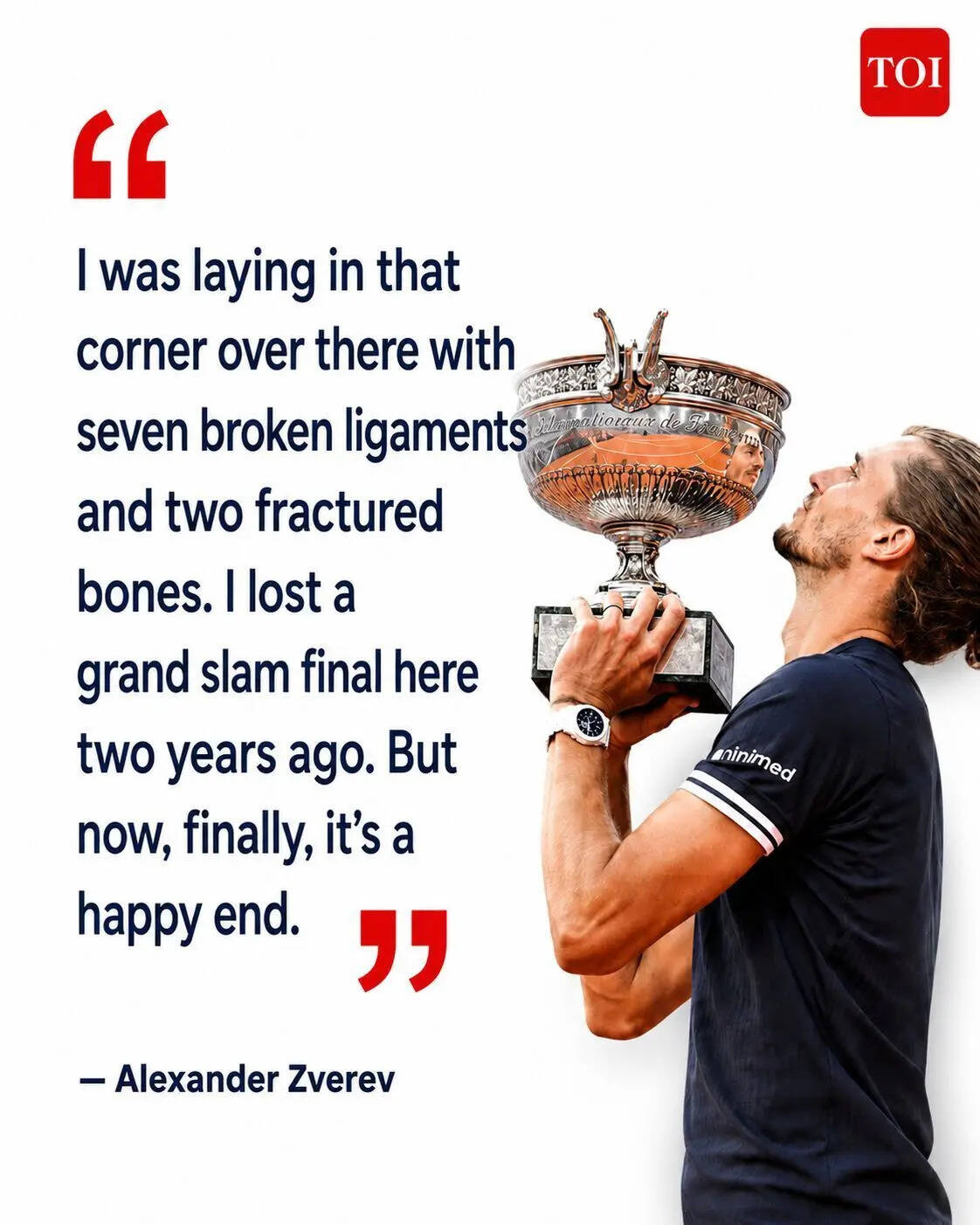
As Zverev said after winning: “I’ve had the best moments of my life on this court, I had the worst moment of my life on this court. I was laying in that corner over there with seven broken ligaments and two fractured bones. I lost a Grand Slam final here two years ago. But now, finally, it’s a happy end.”In Om Shanti Om, the protagonist had to be reincarnated to fulfil his destiny and also needed some supernatural help. Thankfully, Zverev didn’t need reincarnation, fulfilling his destiny in this lifetime. But there’s a second part in the speech: “Hamari filmo ki tarah, hamari zindagi mein bhi end tak sab kuch thik hi ho jaata hai. Happy’s ending. Aur agar end mein sab kuch thik na ho, toh woh the end nahi hai dosto. Picture abhi baaki hai mere dost” (“Like our films, in our lives too, everything becomes all right by the end. A happy ending. And if everything is not all right at the end, then it is not the end, my friends. The picture is still remaining, my friend”).And for Zverev, the picture really was still remaining. And now the question remains: was this a temporary stopgap in the Alcaraz-Sinner era? Or will Zverev be around for the conversation next time around?