






(RNS) — This week marks 50 years of the modern-era death penalty in the United States. In a 1972 landmark case, Furman v. Georgia, the Supreme Court called the death penalty “arbitrary and capricious.” But on July 2, 1976, in Gregg v. Georgia, the Court allowed executions to resume.
It was clear then, and now, that what determines who dies in America is not the atrocity of the crime but the resources of the defendant and the race of the victim. We may say that we need the death penalty for the “worst of the worst” — but the truth is we execute the poorest of the poor, and disproportionately, people of color.
Over the past 50 years, the U.S. has executed 1,670 people — by lethal injection, electrocution, gas, firing squad and hanging. We are one of only a handful of countries who still kills its own citizens to try to show that killing is wrong. And the death penalty is the descendent of racial terror and lynching. The states that held on to slavery the longest are the same states holding on to the death penalty. Where lynchings were happening 100 years ago is precisely where executions happen today. But there is good news in all of this.
When I was born in 1975, most of the world’s 195 countries actively used the death penalty. In just 50 years, most of the world has abolished it. The United States is one of those outliers. When it comes to the number of executions per country, the U.S. is usually in the top five, and always in the top 10. The company we find ourselves in — including China, Saudi Arabia, Yemen, Iran and Iraq — is, needless to say, not a list of countries known for championing human rights.
Here is more good news — enthusiasm around the death penalty is hitting a record low. We are finally seeing polls with a majority of Americans wanting alternatives to the death penalty. On average, a new state abolishes the death penalty every two years. And when it comes to new death sentences, one of the most important data points regarding the death penalty’s future, the numbers are the lowest they have been in decades. In 2025, only 23 people were sentenced to death. Compare that to 325 in 1986.
But that hasn’t just happened by chance. There is a powerful movement working tirelessly to abolish the death penalty. And at the heart of that movement are people who have been directly impacted. Exonerees — survivors of death row, people wrongfully convicted and sentenced to death — are some of the most credible witnesses to how messed up the justice system is, especially when it comes to capital crimes. For every eight executions that have been carried out over the past 50 years, there is one person exonerated after being sentenced to death. In other words, the court reversed its decision. The state killing machine is admitting mistakes made for every nine cases tried.
My friend Derrick Jamison was sentenced to die for a crime he had nothing to do with. He spent nearly 20 years on death row, had six execution dates and at one point was just 90 minutes from his execution. He was finally found innocent when prosecutors were forced to release all the suppressed evidence, over 30 pieces that demonstrated Jamison’s innocence. Groups like Witness to Innocence are led by exonerees, who are heroes in this movement.
There are also executioners like Ron McAndrew who have seen firsthand how the death penalty traumatizes those who are tasked with the terrible job of putting someone to death. McAndrew, who once saw a man’s head begin to smoke in a failed electric chair execution in Florida, said to me, “There is no good way to kill someone.” He said that after helping Florida transition from electric chair to lethal injection. He was haunted by what he did, literally visited in his sleep by the men he killed.
Other expert witnesses include folks like Adam Luck. He defies political camps, but became an abolitionist because of his faith and conscience. Luck was appointed chairman of the Oklahoma Pardon and Parole Board Board. As a devout Christian and a man of deep integrity, he became convinced that we always have to leave room for mercy, redemption and restoration — and it cost him his job when the same governor who appointed him asked him to resign. There is now an entire organization called Conservatives Concerned About the Death Penalty — a reminder that this issue is not about left and right but right and wrong. And also a reminder that you cannot be pro-life and pro-death penalty. This is about the sanctity of life.
Then there are the family members of the victims — those who have lost kids, spouses, parents, friends and colleagues to violent crime. They are often referenced, even exploited, as the reason we need the death penalty — to give “closure” or “justice” to the victims. And yet, at the heart of the modern-day abolitionist movement are murder victim family members who believe in justice but not revenge.
They believe murder should have consequences, but that we can honor their loved ones without more killing. They know that the death penalty does not truly heal wounds — it only creates new wounds. It extends trauma. It produces a whole new set of victims. Some of them have been silenced. One dear sister, SueZann Bosler, was told she could be held in contempt of court for voicing her “opinion” on the death penalty, after explaining that her dad was a pastor and would not want even his murderer to be killed but rather to be offered a chance for redemption.
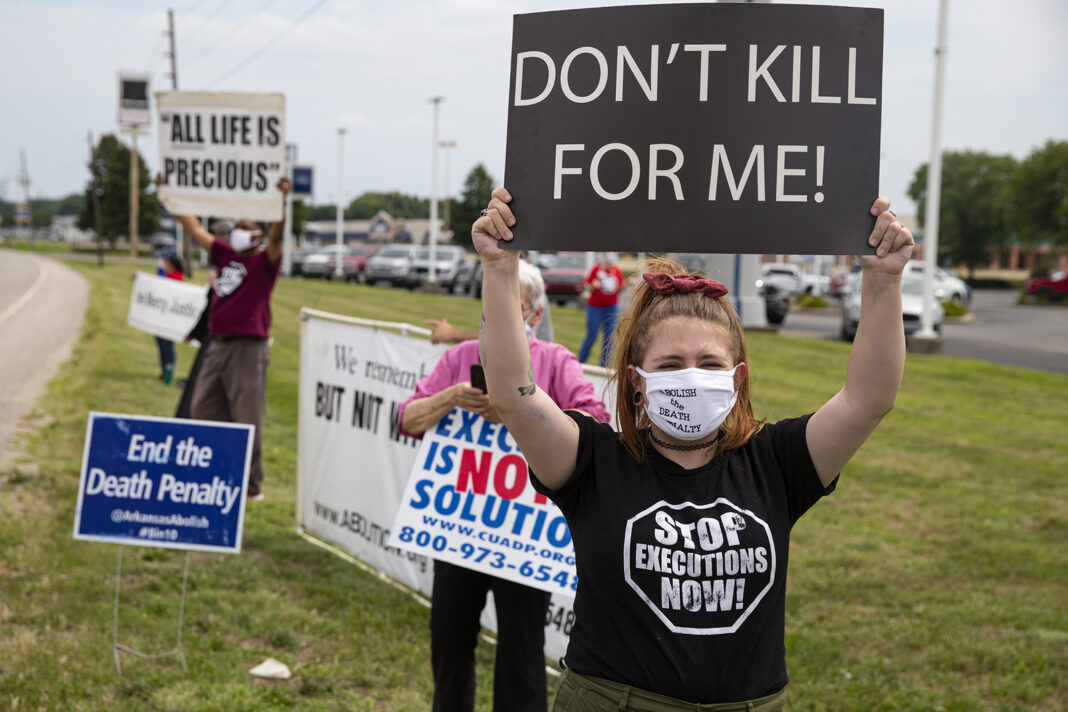
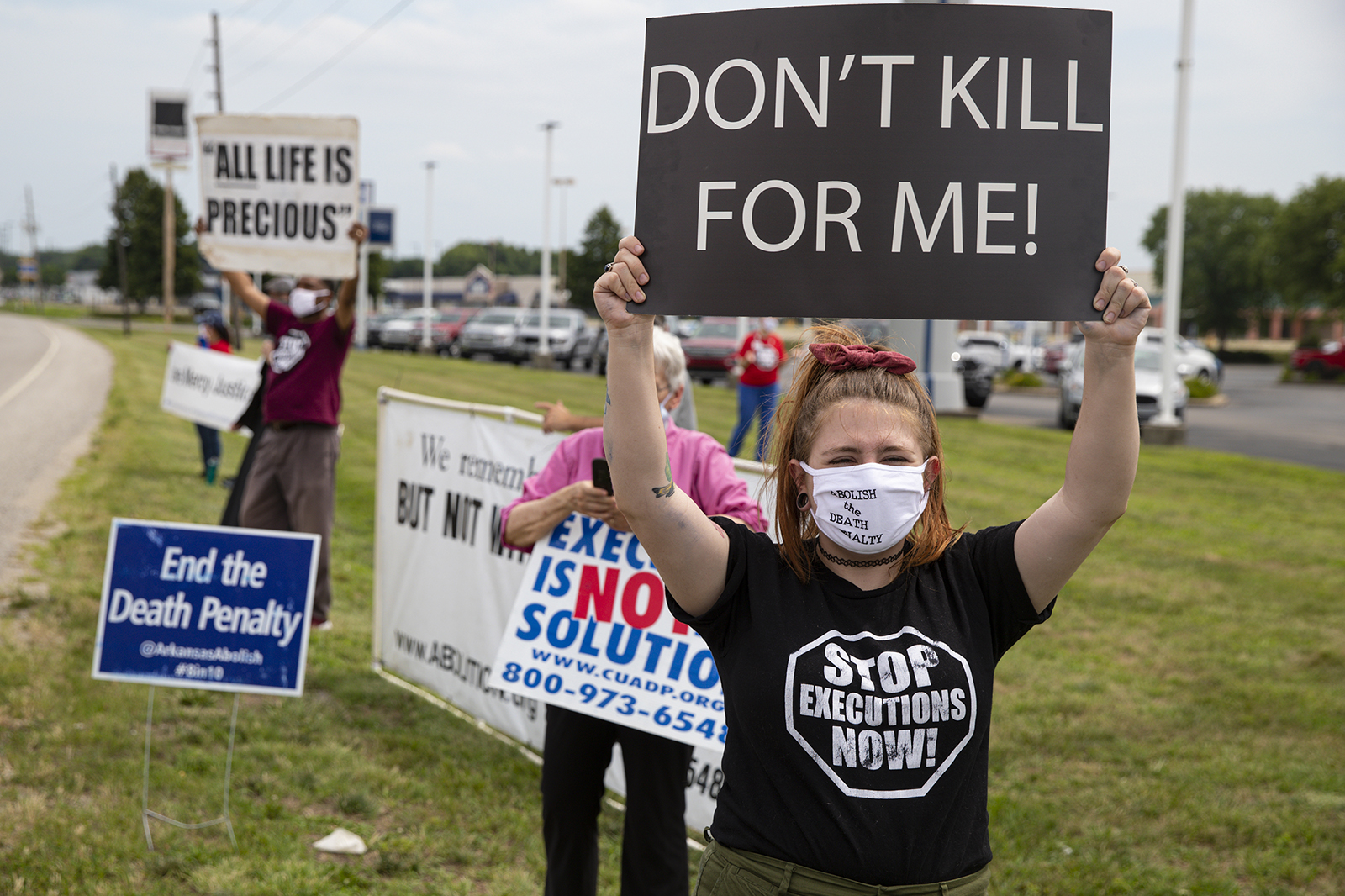
Even now as I write this, these unstoppable people are fasting and keeping vigil — in 100-degree scorching heat — outside the U.S. Supreme Court. And they’ve been doing it for — get this — 33 years. They call it “Starvin’ for Justice.” For four days, death penalty abolitionists from around the country gather at the steps of the Supreme Court in Washington, D.C. This week, from June 29, the anniversary of Furman v. Georgia, until July 2, the anniversary of Gregg v. Georgia, they are standing outside the court from dawn until dusk, talking with passersby, handing out flyers, singing, chanting and praying for an end to the killing.
Beyond this week, groups like Death Penalty Action host vigils during every execution that happens in the U.S., often featuring loved ones of the person being executed. And they begin each vigil by remembering the victims of the crime. The hybrid vigils have gathered thousands of people around the world, and they often stream live from the in-person protests happening on the ground outside the prison or execution chamber.
But more than a movement, this is a family. It’s a family of wounded healers, people who are channeling their pain into change. People who insist that violence doesn’t have to get the last word.
Groups like Journey of Hope are made up of people who have lived through the worst horror I’ve ever heard of, and have come together to share with the world, in the words of one of the great abolitionists, the late Bill Pelke (co-founder of Journey of Hope): “The answer is love and compassion for all of humanity.”
It is a movement of many faiths and of people who are not religious at all but are moved by their conscience. And I’ll have to say, as a Christian, I am honored to stand alongside them. After all, the death penalty wouldn’t stand a chance in America if it weren’t for the support of Christians. The death penalty has survived not in spite of us, but because of us. Wherever Christians are most concentrated and hold power as governors and legislators is where the death penalty continues to hang on. Ninety-five percent of executions happen in the Bible Belt. The Bible Belt is the death belt in America. That’s why this is not just a social issue, but a deeply spiritual and theological one (something that compelled me to write a whole book on it — “Executing Grace”).
A generation from now we will look back on the death penalty like we look back at slavery — with shame and horror, with many of our grandchildren asking how Christians used the Bible to defend such a thing. So this is a time for courage. It does not take courage to say slavery is wrong generations after we abolished it. But it took courage to say slavery was wrong when many people thought it was acceptable, even God-ordained. This is a time for courage.
It is time, long past time, to abolish the death penalty.
(Shane Claiborne is a longtime activist and co-director of Red Letter Christians, a Christian social justice group. The views expressed in this commentary do not necessarily reflect those of Religion News Service.)