








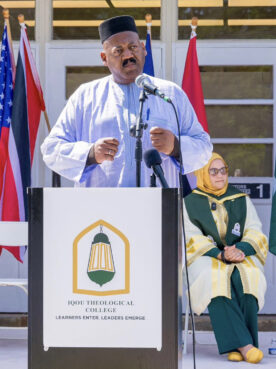
(RNS) — In a former segregated school in rural Virginia, an Islamic college has been reconnecting its mostly African American Muslim students with a legacy of faith and scholarship largely erased from mainstream history.
IQOU Theological College, in the town of Charlotte Court House, for the past two years has housed a small, borrowed collection of ancient manuscripts from the West African city of Timbuktu in Mali, a center of Islamic learning that thrived between the 13th and 17th centuries. It’s also a region where many Africans were kidnapped during the transatlantic slave trade.
Hafiz Hassan Ali Qadri, a Quran teacher at the college, said the 17 manuscripts can offer African American Muslims a concrete link to a part of their ancestors’ history. Seeing handwritten works on law, theology, astronomy and other subjects challenges an enduring narrative that enslaved Africans arrived in the United States with little education or scholarly traditions, he said.
“It goes full circle, showing that this is where we came from — we came from knowledge,” Qadri said. “And what we’re continuing here at the college is knowledge.”


The preservation of the manuscripts is largely credited to Abdel Kader Haidara, a renowned archivist who has safeguarded hundreds of thousands of ancient documents at the Mamma Haidara Commemorative Library, a private manuscript library in Timbuktu. In 2012, when a militant al-Qaida faction seized control of the city, Haidara orchestrated a covert operation to transport thousands of manuscripts to safety in Mali’s capital, Bamako.
Talks of a partnership between Haidara’s library and IQOU College began a decade later, after college staff traveled to Mali and met with him. That visit laid the groundwork for the manuscripts’ two-year temporary placement in Virginia, which is set to end next month.
Speaking to RNS in Arabic from his office in Timbuktu, Haidara said the manuscripts’ presence in the U.S. carries a deep significance.
“The students can find themselves inside the vast words of the manuscripts, which reflect history, sciences and Islamic legacy,” Haidara said. “And maybe, by studying these manuscripts, they could trace their origins, whether to Africa, Asia, or other regions, and be proud of their heritage and religion.”
The manuscripts are available to the public by appointment, said Yasmin Abdulatheem, an instructional designer at IQOU College, adding that the archives can transform “American Muslims from every continent who don’t always get to have the experience or understanding of how far and wide Islamic heritage has gone.”
Tahirah Clark, 63, remembered feeling a sense of connection to the scholars of the past when she saw the ancient documents on campus in 2024 when she was there for her graduation ceremony.
“It was amazing to see the manifestation of the practice of Islam in Africa so long ago, even before my ancestors were brought over to this country,” she said.
Clark, a family law attorney and grandmother, completed an Islamic studies diploma in a year and half, balancing coursework with a full legal caseload and family responsibilities. She said she had long desired to learn about her faith in a structured way but didn’t have time for such a commitment. That changed in 2023, she said, when relatives who took courses at the college encouraged her to sign up, citing the college’s flexibility.
She started with a single online Islamic jurisprudence class, wedged between court hearings and a long commute home. Clark said the course opened her eyes to the vastness of the faith and how much she had been missing. “I needed it on a spiritual level,” she said.
Founded in 2022 by Sheikha Syeda Zainab Adams Gillani, the college currently has about 200 students, ranging in age from 18 to 78, a college official said. Working toward accreditation, the school offers four primary tracks, including a semester-long foundational certificate program and a four-year bachelor’s program.
Some students enroll in the college with goals to become Islamic scholars and teachers. Many, like Clark, say they simply want to enrich their spiritual lives through easily accessible, trustworthy teachers.
And at a time when TikTok preachers with little to no training shape young American Muslims’ religious diet, Qadri, the Quran scholar, said credible institutions are needed to ensure authentic and moderate knowledge is taught.
“Islamic knowledge is being sensationalized for clicks and views,” he said. “Things are being posted online that are just sometimes outlandish, in order to get more people to view and share.”
The school sits in the building of the former Murray Jeffress Elementary School, built in 1952 as a school for African Americans. Purchased by Lighthouse Academia Group, the college primarily offers online courses with a pilot hybrid structure for students who live near the campus.


While the college joins a growing number of online and in-person Islamic seminaries across the country, what makes it unique, Qadri said, is that most of the instructors are classically trained Black Muslims. Many of the 11 instructors at IQOU College spent years studying Islamic sciences at Al-Azhar University in Cairo, Egypt, one of the world’s oldest and most prestigious Sunni centers of Islamic learning.
“I’m really proud to be part of that demographic of second-generation indigenous converts who are able to connect with a certain group of people who don’t really have that much representation,” Qadri said.
The college is affiliated with followers of the late Mubarak Ali Shah Gillani, a Pakistani Sufi religious leader in the U.S. who founded primarily African American Muslim communities in rural parts of South Carolina, New York and California.
And drawing on the experiences of its Azhari-trained scholars, the college also became the first U.S. institution to offer students a supervised Arabic diploma pathway leading interested students to direct admission into Al-Azhar University, said Abdulatheem.
“If one person goes to Mali or an Arab nation to study Islam, they will spend years away from their community,” said Haidara, the Malian librarian who delivered a commencement speech at the college in 2024. “But if they can study in their own country, that is more beneficial for them and their community.”