











(RNS) — As the Knicks faithful thronged Manhattan for the team’s championship parade Thursday (June 18), I marveled at the crowd — exultant, thankful, awestruck — and the many ways the Knicks title run feels like something sacred.
I have my own confession to make. I haven’t been to Lourdes. I haven’t circled the Kaaba. I haven’t walked the El Camino. But as of June 8, in the year 2026, I have been to Madison Square Garden for an NBA Finals game. Does a visit to the “mecca of basketball” make me a pilgrim?
I’m a New York native, and for as long as I can remember, I’ve been a Knicks fan.
I didn’t grow up feeling connected to religion. In the absence of sacred ceremony and identity, I filled the gaps with sports. The closest I came to seeing somebody walk on water was Christmas night in 1984 when, at the age of 10, I was there, at the Garden, witnessing Knicks great Bernard King score 60 points (40 in the first half alone). For much of my early childhood, my crayon illustration of a dunking King stayed taped to the wall next to my pillow. Over the past two decades, I’ve transmitted this allegiance to my kids, even though we live in the land of our longtime tormentors, the Chicago Bulls.
Over that same span of time, the Knicks, and their fans, wandered through the basketball wilderness. Moribund. Hopeless. More than once, my son (the next-generation diehard of our kids) asked why we rooted for such a sad-sack franchise. Faith is belief in things unseen.
Over the past few years, the Knicks did improve. Yes, breaking hearts remained an annual occurrence, but at least we were no longer an NBA punch line.
And then, quite unexpectedly, came this spring’s serendipitous, gleeful Knicks playoff run.

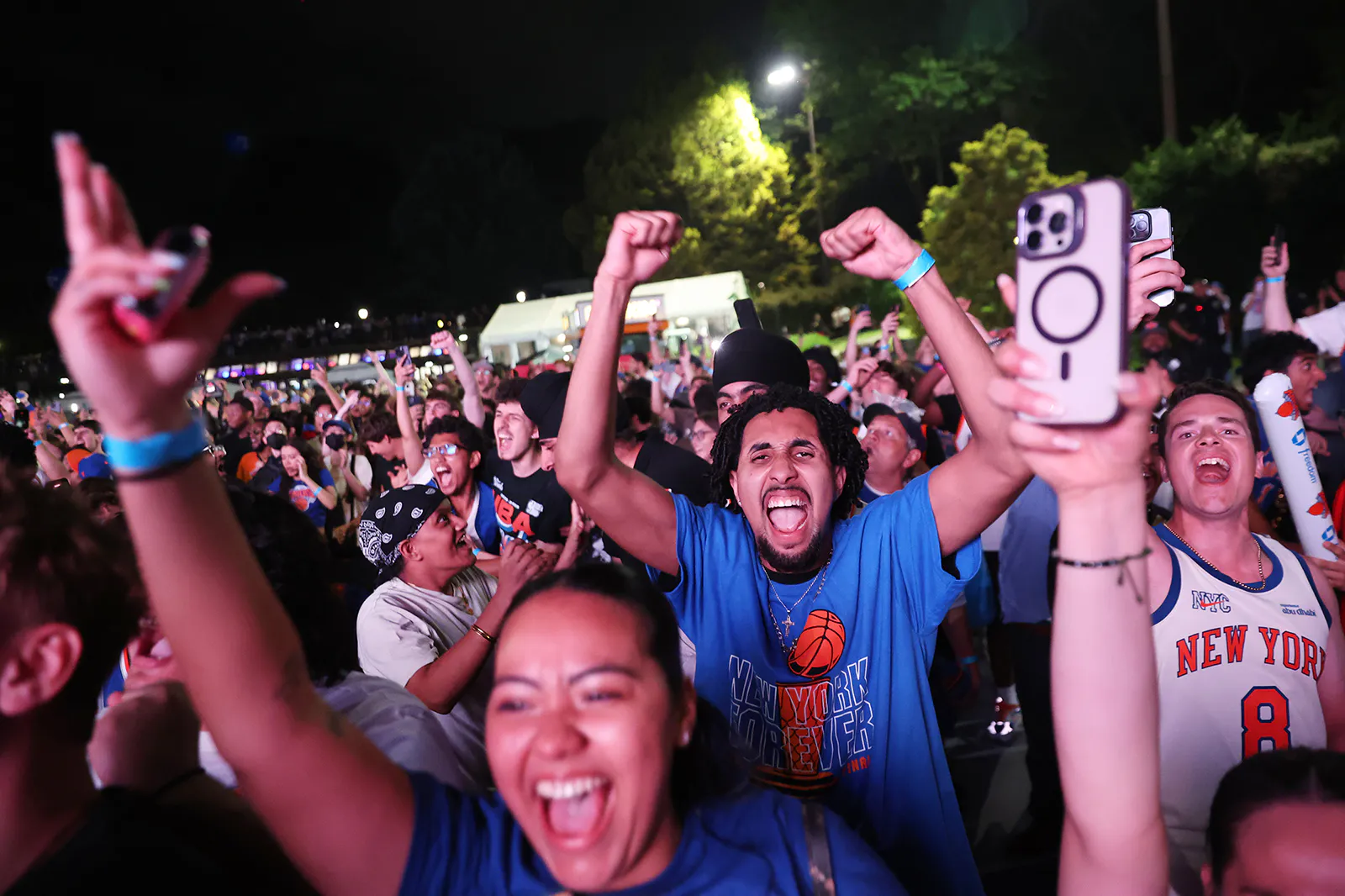
New York Knicks fans celebrate during a watch party inside Central Park during Game 4 of the NBA Finals basketball series between the Knicks and the San Antonio Spurs, June 10, 2026, in New York. (AP Photo/Heather Khalifa)
After some soul-searching, I bought two tickets for Game 3 for my son and me.
At a recent dinner, talking with parents of our daughter’s classmate about their recent journey to visit Islam’s sacred sites in Saudi Arabia, it struck me — maybe this MSG trip was more like a pilgrimage than just another (significant) purchase.
Just what makes a pilgrimage? How and why does travel turn sacred?
Pilgrimage has long been historically and typically religious. Millennia ago, Jews journeyed to celebrate annual pilgrimage festivals at Jerusalem’s sacred center. The Gospels record Jesus’ own pilgrimages to Jerusalem, as a tween and then again as a young man. Over the centuries to come, Christian believers would make their way there to retrace his steps. Coptics and Armenians would get tattooed to memorialize their pilgrimages. Literally hundreds of millions of devoted Hindus convene for the Kumbh Mela every dozen years. Buddhist practitioners flock to the Buddha’s birthplace, the site of his enlightenment, where he gave his first sermon and shared the Four Noble Truths.
We live in an age where religious commitment has declined significantly. Yet pilgrimage survives. Graceland, the Grand Canyon, Ellis Island. Once-in-a-lifetime trips. Journeys of personal exploration and collective meaning-making. A tribe of believers, motivated by shared history, seeking an avenue toward transcendence, a deeper connection to someone or something.
Sacred, secular or somewhere in between, pilgrimages are journeys of intention. And they have some common traits.
Pilgrimages require time, commitment and fidelity to something beyond ourselves. Pilgrimages are usually crowded. They require patience and planning. They offer an experience of community and camaraderie, spectacle and celebration. And they’re often multigenerational family affairs, a way to meaningfully connect past and present, to walk in the footsteps of ancestors, to feel their presence, gone but not forgotten.
Researchers who study “the psycho-social impacts” of the Hajj, one of the five pillars of Islam, spotlight the ways pilgrimage creates “a sense of achievement and satisfaction; a desire for cooperative inter-group relationships; a deeper sense of unity with other [adherents]; and feelings of spiritual resilience and renewal. They also report increases in charitable giving and community involvement upon return.”
Undergirding the whole process is a kind of inevitable, essential sacrifice: physical, emotional, time, and let’s face it — especially with Knicks final tickets — financial!
Research on the motivations of pilgrims reveals a desire for belonging and community, an opportunity for gratitude, a hoped-for healing, a sense of peace — and shopping. Sometimes walking, sometimes crawling on their knees, over horseback and rail, boat and plane, there’s an age-old history of spiritual tourism. People have long spent some portion of their accumulated resources to fulfill holy obligations, and pilgrimage has long been an economic engine for the community surrounding the destination — and on the way there, and on the way back home, a chance to trade, barter, experiment and explore.
New York was a sea of Knicks’ blue and orange when my son and I arrived. Strangers were fist-bumping. The city was buzzing.
On most nearby streets and inside the arena, fans were foaming at the mouth. Generations of deprivation, decades of ineptitude — all percolating to a rapid boil that evening. Geeked up, hollering, I’d teleported to a sports fan’s “Knirvana.”
The Knicks lost Game 3. Still, I’m happy to report that my son and I had an absolute blast. Neither outcome nor expense impacted our enjoyment. Though 50-odd rows above the court, we yelled like we were courtside. We shared a few exorbitantly priced beers in souvenir cups. And, once the buzzer sounded, we commiserated hoarsely with our fellow fans across urinal partitions.
Of course, I’m not the only fan who’s felt something approaching the sacred around sports. As author Erin McKeown has written, “Like places of worship, fields … have community, ritual, and tradition. Standing for decades, they offer consistency and stability while our lives change around them. … (And) sports venues offer a type of diversity of camaraderie you don’t find anywhere else.”
So often, sports can seem to be in competition with matters of the spirit: Sunday mornings spent tailgating rather than praising; kids’ travel sports taking precedent over the most solemn days on our sacred calendars.
But sometimes, once in a long while, the two converge — and one can say, with a mix of humility and pride, joy and thanksgiving, that they serve a shared purpose.
The Knicks staged an improbable comeback to win Game 4. And they closed out the series with a gritty road win in Game 5.
New York erupted. Strangers embraced. There was dancing in the streets. Adults wept. That goes, too, for me, watching a basement TV in Chicago.
When the Knicks won it all this past Saturday night, my experience was less jubilation than calm. A soaking-in of the moment. Memories flooded back. The anxious, drunken energy of the Garden in the mid-’80s. The catchphrases — “Yes! And it counts!” — of long-gone announcers. Time spent shooting hoops on busted rims with old friends. We were all, for a moment, kids again.
In his reflections on pilgrimage, Father Richard Rohr invites us pilgrims to “be like a child who can approach everything with an attitude of wonder and awe and faith.”
The biblical Hebrews spent 40 years wandering the wilderness of Sinai. The Knicks took 53 years to get back to the promised land of an NBA title.
So — am I a pilgrim? Yeah, I guess so.
I think what I learned about pilgrimage — all the anticipation and heartache, the travel and expense, the myth-transmission and community-building — is that it’s the journey, as much as the destination, that makes us pilgrims.
(Tom Levinson helps families explore the intersections of money and meaning. He is the creator and co-host of the award-winning podcast “Money, Meet Meaning.” The views expressed in this commentary do not necessarily reflect those of Religion News Service.)