





AUSTIN, Texas (RNS) — When Mariah and Michaela Montgomery-Lindsay moved more than 150 miles from Houston to Austin with three cats and two dogs in tow, it wasn’t for a job or family, but for church.
“I was just aching for a community of people who understood this transitionary pain that I was experiencing in my life, and this deconstruction that I was going through,” Mariah said.
She and her now-wife, Michaela, had been watching Sunday services of the Austin church, Restore, on YouTube for years. After growing up in a charismatic church and suppressing her gay identity for most of her life, Restore Austin, which offers a rare blend of progressive theology and evangelical expression, was the first church Mariah encountered that understood her exit from evangelicalism and was LGBTQ-affirming. After learning about Restore’s LGBTQ social group, the couple wanted in.
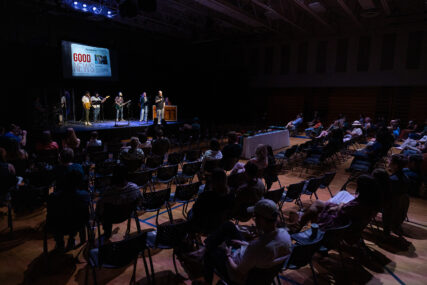
In early 2024, they arrived in the parking lot of the middle school where Restore meets each Sunday. That first visit, Mariah recalled, was a “visceral experience.”
“I think I cried the first 30 minutes of that service,” Mariah said. “I felt so safe to be completely myself.”
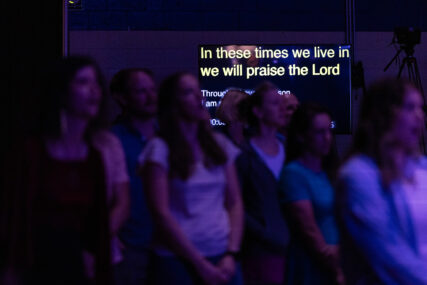
That safety wasn’t signaled by pride flags or priests in rainbow vestments, but unquestioned acceptance. It’s a congregation that will cheer as gay couples share news of their engagements, and each Sunday, a message flashing across the screen declares, “WELCOME to a community that celebrates differences and diversity.”
“People greeted us like a normal couple,” Mariah said.
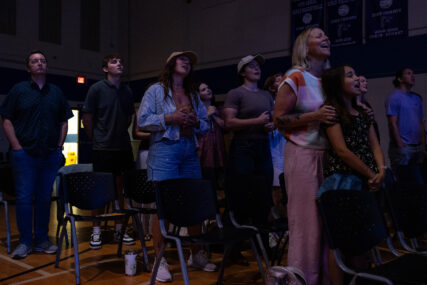
Many of Restore’s roughly 1,200 members are religious exiles who’ve left conservative evangelical churches — often citing an emphasis on Christian nationalism. They’ve come to Restore looking for a church that both worships Jesus as a savior and follows what they describe as his model of radical love. They’re hoping they don’t have to give up their jeans, church coffee and worship music to find it.
“I bet we’re still 90% people who have had bad church experiences,” said Zach Lambert, lead pastor and founder of Restore. “More and more people, I think, have seen a need for a church like ours to be an alternative to Christian nationalist, right-wing churches.”
As Restore continues to grow, it’s become emblematic of a small but significant countertrend in America’s religious landscape. While white evangelicals remain among President Donald’s Trump’s most stalwart supporters, a recent poll found that nearly half of Gen Z agreed that Christians’ support of Trump has made them less likely to go to church. And young women and LGBTQ Americans are increasingly likely to claim no religious identity.
Restore, and other post-evangelical churches like it, have become a home for Christians who reject the MAGA movement while refusing to discard their faith. While politically and theologically more aligned with liberal mainline denominations, these churches retain the evangelical aesthetics so familiar and cherished by the exvangelicals in their pews — especially the music style — even as they insist racial justice, gender equality and LGBTQ inclusion are necessary outcomes of the gospel.
Church origins
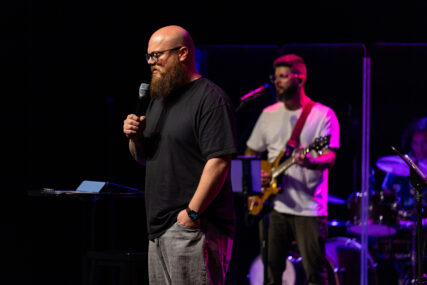
As a young person, Lambert’s faith was formed by two Southern Baptist megachurches; the one in Austin where he was raised, and later, Prestonwood Baptist Church, a 40,000-member Texas Southern Baptist congregation where he interned for two years. Both were the kind of church many of his now-congregants have fled.
At Prestonwood, he recalled, he was groomed to become a megachurch pastor. But his illusions about ministry quickly evaporated. He described leaders who demanded unquestioning loyalty, teachings that demeaned women and a church culture preoccupied with public image.
“By the end of it, I was really done,” Lambert said. “I quit, thinking I was probably never going to be in ministry again.”
Soon after, though, Lambert connected with evangelical churches that seemed more receptive to some of the progressive values he’d gradually embraced. In 2016, he and a launch team planted Restore. It was part of the Evangelical Free Church of America, but allowed women leaders, invited LGBTQ people to lead and marry, and was designed for people escaping negative church experiences yet yearning for a faith community. Austin, a longtime Democratic outpost in Texas, seemed like the ideal place.
But like many evangelical churches, most congregations in the Evangelical Free Church of America believe the Bible teaches that only men should be pastors and that marriage should be between a man and a woman. When Restore baptized a lesbian couple in its first year, Lambert said, local churches organized to remove Restore from the denomination. In 2019, they were successful.
“Our church was kicked out,” Lambert said. “I was put on trial and my ministry license was revoked.”
After being unaffiliated for several years, Restore last year joined the United Methodist Church, an LGBTQ-affirming mainline denomination on the other end of the religious spectrum.
The ‘magic combination’
In many ways, Restore’s backstory — formed in an evangelical context, then forced out of it — mirrors that of many attendees. And it’s what made it the perfect fit for Eric McDermid, a 43-year-old retired data scientist. After years at an Austin megachurch, McDermid left when he saw widespread support for Trump and what he viewed as selective application of Scripture.
McDermid and his wife tried out some mainline churches, but they missed some aspects of the megachurch model — especially how it welcomes newcomers with clear signs, coffee and a simple worship format. At Restore, he found those elements, plus a progressive faith.
“The comfortable, contemporary, laid-back setting, but these kinds of beliefs … that was the magic combination for us,” said McDermid, who now serves on Restore’s leadership team.
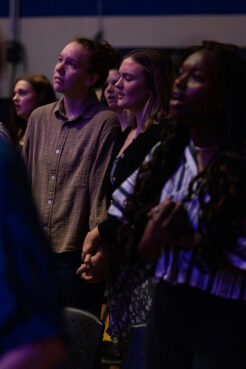
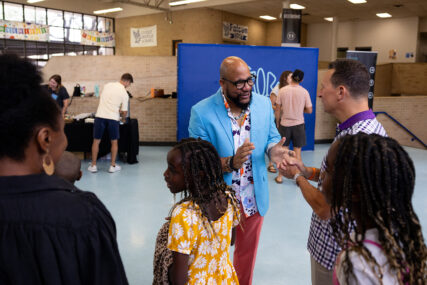
The church’s history has also made it more attuned to members’ religious baggage. Mark Jordan, Restore’s care pastor, is a veteran and trained hospital chaplain, and no stranger to trauma. He’s often the first to greet newcomers at the door, and, with kind eyes and a warm smile, he makes it his mission to exude a “non-anxious presence.”
“A lot of people, when they come in, especially those of the LGBTQ community, the question that they ask me is, ‘Is this a safe space?’” Jordan said. “What I look forward to is not only connecting with people, but being a part of a safe, inclusive community. That is the work of Jesus.”
Scripture has often been weaponized against church members, especially the roughly 33% who are LGBTQ, Lambert said. Because many members struggle with reading the Bible and don’t carry it to church, Bible passages are displayed on the screen. When they contain something potentially upsetting — such as portions commonly known as LGBTQ clobber passages — it’s normal for speakers to give a warning.
Sermons focus less on requiring certainty, and more on adding context and inviting reflection. Communion is open to everyone, including those with doubts.
“Come to this table, you who have much faith and you who would like to have more … you who have tried to follow Jesus and you who have failed,” Lambert says each week.
For Nicolle Truett, it wasn’t easy to settle into Restore’s culture of unconditional welcome. Raised as a missionary kid in the Foursquare Church, she later left the Pentecostal denomination, saying she was removed from her job there soon after she reported abuse. Though her experience left her feeling “angry and cynical” when she first came to Restore, eventually, she said, the community compelled her to stay. She told RNS that people at Restore get what it’s like to be mistreated in a faith community they loved. But they’re also committed to avoiding the kind of us-vs-them, binary thinking they often found in those settings.
“There’s never an indication that we have what is right and everyone else has what is wrong,” she said. “Everybody here has a story of being excluded and abused and harmed, and still has a commitment to figure out how to do it better and how not to do this again to anybody else.”
Post-evangelical
By the time Restore was forced out of its first denomination in 2019, Lambert had gained a social media following for his online advocacy on topics like free lunch programs and LGBTQ rights.
“Bible verses condemning trans folks: 0; Bible verses about welcoming migrants: 33; Bible verses about advocating for peace: 429; Bible verses about loving God and others: 714; Bible verses about taking care of the poor: 2000+” Lambert wrote in one viral post.
Though his outspoken views have earned him many critics who accuse him of partisanship and heresy, his online reach is part of what connected him and Restore to a larger movement.
Lambert began to discover pastors with similar stories, including Mike Goldsworthy, who led a church in Long Beach, California. In October 2021, Goldsworthy convened roughly 100 likeminded pastors who led congregations with evangelical ties but who believed evangelicalism had been co-opted by the MAGA movement.
Out of that initial convening, Lambert, Goldsworthy and Keri Ladouceur co-founded the Post-Evangelical Collective, now a network of over 150 churches connected by shared values, regional bodies and a national conference that, Ladouceur said, has grown roughly 25% each year.
“Many had been exiled from their previous denominational affiliation, many had been really lonely and kind of wondering, you know, ‘Am I the only one?’” said Ladouceur, who is based in Raleigh, North Carolina and serves as executive director of the collective. “There was such a sense of validation and permission and shared imagination to rethink, what does it mean to be the church in this time, beyond Christian nationalism?”
Christian ethicist David Gushee, who serves on the collective’s wisdom board, said while Lambert’s public platform has only grown since co-founding the collective — he has 56K X followers and is the bestselling author of “Better Ways to Read the Bible” — Lambert sees himself first as a local pastor. That, Gushee said, has helped kept the collective “church-oriented.”
“There’s a way to be post-evangelical that is mainly about opposition to evangelicalism,” Gushee said. “Zach has had plenty of reasons to be angry and traumatized and against, but that’s not what he leads with. He leads with a constructive, winsome Christian vision that is focused on growing a church that can serve the legions of post-evangelicals who need community.”
Lately, Lambert and Restore’s leaders have been growing the church through their partnership with the United Methodist Church, a move that grants them more resources and support. It also merged with Memorial United Methodist Church, a 151-year-old congregation in East Austin, and is in the process of renovating and moving to Memorial’s 35,000-square-foot campus. The move will allow Restore to have a consistent worship space for the first time in its 10-year history, and will provide a central hub for Restore’s justice work.
A wedding
In the two years that they’ve been at Restore, Mariah and Michaela Montgomery-Lindsay have been part of the church’s evolution. After joining Restore’s LGBTQ social group, they saw a need for an LGBTQ group more focused on Bible study — so they formed one.
In May, they gathered in the hills outside of Austin, and surrounded by the new friends they’d moved to Austin to meet, Lambert married them.
“Your marriage brings great joy to the heart of God,” Lambert declared, “just as it does to mine and to the hearts of everyone here today.”
This story was produced with funding from the Templeton Religion Trust.