








The Employees’ Provident Funds Scheme, 2026 has generated significant interest among employees across India. While the new scheme replaces the Employees’ Provident Funds Scheme, 1952 and forms part of the social security framework under the Code on Social Security, 2020, most subscribers are interested in understanding what it means for their monthly deductions, take-home pay, withdrawals and long-term savings. The good news is that many core features of the provident fund system remain familiar. Existing PF accounts continue, contribution rates broadly remain unchanged and accumulated balances remain protected. However, the new scheme also introduces some important clarifications and practical changes that employees should understand.
EPF Scheme 2026 : Top 10 Questions Answered
Here are 10 questions that many EPF subscribers are asking.
1. Do I need to open a new PF account under the EPF Scheme, 2026?
No, if you are already an EPF member, your membership continues automatically under the new scheme. There is no requirement to open a fresh PF account, obtain a new Universal Account Number (UAN) or transfer your existing balance because of the transition to the new framework. Existing service history and provident fund accumulations continue seamlessly. For most employees, the transition is intended to be administrative rather than disruptive.
2. Has the PF contribution rate changed?
No, the EPF Scheme, 2026 largely retains the existing contribution structure. Employees and employers continue to contribute 12% of wages, subject to the applicable wage ceiling.
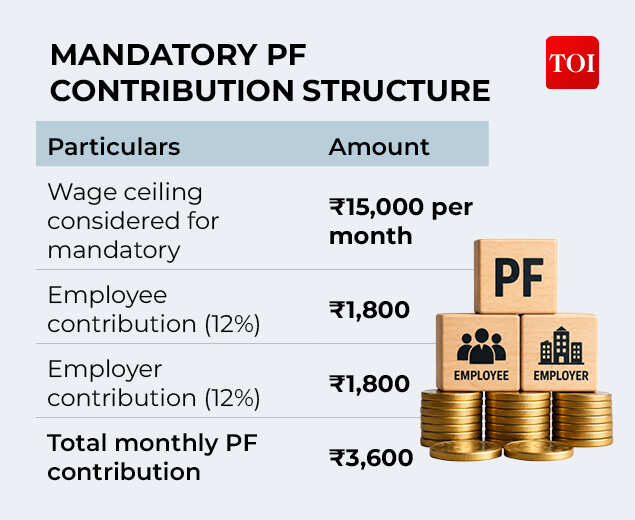
Mandatory PF Contribution Structure
3. Has the wage ceiling increased?
As of now, employees should consider that the wage ceiling has not changed. The new scheme contemplates a notified wage ceiling for contributions. However, until a revised ceiling is notified, the existing wage ceiling framework is expected to continue. This means subject to terms of employment, mandatory contributions may continue to be restricted on the prescribed ceiling amount even where actual wages are higher.
4. I earn more than the wage ceiling. Can I still contribute PF on my full salary?
Yes, one of the practical questions many employees are asking is whether they can continue contributing PF on wages exceeding the statutory ceiling. The answer is yes.The new scheme allows employees to make voluntary contributions on wages above the statutory ceiling and also permits contributions at rates higher than the standard 12%, subject to the conditions of the scheme. For employees seeking to build a larger retirement corpus, this flexibility may continue to be an attractive option.
5. Can I reduce or stop higher voluntary PF contributions later?
This is one of the most significant clarifications under the new framework. The new scheme specifically provides flexibility for employees and employers to reduce or discontinue such additional voluntary contributions.This can be useful when financial priorities change. For example, an employee may choose to make higher PF contributions during the early years of employment and subsequently redirect part of those funds towards a home purchase, children’s education or other financial objectives.
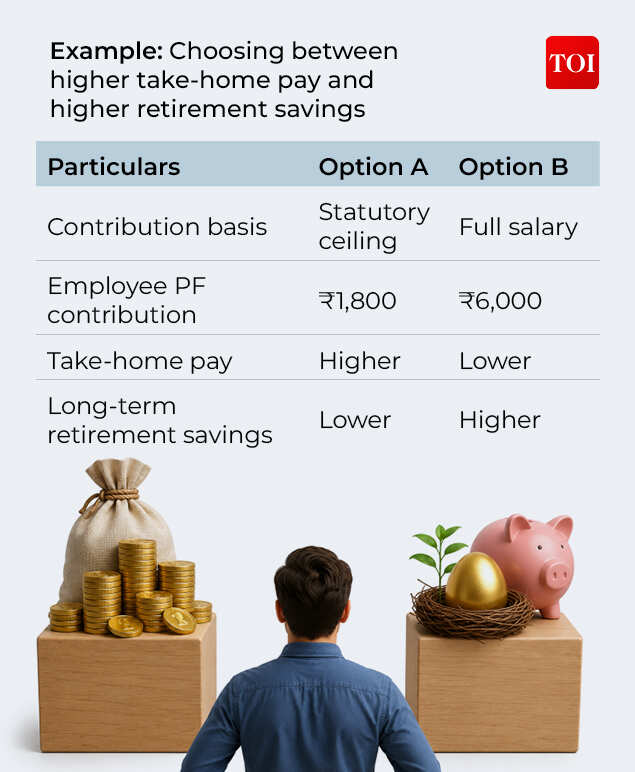
Higher voluntary PF contributions
An employee’s choice will depend on personal financial goals. The new scheme provides flexibility to revisit such decisions over time.
6. Does my employer have to match my extra PF contribution?
Not necessarily. While the scheme permits employers to make matching contributions against additional voluntary contributions made by employees, employers are not obligated to do so. Employees who contribute PF on wages above the statutory ceiling may therefore wish to check with their HR or payroll teams regarding:
- Whether employer contributions are restricted to the statutory ceiling;
- Whether contributions are made on actual salary;
- Whether matching contributions apply to voluntary PF contributions; and
- The process for changing voluntary contribution elections.
7. Have PF partial withdrawal rules become easier?
The partial withdrawal framework has become more streamlined. Instead of a large number of individual withdrawal categories, the scheme broadly groups partial withdrawals into categories such as:
- Essential needs (including illness, education and marriage);
- Housing-related needs; and
- Special circumstances.
The intention appears to be simplifying the partial withdrawal framework and making it easier for members to understand their eligibility.
8. What happens if I resign or lose my job?
This is an area where employees should pay special attention. Under the new framework, a member who leaves employment may be able to withdraw up to 75% of the eligible corpus through partial withdrawal provisions. However, full withdrawal after leaving employment may require the individual to remain outside covered employment for 12 months. Many employees may be familiar with the earlier understanding around shorter unemployment periods. As a result, individuals planning to access their PF corpus after leaving employment should carefully review the revised conditions before making financial decisions.
9. My company has its own PF trust. Does anything change for me?
Potentially, yes. Employees working in organisations that operate exempted PF trusts may notice changes in governance and administration.The new framework introduces additional requirements for PF trusts and envisages stronger digital capabilities, including electronic claim filing and online settlement processes. The scheme also introduces conditions regarding interest crediting by exempted trusts.For employees, the most visible impact may be improved digital servicing and more structured governance of trust operations.
10. Do I need to update my nominations and KYC details?
Many employees may need to review their records. The scheme places importance on Aadhaar, PAN, Aadhaar-linked bank account details, UAN details and electronic nomination requirements. Employees may also need to review existing nominations because the new framework contains specific provisions relating to nominations and family definitions. Existing nominations that are inconsistent with the new provisions may need attention. Employees should therefore ensure their details on the relevant portals are accurate and updated.
Quick Guide: What should employees do now?
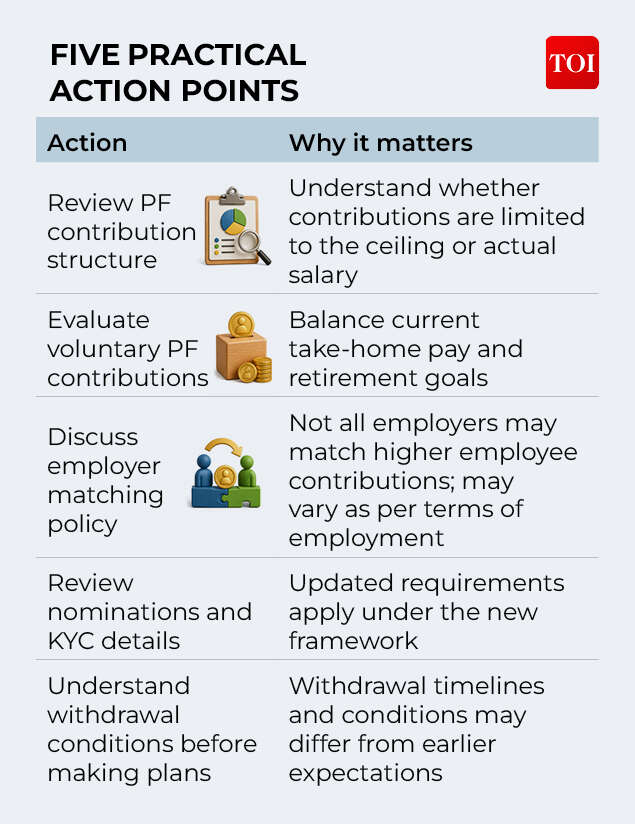
5 practical action points
Key takeaways for readers
- Existing PF accounts and balances continue without interruption
- 12% contribution structure remains broadly unchanged
- Employees can continue making voluntary contributions above the statutory requirement
- The scheme expressly provides greater flexibility to reduce or discontinue additional voluntary contributions
- Employers are generally not required to match voluntary contributions made by employees
- Withdrawal rules have been simplified, but employees should carefully review revised conditions applicable to full and partial withdrawals
- Employees should review nominations, Aadhaar, PAN and other KYC details
For most employees, the EPF Scheme, 2026 is not about starting afresh. Rather, it represents a transition to a modernised framework that seeks to retain the familiar features of provident fund savings while introducing greater clarity, flexibility and digitalisation.The questions that matter most are no longer simply about contribution rates. Employees are increasingly asking how much they should contribute, whether voluntary contributions remain worthwhile, when withdrawals can be made and what actions they need to take to remain compliant. The answers will differ from one employee to another, but understanding these changes can help subscribers make more informed decisions about both their immediate financial needs and long-term retirement planning.(The author, Puneet Gupta is Partner, People Advisory Services Tax at EY India)