








NEW DELHI: The latest nipah virus infection in Kerala has once again drawn attention to a striking public health pattern: while India has reported the deadly disease from only two states in the past 25 years, Kerala has accounted for most confirmed cases and outbreaks since 2018, making it the country’s principal nipah hotspot.The latest case, involving a 43-year-old man in Kozhikode, has triggered intensive surveillance and contact tracing, with the Centre deploying a joint national response team to identify where the patient may have contracted the infection and assess the risk of further spread.
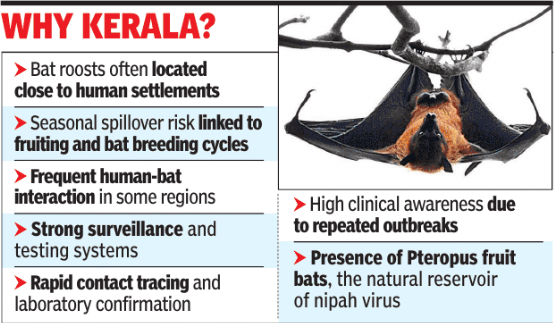
The multi-agency team will support epidemiological investigations, risk assessment and containment efforts alongside state authorities. Health ministry officials said its immediate priority is to trace the source of exposure and determine how the patient became infected.Historically, nipah virus has been reported only from West Bengal and Kerala. India’s first outbreak was recorded in Siliguri, West Bengal, in 2001, followed by another in Nadia district in 2007. Kerala reported its first outbreak in 2018, after which repeated outbreaks and sporadic cases were detected in Kozhikode, Malappuram and Ernakulam. West Bengal also reported confirmed cases in North 24 Parganas earlier this year.“Kerala’s repeated nipah outbreaks are likely driven by a combination of a close animalhuman interface and a highly sensitive surveillance system. Fruit bats frequently interact with human settlements, orchards and fruit-growing areas, while the state’s healthcare system has developed a high level of awareness because of previous outbreaks, allowing cases to be detected quickly,” an official familiar with nipah surveillance said.Fruit bats, or flying foxes, are the natural reservoir of nipah virus, a zoonotic disease that can spread to humans through contact with bat secretions or contaminated food, and also through close contact with infected individuals.Researchers say Kerala’s ecology may favour recurring nipah spillovers. Studies have documented widespread populations of Pteropus fruit bats and roosting sites close to human settlements. Scientists have also identified habitat disturbance and seasonal increases in bat activity between April and September as factors that may elevate spillover risk.Nipah is classified by the World Health Organisation as apriority pathogen because of its high fatality rate, outbreak potential and the lack of approved treatments or vaccines.Epidemiologist Dr Chandrakant Lahariya said nipah is not unique to Kerala and earlier outbreaks in West Bengal show the virus exists in India. However, Kerala’s highly alert public health system makes suspected infections more likely to be detected and confirmed, while repeated outbreaks have strengthened surveillance and contact-tracing mechanisms.Officials said findings from the ongoing investigation are expected to shed light on the source of exposure and help determine whether the latest infection represents an isolated spillover event or signals a wider public health risk.