







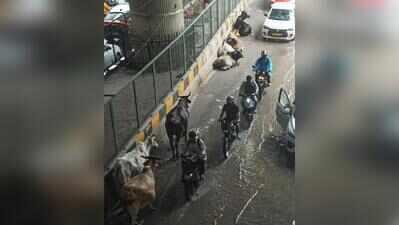
New Delhi: Forget traffic signals. On several roads in south and central Delhi, it is garbage dumps and cattle gathered around them that dictate the pace of traffic, leaving commuters trapped.Despite repeated complaints, residents say civic action lasts only a day or two before the roads return to the same state.TOI visited several stretches in the city, including Greater Kailash-II, Chirag Delhi, Pillanji, Kidwai Nagar and Ashok Nagar, found that the problem persists not just in narrow internal colony lanes but busy main roads carrying thousands of vehicles every day. Commuters forced to stop and wait as cattle leisurely fed on piles of garbage or rested in the middle of the carriageway were common sights.Drivers leaned on their horns, but the animals barely reacted, moving at their own pace. The accompanying foul stench of rotting waste turns an ordinary commute into a daily ordeal, exposing the failure to tackle two long-standing civic problems — uncollected garbage and stray cattle.Both are closely linked too. Scattered garbage attracts stray cattle as a source of food. In many cases, the cattle belong to illegal dairies whose owners leave their cattle out on the roads where they munch on plastic bags and rotting food. The animals are then taken back to the dairies and milked. Residents say the roadside now resembles dumping grounds.“This isn’t just an eyesore anymore; it’s a safety hazard,” said Rajesh Kumar, 39, a resident of GK-II. “I go for a morning walk at 6 a.m., but the first thing I see is heaps of garbage. Then the putrid smell hits. I’ve stopped complaining because the waste returns within a couple of days.”Shabina Ali, a resident of Pilanji Village, said the overflowing garbage has become a regular feeding spot for cattle. “Cows and stray dogs gather here every day. The smell is unbearable, and the road becomes difficult to use. Despite repeated complaints, nothing changes,” she said.Commuters said navigating these roads has become stressful, especially during peak hours. “You have to watch not just the traffic but also cows that can suddenly enter your lane,” said Amit Verma, a daily commuter from Chirag Delhi.MCD officials said that the process of garbage collection is in a transition phase. The new concessionaire appointed to clear garbage will take over from the old agency in phases, starting August 27.An official said that the outgoing agency had 300 garbage collection vehicles in its fleet, but the new one has 900.“An additional 407 tippers and loaders have also been deployed to support waste clearance during the transition,” the official added.MCD attributed the garbage accumulation at some locations to the ongoing transition and challenges posed by the rain. “This is a temporary phase. Give us about a month after the new concessionaires take over, and we will be fully accountable for the system,” an official said.The officials argued that while garbage has accumulated at some spots, many areas are being cleaned regularly, and isolated locations should not be seen as representative of the overall situation.Meanwhile, Delhi’s cow shelters are struggling with overcrowding and allege they are inadequately funded. While the Delhi government and the MCD provide Rs 20 each per cow per day—a total of Rs 40—gaushala operators say the actual cost of fodder, medicines and staff ranges between Rs 100 and Rs 130.An official said a proposal to increase the per-cow grant is under consideration, but there is no timeline for its implementation.Delhi has four operational gaushalas, with a sanctioned capacity of 19,838 cattle. They house 21,860—over 2,000 more than they are designed to accommodate. Last year, MCD allocated Rs 35 crore for the operation and maintenance of gaushalas. This year, only the dues have been cleared.Delhi govt, meanwhile, has earmarked Rs 47 crore to build a ‘modern gaushala’ at Ghumanhera, with capacity to house 5,000 cattle. Chief minister Rekha Gupta released Rs 20 crore in March for cow welfare and said 10 more modern gaushalas will be opened soon.


