







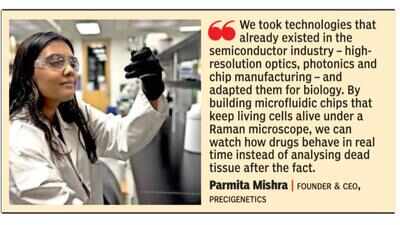
Artificial intelligence has become remarkably good at writing code, generating images and even designing new proteins. Yet when it comes to under-standing what happens inside a living human cell, it is still largely guessing. The problem, according to Parmita Mishra, founder and chief executive of Silicon Valley-based Precigenetics, is not that AI lacks intelligence. It lacks the right data.“You can give AI as many research papers as you want,” the 27-year-old says. “It still won’t understand how a drug behaves inside a living cell. Just like a self-driving car can’t learn to drive from traffic manuals alone, AI needs to actually observe biology.” That belief has led Parmita to an unlikely place for a biotechnology company: the semiconductor industry. Her team has borrowed technologies developed over decades for making computer chips and adapted them to watch living human cells respond to medicines in real time. The company believes those observations could eventually become the missing dataset that allows AI to accelerate drug discovery.Parmita grew up in Delhi in a family of doctors before studying computational biology and computer science at the University of Pennsylvania. She says her exposure to hospitals from an early age, coupled with her engineering training, convinced her that biology needed to borrow more from disciplines such as computing and semiconductor engineering.Inspiration, she says, came from Nobel laureate CV Raman. His work on Raman spectroscopy transformed chemistry by showing that when light strikes a material, the way the photons scatter reveals its chemical composition. Today, Raman spectroscopy is routinely used to identify chemicals, drugs and materials.“But it was never used for living cells,” Parmita says. “People used it in chemistry, in pharma quality control, in semiconductors, but not to continuously study living biology. We realised that wasn’t a scientific limitation. It was an engineering problem.”The team began with a Raman microscope similar to those already used in the semiconductor industry for inspecting materials at extremely high resolution. The first experiments failed almost immediately. “We literally took one of the semiconductor microscopes and asked ourselves, ‘What is this missing?’” Parmita recalls. “The laser was killing the cells. So we asked why. The cells weren’t getting nutrition, oxygen.”Every problem solved exposed another. The cells also needed carbon dioxide at the same concentration found inside the human body. They needed a constant temperature of 37°C. They needed nutrients flowing around them, much as blood vessels nourish cells inside the body.“So we kept solving one engineering problem after another,” she says. Patented microfluidic chipThe result is a patented microfluidic chip that functions like a miniature life-support system. Parmita describes it as an artificial network of blood vessels and lungs that keeps living cells alive while they are continuously observed under the microscope. Instead of placing cells in a dish, adding a drug and examining them a day later after staining and destroying them, researchers can now watch the drug interacting with living tissue as it happens. The semiconductor influence extends beyond the microscope. The chips themselves are manufactured using techniques borrowed fromchip fabrication.“We’re just borrowing from the semiconductor industry,” Parmita says. “We’re not claiming to be Einstein. We’re applied scientists.” She points to photolithography – the same manufacturing process used to print intricate patterns onto silicon wafers – as the inspiration for fabricating the tiny channels through which nutrients and medicines flow. Half of Precigenetics’ engineering team comes from semiconductor backgrounds. The company has also borrowed the industry’s philosophy of scaling.In computing, Moore’s Law predicted that chip performance would improve rapidly while costs fell. Drug development, Parmita notes, suffersfrom the opposite phenomenon, known in the pharmaceutical industry as Eroom’s Law, under which discovering new medicines becomesslower and more expensive over time.“I just thought, why not literally copy Moore’s Law? Why not build chips to solve the problem?” she says.Deluge of dataWatching living cells also produces something the pharma industry has rarely possessed: enormous volumes of data. Every cell can generate between three and ten gigabytes of information every hour, revealing how its chemistry changes as medicines are introduced. Precigenetics aims to build one ofthe world’s largest databases of how living human cells respond to drugs. Parmita likens it to the protein data-bases that enabled breakthroughs such as AlphaFold, except this database would capture cellular behaviour rather than static molecular structures.For now, Precigenetics is focused on laying the foundations. The company, backed by prominent investors, operates research laboratories inCalifornia’s Bay Area, where it is developing the platform to study living cells, while its Arizona facility manufactures the microfluidic chips and optical systems. In India, it is establishing a pathology laboratory in Delhi to digitise tissue samples from patients and build datasets that better represent Indian populations.Its initial work is centred on liver toxicity screening and melanoma models, with the longer-term ambition of expanding its platform to other cancers and diseases – and giving AI the kind of living biological data it has never had before.


