







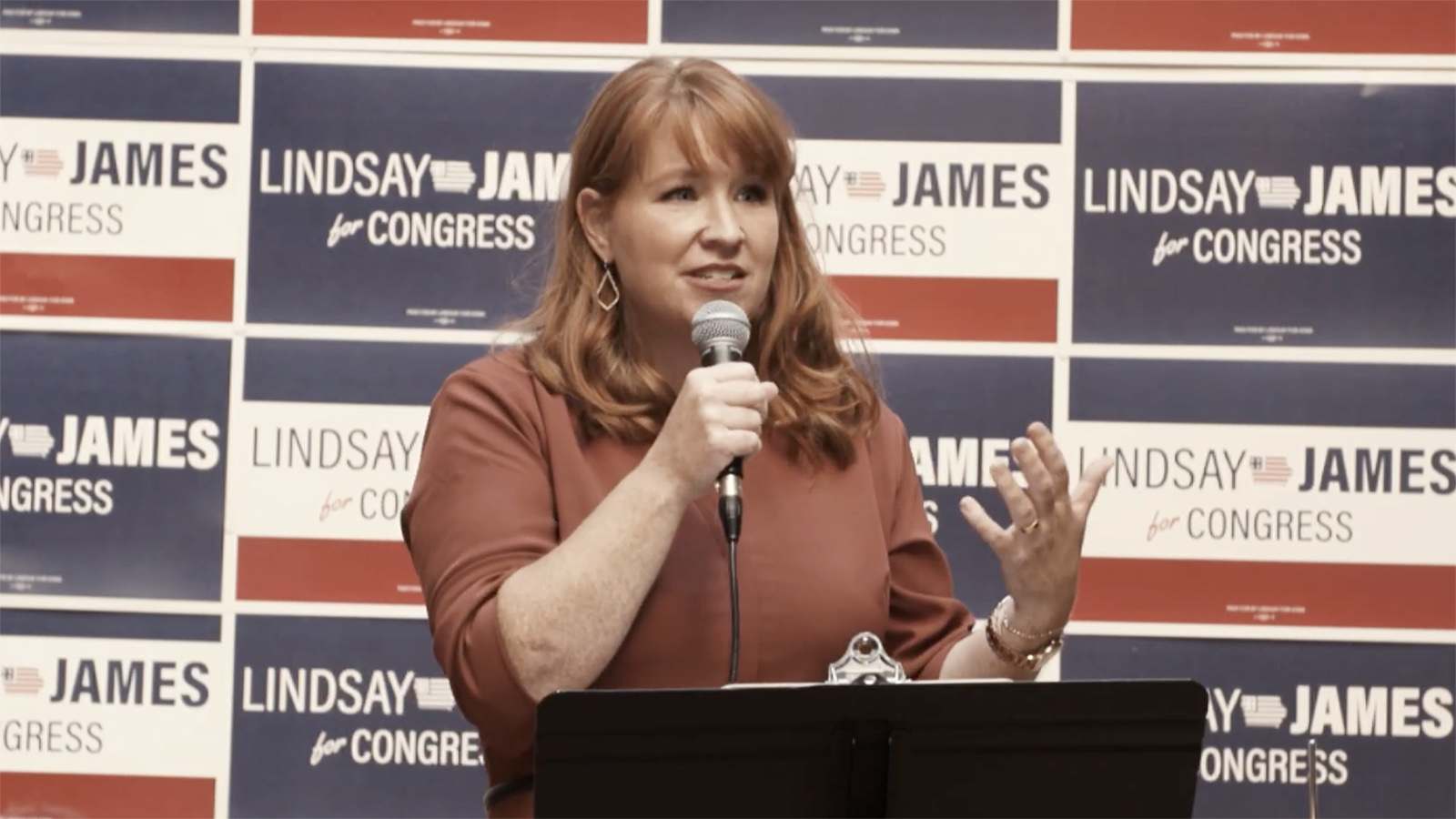
(RNS) — At last month’s Family Leadership Summit in Des Moines, Iowa, Joe Mitchell, a Republican running for U.S. Congress in the state’s second congressional district, jabbed at his Democratic opponent, state representative the Rev. Lindsay James, saying she “calls herself a pastor.” He then turned to the crowd of conservative evangelical pastors and coined a term he said applies to James, a Presbyterian minister, and other faith-forward Democratic candidates — namely, Lutheran minister the Rev. Sarah Trone Garriott, an Iowa state senator also running for another seat in Congress, and James Talarico, a state senator and Presbyterian seminarian running for U.S. Senate in Texas.
“I call them PINOS,” he said, explaining the term is an acronym for “Pastors in Name Only.”
“Because they’re not real pastors, right? They don’t profess the true gospel of Jesus Christ,” added Mitchell, who has attended an evangelical church in the past.
It’s the latest in a series of faith-focused attacks that have intensified amid an election cycle featuring a striking number of clergy campaigning as Democrats — and, in recent months, besting their challengers. At least 12 pastors, seminarians and former clergy have run for federal office as Democrats this year, and five have already become the Democratic nominees. Some are even competing against each other: In Iowa, James, who is ordained within the Presbyterian Church (USA), had to beat out another pastor, United Methodist minister the Rev. Clint Twedt-Ball, to win her primary.
At least seven current and former pastors, all evangelicals, have also launched campaigns for Congress as Republicans this year, but with less success. Of those seven, only three — Pastor Mark Harris, an incumbent in North Carolina’s 8th district; Pastor John Elleson, who is running in Illinois’ deep-blue 9th district; and Tim Walberg, an incumbent and former pastor in Michigan’s 5th district — ultimately became nominees.
Tensions are high in competitive races with clergy candidates, with Republican opponents sometimes even turning to allegations of blasphemy as they hope to capitalize on longstanding divisions within Christianity to eke out victories. That includes Garriott, whose race is rated by The Cook Political Report as one of only 18 “toss-up” House elections in the country; in addition to Mitchell’s “PINO” remarks, Republican officials have referred to Garriott as the “Wicked Witch of Woke.” House Speaker Mike Johnson has also joined other Republicans in accusing her of having “officiated a Satanist wedding,” even though the allegation appears dubious: while Garriott has spoken publicly about participating in a wedding for people who self-identified as Satanists in meetings with pastors, she could not have officiated the wedding, as she was a pastoral intern at the time, and the service itself was conducted using Christian Scripture and liturgy.

Republicans in Texas have also spent months railing against the religious beliefs of James Talarico, who has made faith a centerpiece of a U.S. Senate campaign under the slogan “Let’s flip some tables.” Texas Lt. Gov. Dan Patrick has said he has “never seen anyone commit so much blasphemy against the word of God and the Bible” as Talarico, and insisted he believes the seminarian may end up “going to Hell.” Similarly, Ken Paxton, an evangelical Christian and Talarico’s opponent, has called Talarico’s views “antithetical to historical Christian views,” arguing they were “adopted from liberal theology” and are “literally the opposite of Christianity.”
Both Lindsay James and Garriott told RNS the attacks on their faith and ordination status are “disappointing” and doubled as an indictment of their broader faith communities.
James, who is seeking to lead a district that leans Republican but is seen as competitive this year, noted she worked as a chaplain on college campuses ministering to students and doing what she called “incredibly beautiful work.” The suggestion that she is somehow not a pastor, James said, is “not just disappointing for me” but also “disappointing for all pastors and Christians across the state.”
“These kinds of attacks speak more about who my opponent is, than who I am,” she said.
Garriott argued similarly. She said her background as a parish minister and hospital chaplain are important to her personally and inform her work as a lawmaker.
“I was walking into the worst moments of people’s lives multiple times through a shift,” Garriott said, referring to her time as a chaplain. “That’s helped me develop a courage to show up for folks, no matter who they are, no matter what they’re experiencing.”

(Photo by Kelly Sikkema/Unsplash/Creative Commons)
Garriott added that, if elected, she hopes to preach regularly, as she has while serving as a state senator and on the campaign trail. Despite her grueling schedule, she has even maintained an atypically time-consuming aspect of her sermon-writing: memorizing the Bible passage she plans to preach on verbatim, then reciting it from memory before launching into her sermon.
“These attacks really are, again, not just against me as a faith leader, but me as a Lutheran minister and the churches that I’ve served,” Garriott said. “People find it really offensive — it makes them upset.”
She also argued that the line of attack suggests her opponents are desperate.
“It’s a sign that they are really scared they’re gonna lose this seat,” said Garriott, who, church leaders confirmed, remains a pastor in good standing within the ELCA’s Southeastern Iowa Synod.
Marie Griffith, a religion professor at Washington University in St. Louis and former director of the school’s John C. Danforth Center on Religion and Politics, told RNS she sees the Republican strategy as partly an example of run-of-the-mill partisan politics applied to candidates who happen to be clergy. But the nature of the attacks, she said, also points to a more than century-old divide between evangelicals who tend to be Republicans and a coalition of liberal mainline Black Protestants who tend to vote Democratic.
What’s more, evangelicals, whose pastors do not always attend seminary, have long showcased a “suspicion of education” and the “educated elite,” Griffith said. That skepticism could extend to figures such as James, Garriott and Talarico — all of whom have earned or are pursuing a Master of Divinity, as typically required by their denominations for ordination.
“It is plausible to many conservative evangelicals in the pews to say, ‘Mike Johnson is just as much a theological expert as some dude with a Ph.D. from Harvard Divinity School, or some liberal Christian institution,’” Griffith said.
Mitchell and other conservatives have pointed to their opponents’ support for LGBTQ+ rights — particularly transgender rights and votes in favor of various forms of gender-affirming care — as evidence of their insufficient faith. But that framing exposes another theological rift: In recent decades, many mainline Christian denominations distanced themselves from evangelical views on gender and sexuality by formally ordaining LGBTQ+ people, officiating same-sex marriages and affirming LGBTQ+ identities.
And recent election cycles have seen attacks on the faith of liberal-leaning Democratic clergy fall flat. When the Rev. Raphael Warnock, head of Ebenezer Baptist Church in Atlanta, was running for U.S. Senate in Georgia in 2020, Republicans decried his claim of being a “pro-choice pastor,” with then-Rep. Doug Collins condemning the idea as a “lie from the bed of Hell.” But polls indicated that most Catholics in the state and slightly more than half of Georgia’s Protestants believed abortion should be legal in all or most cases, and Warnock ultimately won his Senate seat — a victory later touted by Democratic Party leaders as a model for securing more wins in the South.
Democrats, of course, have also challenged the faith of Republicans. Just last month, Warnock openly questioned the Christian beliefs of Mike Johnson, a Southern Baptist, spurring a brief meeting on Capitol Hill between the lawmakers where they discussed their different approaches to Christianity and the Bible.
Yet the intensity and frequency of Republican attacks on liberal pastors’ religious beliefs is unusual, and mirrors efforts to undermine the credibility of liberal-leaning clergy who have criticized President Donald Trump’s administration. When the Rt. Rev. Mariann Budde, the Episcopal Bishop of Washington, asked Trump during a sermon at the Washington National Cathedral on the president’s first full day in office to “have mercy” on immigrants and transgender people, he responded with a Truth Social post that referred to her as a “so-called Bishop.” The Department of Homeland Security has been similarly dismissive of clergy who have protested the president’s immigration policies, with agency officials once publicly mocking participants in an immigrant rights demonstration led by faith leaders as “imbecilic morons” who need to “get a job.”
Even so, another pastor is poised to attract more Republican attacks on Tuesday, when the Rev. Adam Hamilton, who leads the largest United Methodist church in the U.S., is expected to win the Democratic primary in his bid to become the next U.S. Senator from Kansas.
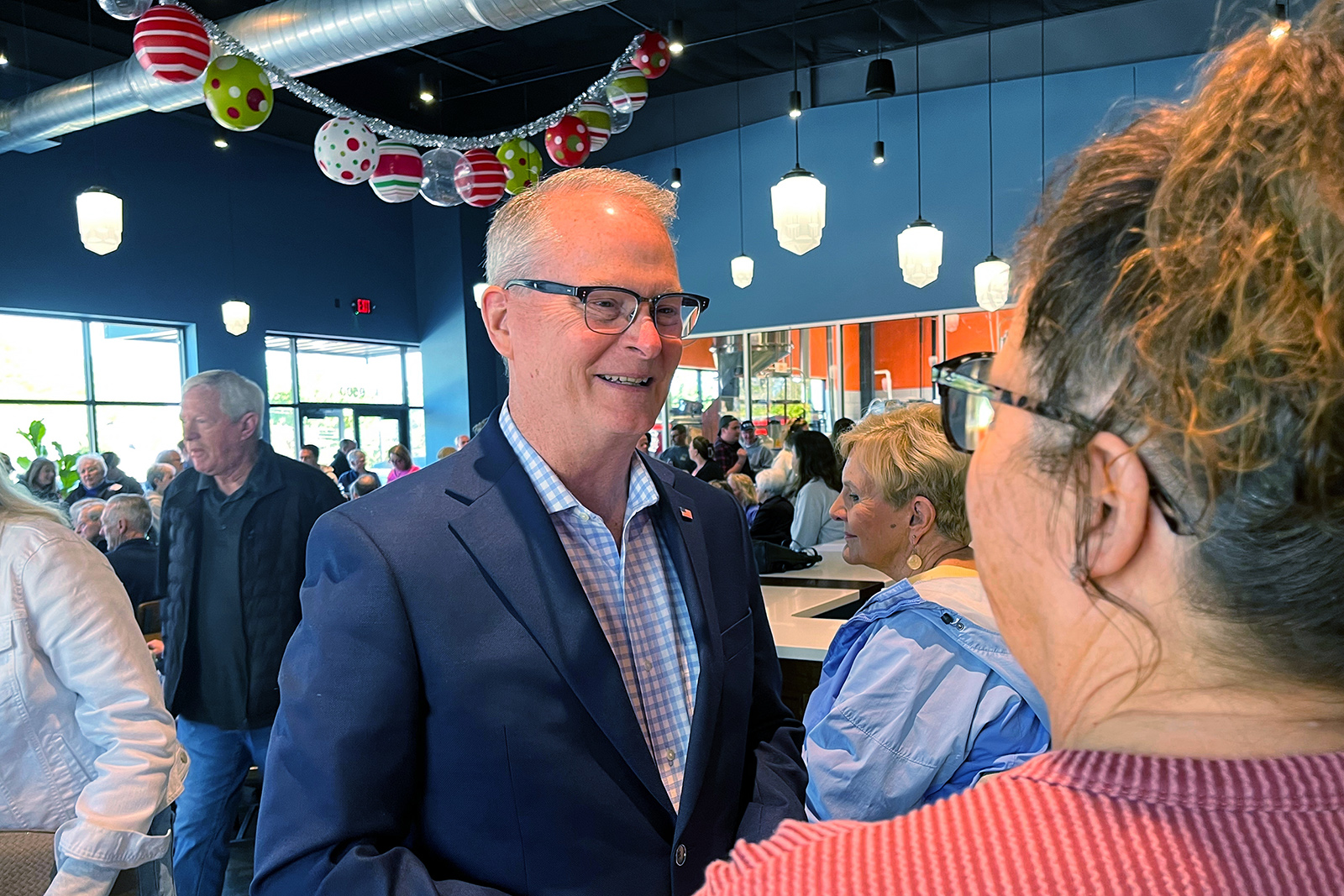
Winning a statewide election as a Democrat in Kansas is an uphill battle, but Hamilton is already breaking fundraising records, won the endorsement of the Kansas City Star in the primary and has been drawing attention from conservatives. Last month, right wing outlet Breitbart News referred to Hamilton’s denomination as “radically leftist” and wrote critically of the pastor’s suggestion in a sermon that the Bible contains errors — an idea that, while rejected by many evangelicals, has been embraced by many mainline Christians for more than a century.
For Griffith, the attacks highlight a “core disagreement on what, fundamentally, Christianity stands for.” And if Democratic clergy and other other faith-forward candidates do well in November, she said, it could destabilize a religious coalition conservatives spent decades building into a political power bloc.
“Republicans feel that they have had the religious upper hand for so long, that it’s pretty threatening to see someone like Talarico or any of these figures (running for office),” Griffith said.
But a spiritual shift of sorts may already be at hand. The Rev. Frederick Haynes III, a prominent Baptist pastor in Texas, has already won the Democratic primary for Texas’ 30th deeply blue congressional district, making it highly likely that he will be sworn in as a member of Congress next year. He told RNS he sees the success of Democratic clergy at the polls this year as a testament to their “track record of community service” and “fighting for the people.”
“There is almost an appreciative wave for the service that has been rendered that causes the people to rise up and say, ‘We want you to serve as our representative because you have served us while not being a quote-unquote public servant or politician, but you’ve done the work of public service,’” Haynes said.
Adelle M. Banks contributed to this report.


