






NEW DELHI: Last year it was Sharmistha Panoli, the law student jailed over a communal post on Operation Sindoor. This year it’s Ruchika Singh, named in a zero FIR for allegedly abusing PM Narendra Modi at a Jantar Mantar protest. Different women, different videos, same old question: What does the law actually count as abuse, and what does it just let slide? The Sharmistha Panoli case Panoli was arrested from Gurgaon on May 30, 2025 by a Kolkata Police team, days after an FIR was lodged at Garden Reach police station on May 15 over an Instagram video containing what police called “disrespectful and derogatory remarks” targeting a religion. The post came in response to another user’s comments on Operation Sindoor. Four FIRs had piled up against her in Kolkata by the time of her arrest; she had evaded a court summons before the warrant was executed. “An FIR was lodged at the Garden Reach PS on May 15… a court issued an arrest warrant, based on which she was arrested from Gurgaon,” DC (Port) Harikrishna Pai said. Panoli deleted the post and apologised on X, saying she had received rape and death threats over the video and asking the country to accept her “unconditional apology.” She was produced before Alipore court and remanded to judicial custody until June 13. Her university, Symbiosis International, suspended her and barred her from placements, with pro-VC Vidya Yeravdekar noting the institution’s disciplinary committee acted after giving her a fair hearing. The arrest triggered a political storm. BJP MP Kangana Ranaut said punishing a young woman who had already apologised and deleted her post was unjust, while AP deputy CM Pawan Kalyan accused the Bengal government of selective outrage, asking why there was no similar swiftness when Sanatana Dharma was mocked. Panoli walked free on June 6 after Calcutta HC granted her interim bail on a Rs 10,000 bond, with the court observing that the complaint did not disclose a cognisable offence. The fallout didn’t end there. The Supreme Court, hearing a plea by Wazahat Khan — whose complaint had triggered Panoli’s arrest and who himself faced FIRs in five states for allegedly hate-filled posts against Hindus — stayed coercive action against him while making clear that hate speech falls outside the protection of Article 19(1)(a). “It is not so simple. All these comments are hate-mongering,” the bench said, even as it flagged with equal concern that social media abuse was clogging the criminal justice system and citizens needed to “know the value” of their free-speech rights rather than force the state to step in.
What the law says
The Ruchika case, a year on Over a year later came Ruchika Singh. A protester allegedly seen abusing PM Modi during a sit-in at Jantar Mantar — organised amid outrage over the NEET paper leak that also cost Dharmendra Pradhan his post as education minister — she was named in a zero FIR filed in Noida on July 29, based on a complaint by Ghaziabad-based advocate Smriti Singh. “After collecting details, I went to the police and submitted a complaint,” Smriti said. The FIR, registered under various BNS sections by SHO Amit Khare of Expressway police station, was transferred to Delhi Police on Friday since the alleged offence occurred in the capital. Unlike Panoli, Ruchika has not been arrested; Delhi Police said they would first examine the FIR’s contents before further action.She later released a video apologising, claiming she was only 15 years old and had been “influenced” by others at the protest. PM Modi responded on Instagram, calling the abuse — some of it directed at him and his late mother — “a cultural shock” but urging Indians to forgive the “misguided children” rather than punish them. “These children are ours, too. It is our duty to show them the right path,” he said, adding that dragging youths through court proceedings would not change the situation.
Where law draws the line
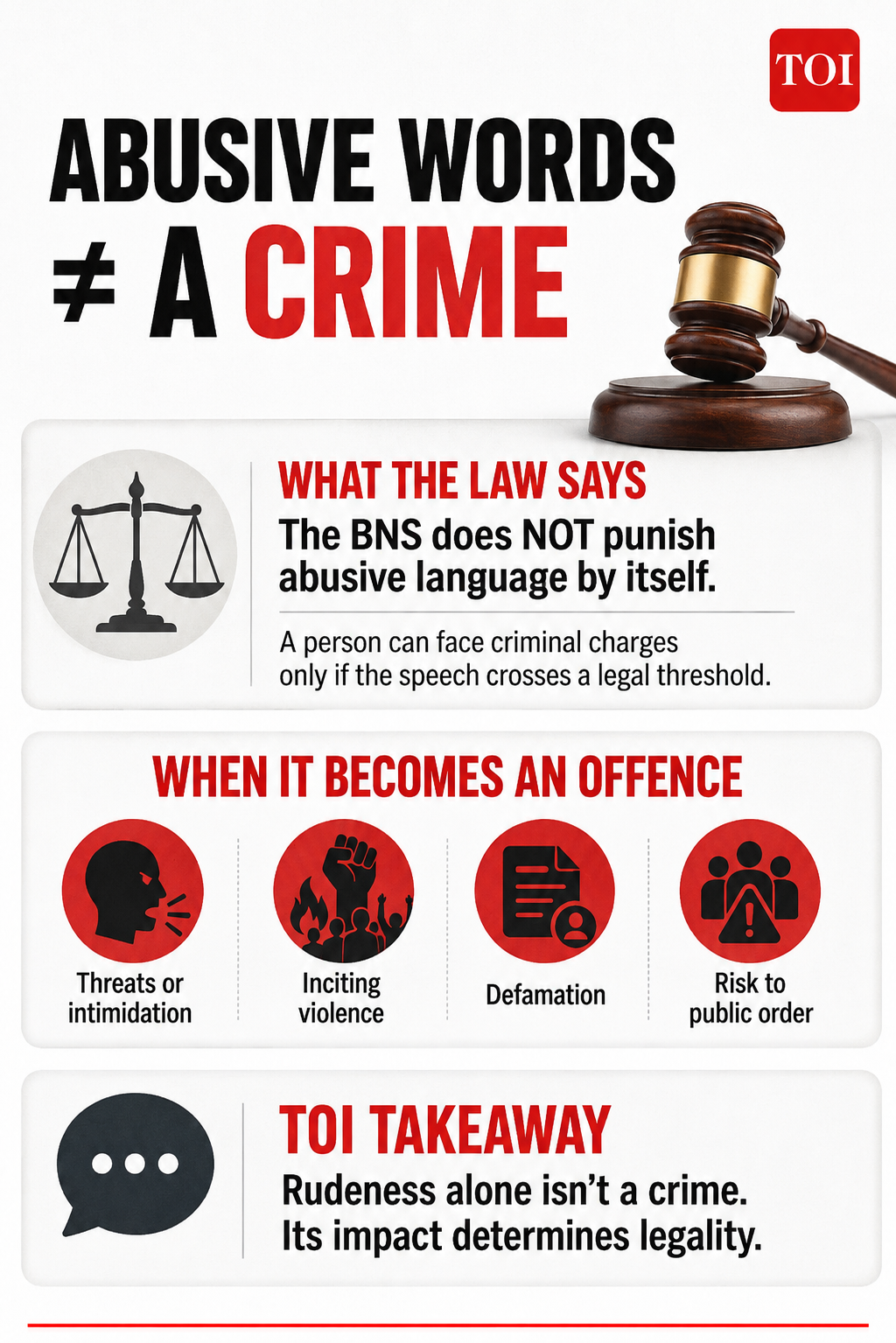
No standalone offence for being offensiveSupreme Court advocate-on-record Vivek Narayan Sharma told TOI, one of the biggest misconceptions surrounding such controversies is that the Bharatiya Nyaya Sanhita (BNS) criminalises abusive or insulting language by itself.“There is no standalone offence under the BNS for simply being offensive or insulting,” Sharma said. “The law is concerned not with whether the listener felt offended, but whether the speech crosses a specific legal threshold such as incitement, criminal intimidation, defamation or a real threat to public order.”In other words, rudeness may be socially unacceptable, but it is not automatically a crime.
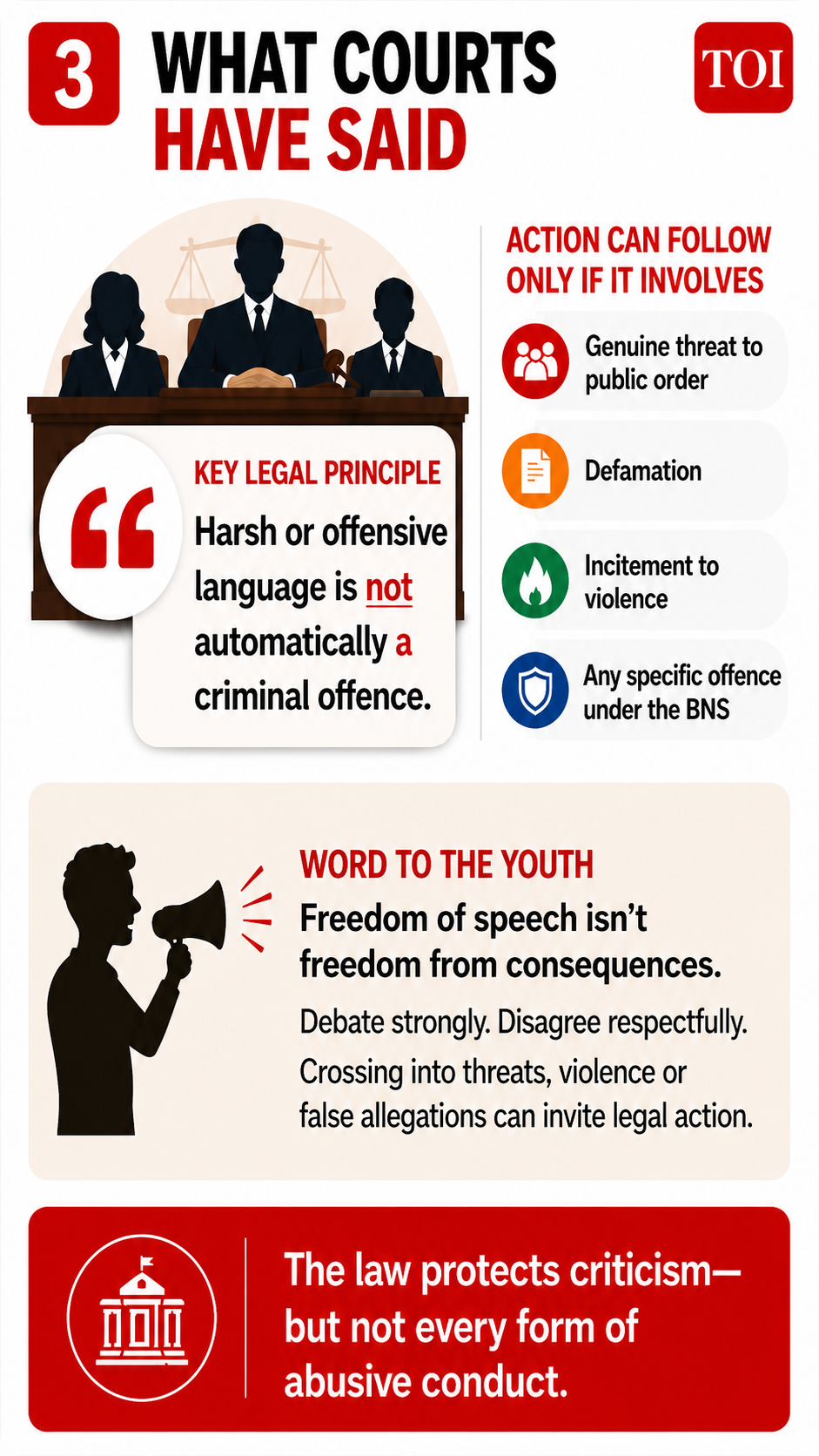
What courts have said
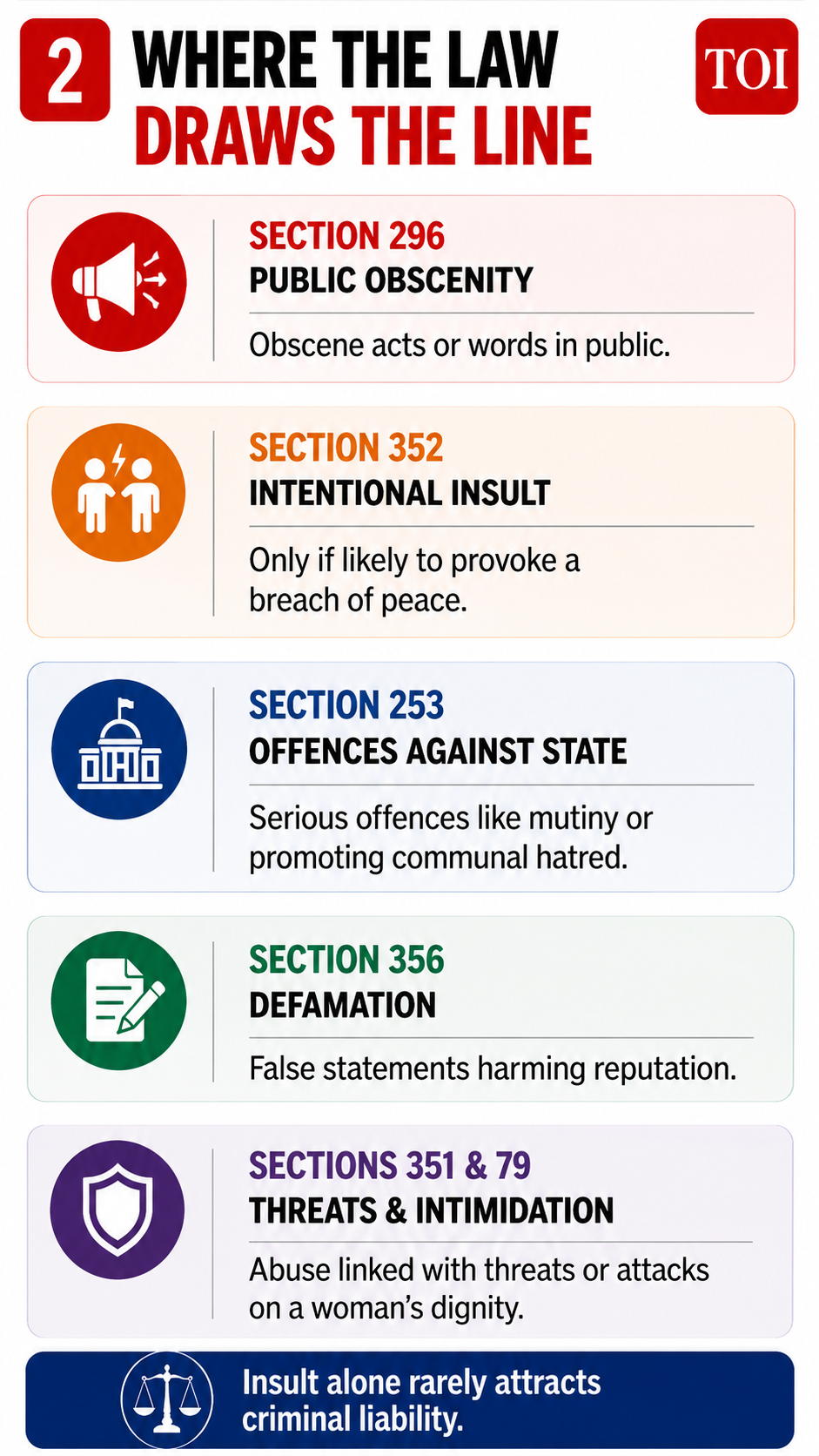
Where the law draws the lineThe BNS contains several provisions that are frequently cited in cases involving objectionable speech, but each has a narrowly defined scope.Section 296, dealing with public obscenity, applies only when obscene words or acts are committed in a public place causing annoyance. Courts have traditionally interpreted the provision narrowly, meaning crude criticism or offensive political slogans would not necessarily qualify unless they meet the legal definition of obscenity.Section 352, relating to intentional insult, is also more limited than commonly believed. Mere abuse is insufficient. Prosecutors must establish that the words were intended, or were likely, to provoke a breach of public peace. An angry outburst without any realistic possibility of violence may therefore fail to satisfy the statutory test.Similarly, Section 356 on defamation concerns false statements that harm another person’s reputation. It also contains statutory protections for good-faith criticism of the conduct of public servants while performing official duties.Sections dealing with criminal intimidation or outraging the modesty of a woman apply only where abusive words are accompanied by threats, intimidation or other legally recognised aggravating circumstances. The law, Sharma said, punishes the accompanying criminal conduct—not offensive language in isolation.Courts have repeatedly emphasised restraintRecent judicial observations have also reflected this careful balancing act.During hearings in cases involving social media posts, the Supreme Court remarked that hate speech does not enjoy constitutional protection under Article 19(1)(a) and stressed that freedom of speech carries corresponding responsibilities. Judges observed that divisive and inflammatory speech fuels litigation and social discord while urging citizens to exercise self-restraint instead of leaving regulation entirely to the State.At the same time, courts have also cautioned against criminalising every offensive statement.The research notes cite a Telangana high court ruling which held that harsh or offensive political remarks are not automatically criminal unless they satisfy the ingredients of a specific offence such as defamation or create a genuine threat to public order. According to Sharma, the Supreme Court later declined to interfere with that reasoning, reinforcing the distinction between offensive speech and criminal speech.The broader constitutional principle is that speech cannot be restricted merely because it is unpleasant or unpopular; prosecution requires the statutory ingredients of a defined offence.Law and civility are not the sameSharma argues that legality and decency should never be confused.“The law protects robust criticism of public officials because democracy requires space for disagreement,” he said. “But choosing abuse instead of reasoned criticism is ultimately a question of character rather than legality.”Courts have repeatedly reminded citizens that freedom of speech is among the Constitution’s most valuable rights, but one that carries corresponding responsibilities. The challenge for investigators and courts, therefore, is to distinguish constitutionally protected—even if deeply offensive—speech from speech that crosses the line into incitement, criminal intimidation, defamation or threats to public order.Two cases, a year apart — one led to an arrest, the other remains under investigation — but they raise the same unresolved question for India’s courts: When does crude, angry speech cross the line from bad taste into a crime, and who gets to decide?


