





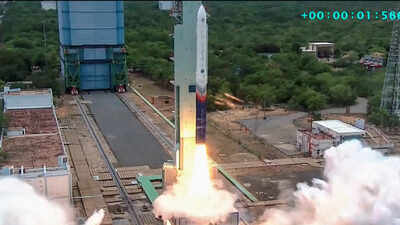
SRIHARIKOTA: After some anxious moments when the automatic launch sequence of Vikram-1 was halted midway at just five minutes before lift-off, Skyroot Aerospace finally created history after it successfully placed India’s first privately developed orbital-class rocket into space.The seven-storey tall Vikram-1 rocket, with a lift-off weight of 45,000 kg, blasted off at 12.05 pm, a good 35 minutes behind the originally scheduled time, from the first launch pad at the Satish Dhawan Space Centre-Sriharikota Range on its maiden orbital test flight, Mission Aagaman.The vehicle completed its planned flight sequence and placed its payloads into the targeted low Earth orbit, validating key systems developed by the Hyderabad-based startup.Prime Minister Narendra Modi spoke personally with the Skyroot founders Pawan Kumar Chandana and Naga Bharath Daka on phone and congratulated the duo on the successful completion of Mission Aagaman.The PM, who sent a postcard into space abroad Vikram-1 with Vande Mataram written on it, pointed out to the Skyroot team that the feat was also momentous coming as it does when Vande Mataram is commemorating 150 years.The feat marks a major milestone for the country’s commercial launch sector and opens a new chapter at Sriharikota 46 years after ISRO’s first successfully launched India’s first launch vehicle SLV-3 into orbit.The launch came exactly 46 years after ISRO’s SLV-3E2 placed the Rohini satellite RS-1 into orbit on July 18, 1980, making India the sixth nation capable of launching satellites independently. Like SLV-3, Vikram-1 stands 22 metres tall, but its success represents a different leap: the arrival of private Indian industry in orbital launch operations.Built with an all-carbon composite structure, Vikram-1 uses in-house propulsion systems, including high-thrust solid-fuel stages and 3D-printed engines. The mission targeted a 450 km orbit at an inclination of 60 degrees and lasted just under 16 minutes.The rocket carried a mix of demonstration and symbolic payloads, including Skyroot’s SCOPE payload, SOLARAS, a 1U CubeSat from Karnataka-based Grahaa Space, Embrace, an in-orbit robotic arm demonstration from Telangana-based Cosmoserve Space, and payloads from Germany’s DCubed GmbH.It also carried a handwritten postcard from Prime Minister Narendra Modi bearing the words “Vande Mataram”, along with hundreds of letters from Skyroot’s team and supporters.In attendance at the historic launch were astronaut Shubhanshu Shukla, Andhra Pradesh IT minister Nara Lokesh, with his son in tow, in addition to ISRO chairman V Narayanan, IN-SPACe chairman Pawan Goenka and former ISRO director S Somanath.Founded in 2018 by former ISRO scientists Chandana and Daka, Skyroot had earlier made history on Nov 18, 2022 when Vikram-S became the first privately built Indian rocket to reach space on a suborbital flight. With Aagaman, the company has now moved from demonstration to orbital capability.