



(RNS) — While there is growing awareness of the severe humanitarian crisis in Cuba, in large measure brought on by the U.S. fuel blockade, few are paying attention to the damage that decades of sanctions are inflicting on the Catholic Church’s ability to serve the Cuban people.
The United States has pressed economic sanctions on Cuba for over 60 years. Congress strengthened those sanctions through the Helms-Burton Act in 1996, extending penalties to some foreign companies doing business with Cuba. While the Obama administration partially eased sanctions, the Trump administration, particularly in its second term, reimposed sanctions even more stringently, including a prohibition on oil delivery to Cuba.
Those policies have triggered Cuba’s deep economic crisis. Not only has the United States prevented any fuel deliveries to the country — for months now — but it has also imposed such severe penalties on international businesses and aid organizations that Cuba’s entire economy is affected. The latest round of measures imposed on May 1 forced the withdrawal of the international banks through which the country does business, and forced out foreign investors in Cuba’s main industries, such as mining. Every major source of revenue to the country has now been disrupted.
As a result, the state can no longer afford to purchase the basic foods it provides to Cuban households at subsidized prices or to maintain health care or schools. The most direct cause of the acute humanitarian crisis taking place now has been the fuel embargo, which has drastically cut electricity generation in Cuba. Those cuts have caused frequent and prolonged blackouts and affected every aspect of the economy and infrastructure, especially hospitals, including of course those caring for children.
I saw a different Cuba nearly two decades ago.
In 2007, while serving as president of Fairfield University, I led an academic delegation to Cuba. Academic exchange was then one of the few legal avenues for Americans to visit the island. During our week there we met scholars at the University of Havana, journalists and medical professionals.
As a Jesuit, the most memorable part of the visit was spending time with the Jesuit community at Havana’s Church of the Sacred Heart of Jesus. Their historic downtown parish showed signs of decades of neglect — neither the Jesuits nor the archdiocese had money to maintain it — but their spirit was hopeful. They believed that dialogue with the Cuban government was gradually opening opportunities for the church to expand its pastoral ministry.
That optimism was visible at the Pedro Arrupe Center, a newly established Jesuit retreat house — in what once had been one of Havana’s wealthier neighborhoods — that had recently been restored with international Catholic support. The Cuban Jesuits had been able to reestablish an important Jesuit spiritual ministry right in the middle of Havana. This could not have happened without the government’s knowledge and acquiescence. So despite longstanding tensions, the church and the Cuban government had begun finding limited ways to coexist.
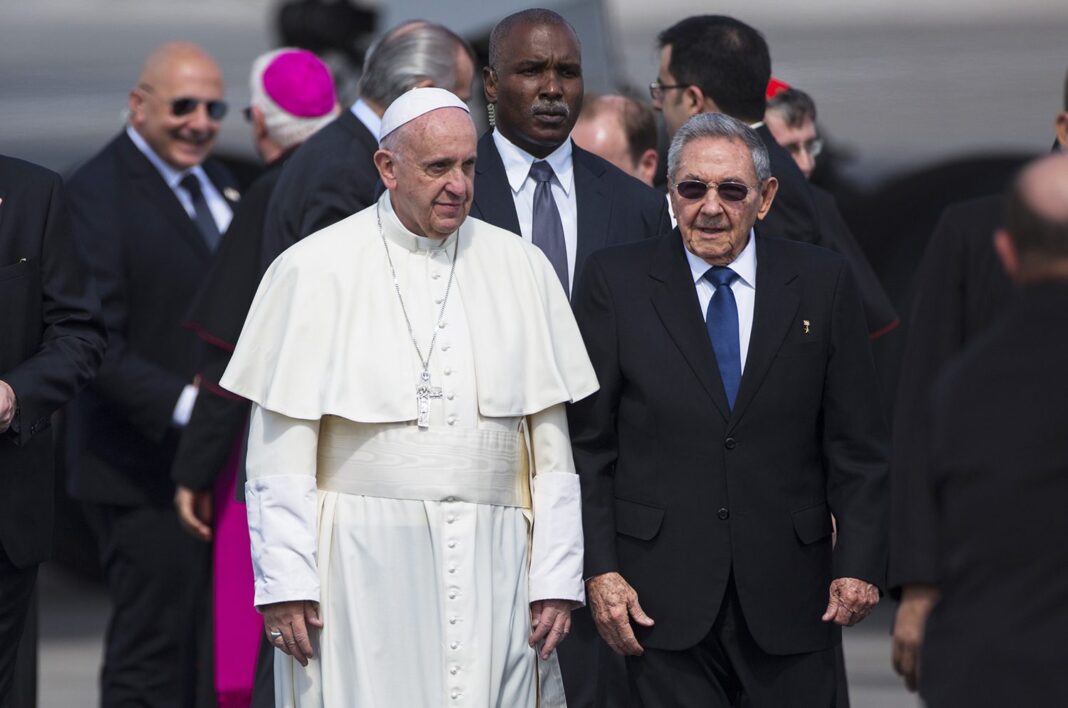
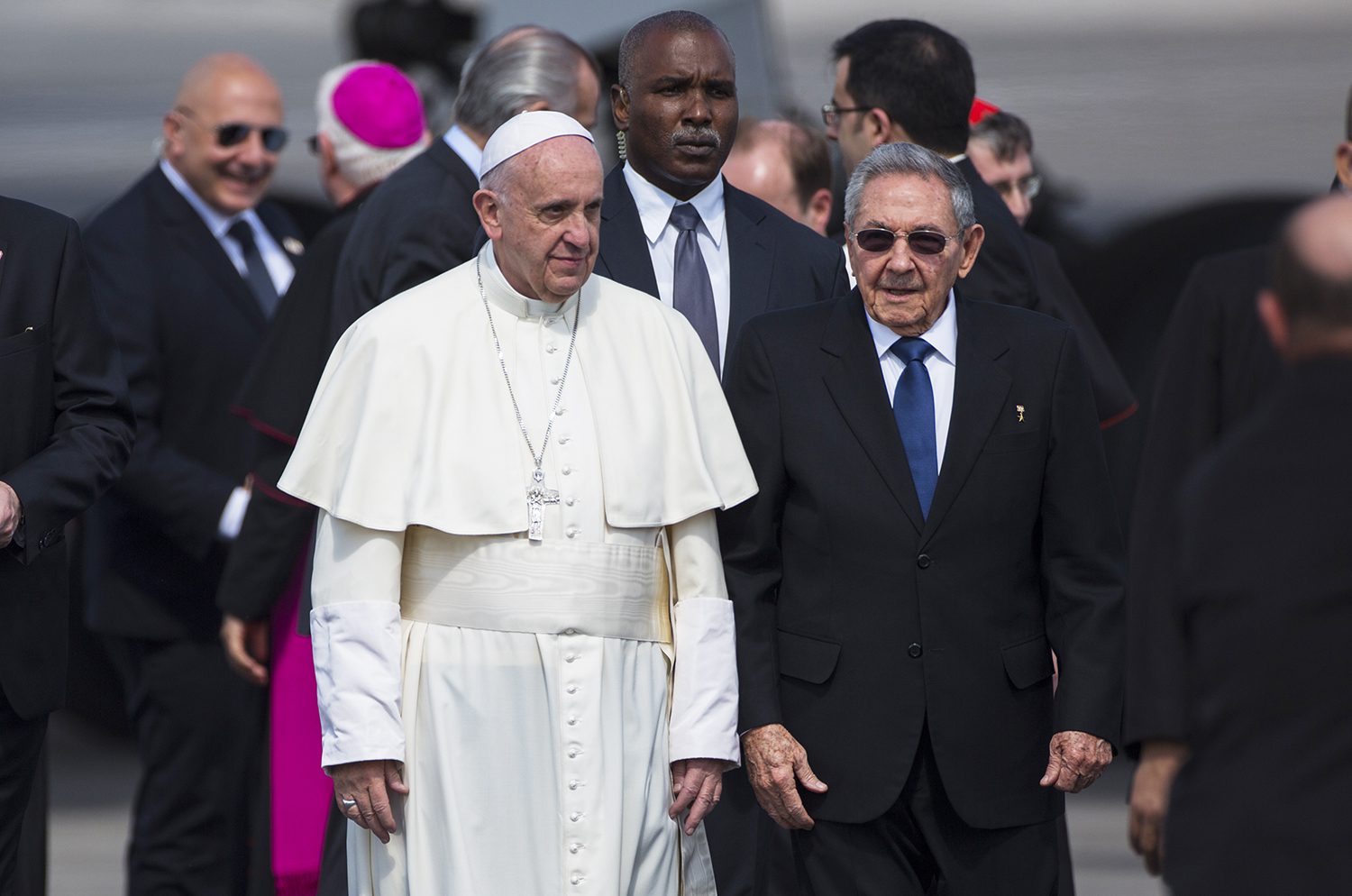
The high point of our visit was meeting Cardinal Jaime Ortega, the archbishop of Havana. Ortega was guardedly optimistic that patient dialogue offered the best hope for expanding the church’s freedom and service. He famously facilitated the visits of three popes to Cuba: Pope John Paul II, Pope Benedict XVI and Pope Francis. He also facilitated the restoration of diplomatic relations between the United States and Cuba in 2014, acting as a go-between at the request of Pope Francis, with President Barack Obama and Cuban President Raúl Castro. During his three decades leading the Archdiocese of Havana, he oversaw the restoration of churches, strengthened the Cuban bishops’ conference and opened the first Catholic seminary building constructed in Cuba since the 1959 Cuban Revolution.
But today, those gains are under severe strain.
In January, Cuban bishops warned that worsening energy shortages and economic hardship were falling most heavily on the country’s most vulnerable people. They wrote that “Cuba needs change and the need is increasingly urgent, but it does not need more anguish or suffering,” urging governments to resolve their differences “through dialogue and diplomacy.”
In February, Pope Leo XIV echoed that appeal, calling for sincere dialogue that would avoid increasing “the suffering of the dear Cuban people.” In May, Cardinal Michael Czerny, prefect of the Dicastery for Promoting Integral Human Development and a frequent spokesperson for the pope, emphasized that lasting solutions come through dialogue, international cooperation and respect for human dignity rather than measures that deepen suffering. He said that the pope has reminded us that “no stable order can arise from the force of arms or from pressure that humiliates peoples.”
The Cuban government recently announced expansive economic reforms, lifting restrictions on investment, corporate ownership and trade by private actors. Rather than directly distributing resources to manage the economy, the state will introduce a system of taxes and incentives.
But these reforms cannot do much to mitigate the tremendous damage being done by the U.S. sanctions. No amount of greater economic efficiency within Cuba can make up for the fuel blockade, the collapse of the electrical grid and the freezing of Cuba’s trade partners. All of this affects basic necessities including food and water. Sister Noemy Ayala, a Carmelite Sister of St. Joseph living in Havana, told National Catholic Reporter, “We have to live with the uncertainty that the power could go out at any moment … and when it does, we have no water because the pump cannot get started.”
The church experiences Cuba’s hardships alongside everyone else. It has been recently reported, for example, that the sisters who bake the hosts for Holy Communion for most of the parishes in Cuba can no longer provide them because they cannot use their ovens due to lack of gas and electricity. Churches have appealed abroad for assistance simply to celebrate the Eucharist.
Meanwhile, parishioners increasingly arrive seeking not only spiritual comfort but basic necessities.
Bishop Arturo González Amador, president of the Cuban bishops’ conference, reported, “There are people who come in saying they haven’t eaten in days and don’t know who to turn to. Food cannot be preserved due to the lack of electricity, and recently there have been frequent fainting spells during (church) services because many people haven’t eaten.”
None of this means the Cuban government bears no responsibility for the country’s crisis. But it is the current U.S. policies — which quite literally reduce the country to a preindustrial condition — that are making daily life unbearable for ordinary Cubans.
We Americans must realize that when we punish Cuba, we do not punish only the government. We punish the most vulnerable: the sick, the elderly, children, the poorest of the poor. And as Catholics, we should realize that we punish our brothers and sisters in Christ, even as they try to serve those in need, and we hinder the mission of the church. And this is precisely at a time when the church is finding its way to being an agent of change for this troubled and suffering country.
The church has become one of the few institutions capable of accompanying vulnerable families, providing humanitarian assistance and creating space for dialogue. Policies that further weaken the church’s ability to carry out that mission ultimately harm the very people the United States says it wants to support.
(The Rev. Jeffrey von Arx, S.J. is president emeritus of Fairfield University. The views expressed in this commentary do not necessarily reflect those of Religion News Service.)