






(RNS)–The woman in the front pew caught my attention. Her pink calico dress looked straight from the set of Little House on the Prairie. She was pregnant and holding a baby in her arms. Four other children stood next to her, end-capped by the father.
At 14, I was immediately fascinated by their cheerful courage to live a countercultural life in our church of working moms and the standard 2.5 kids. I loved Little House. I wanted to be a Christian wife and mother, and I decided then and there to be just like her. Five years later, I’d get my chance. Mentored by the calico-dressed trad wife, I would become pregnant nine times in 10 years, with five live births and four living children. I believed our lifestyle was nurturing and wholesome—devoted to God—and that when we suffered, we were aligned with Christ.
My mentor was among the first adherents of Bill Gothard’s Institute of Basic Life Principles (IBLP) at our Southern Baptist megachurch. Bill Gothard, now 91 and currently in the news again due to his recent heart attack and subsequent coma, never married or had children. But he and the Quiverfull movement he promoted had a lot to say about families, ultimately spearheading a multi-million-dollar organization that spread Christian fundamentalism across America through his stadium events, homeschool curriculum, and training academies.
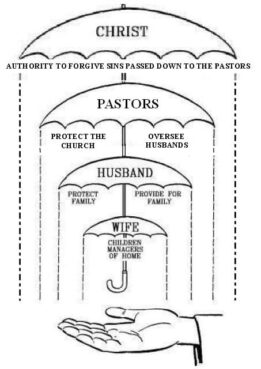
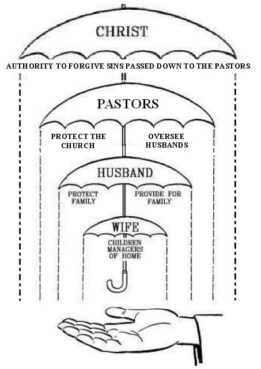
Gothard often preached on the holy virtues of motherhood and procreation, teaching a patriarchal hierarchy known as the Umbrella of Authority (or Umbrella of Protection): husbands make all decisions, women submit, children obey. The hidden math was all-around us, along with sermons on the dangers of the Great Replacement—when immigrants and people of color would outpopulate whites, creating instability. White men must lead and protect; white women must provide as many godly children as possible. Our country’s salvation depended on it.
The ideology manifests in every part of practical household management, from gender roles and Bible study to nutrition. Young people were simply to trust God and have babies. Refusing to do so reflected weak faith.
When it came to contraception, persuasion looked like the following: Psalm 127: 4-5, “Like arrows in the hands of a warrior are children born in one’s youth. Happy is the man who has his quiver full of them.”
In short order, concerns such as maternal health, affordability, desire, mental capacity, climate impact, or maturity were swept away. Taught to obey, we did, living the realities of high-control family life with unlimited babies behind closed doors.
I escaped patriarchal domestic violence in 2007. In 2026, Gothard is old and disgraced, having resigned from leadership in 2014 following allegations of sexual abuse. But I hear echoes on repeat now.
At the 2026 CPAC conference, activist Isabel Brown urged women to “have more kids than they can afford, before they think they’re ready,” a call echoed by Erika Kirk at the TP USA conference. I shuddered to hear it. I doubt most 20-year-olds today understand the history, dangers, or context of this message.
Yesterday’s Quiverfull movement has been rebranded as today’s pronatalist movement. Pronatalists these days are not always faith-based. Silicon Valley has its own version of pronatalism, although it’s not lost on me how many tech leaders are from South Africa and their legacy of apartheid. But from what I’ve seen firsthand, I have no doubt that the fear driving much of today’s Christian pronatalism –the fear of white evangelicals becoming a minority — is the same fear that ran through so many churches in this country from the Civil War to the civil rights movement and the pews I’ve sat in.
From 1984-2000, I attended First Baptist Church in Jacksonville, Florida, which at the time was one of the largest Southern Baptist megachurches in the country. Established in 1838 on a local plantation as the Bethel Baptist Church, the congregation split along racial lines after the Civil War. White member went on to found what became First Baptist, roughly two decades after the Southern Baptist Convention formed to protect churches that supported enslavement.
The racism often came sugar-coated—Southern Christians were raised to be polite. It could seem coincidental that there were no Black leaders, and that all the trad wives and quiverfull homeschooling families were white. And yet, there were breakthrough moments where the warnings felt explicit.
Even in my 1980’s childhood, segregation still was openly supported from the pulpit. Our pastors often referred to our “sister churches” and said that “separate but equal” was kind. “Everyone is just happier this way,” I remember them saying.
The inner-city was predominantly Black. But our 11 blocks in the center were intended to be an island of wealthy, white hope. We even constructed an operational lighthouse that cast powerful beams of light into neighborhood windows until it was court-ordered to shut down. We proudly studied our church history every year and saw ourselves as a beacon. Our tagline was “sharing the love of Christ from the heart of downtown Jacksonville.”
Forced busing was a hotly contested issue in Jacksonville, Florida, and I sat through many sermons warning us about the dangers of mixed society and crime. The pastors and visiting theologians warned us of a time when whites would no longer be the majority. America would achieve racial balance between whites and non-whites by the mid 2020s, which would induce chronic instability and poverty. Other than godlessness, no other explanation was offered for this dire economic downturn, and no other solution was offered other than rapid procreation and conservative voting.
In retrospect, growing up in an affluent, white Southern evangelical church is what shaped me to accept the trad wife, quiverfull lifestyle. Now, in 2026, for the first time, white births are no longer the majority in the U.S., a study found.
While racial disparities and culture wars still top our headlines, the news can feel disconnected from the Christian trad wife and pro-natalist movements. But they’re not disconnected; they’re nesting, co-dependent ideologies, each needing the other to thrive. And they’re not new: what we’re experiencing today is less a regression and more of a rebrand, capitalizing on the same racist fears.
TP USA’s promotion of Head of Household voting is directly related to Gothard’s Umbrella of Authority, where the husband makes every decision for the home, including birth rate and vote. And, many of the same people pushing women toward bigger families also tend to support the SAVE Act, which would disenfrancise married women voters, the gutting of the Voting Rights Act and tough anti-immigration policies. Grow the white Christian patriarchal families, and shrink the electorate that can check them–I don’t think any of that is coincidental.

What I learned as a fundamentalist housewife in Christian patriarchy is that changing laws takes a long time; changing hearts and minds in a culture war is faster. The calico dresses may be gone. But the fear remains, and many white Christians are fighting against it by growing large white Christian families they aren’t equipped to raise or afford.
Tia Levings is the author of the New York Times bestseller, A Well-Trained Wife: My Escape from Christian Patriarchy, and I Belong to Me: A Survivor’s Guide to Recovery and Hope after Religious Trauma.