






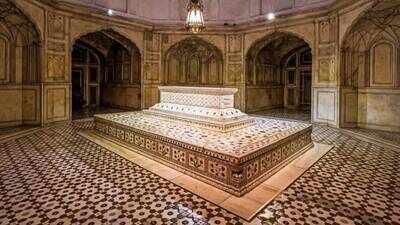
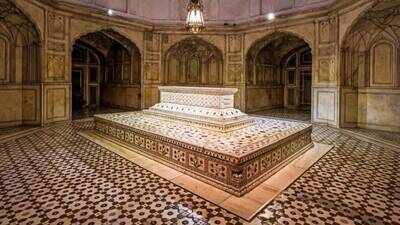
Among the many fascinating stories of the Mughal Empire, few are as unusual as that of Emperor Jahangir. The fourth Mughal ruler, known for his love of art, architecture and nature, is perhaps the only emperor in history to have two burial sites. While his magnificent mausoleum stands in Lahore, Pakistan, a lesser-known grave in Jammu and Kashmir’s Rajouri district is believed to hold only his intestines.The unusual burial has intrigued historians for centuries and is rooted in the circumstances surrounding Jahangir’s death during his final journey from Kashmir in 1627.
Jahangir died on his way back from Kashmir
Jahangir, who ruled the Mughal Empire from 1605 to 1627, spent his final years travelling frequently between Lahore and Kashmir. The emperor preferred Kashmir’s cooler climate and often escaped the summer heat by staying in the valley.In October 1627, while returning from Kashmir, Jahangir fell seriously ill near Rajouri. Historical records state that he died on October 28 near Bhimber, close to present-day Rajouri.His death created an immediate political crisis.According to historians, announcing the emperor’s death before reaching Lahore could have triggered a bitter succession battle among the Mughal princes. To avoid unrest, Empress Nur Jahan and senior nobles reportedly decided to keep his death a secret until the royal entourage reached Lahore.
Why were Jahangir’s intestines buried in Rajouri?
The journey from Rajouri to Lahore would have taken several days. In the absence of modern preservation techniques, transporting the emperor’s body over such a long distance posed a major challenge.According to historians and officials from the Archaeological Survey of India, royal physicians embalmed Jahangir’s body to slow decomposition. As part of the embalming process, his intestines were removed and buried at a Mughal sarai, in Chingus, near Rajouri.The name “Chingus” itself comes from the Persian word for “intestines,” making it one of the most unusual place names linked to Mughal history.According to G S Gaur, Deputy Superintendent Archaeologist with the Archaeological Survey of India, Nur Jahan was advised not to declare Jahangir’s death immediately because it could have led to a war of succession. The removal of the intestines was carried out to preserve the emperor’s body until it reached Lahore.Some historical accounts also claim that the emperor’s body was placed on an elephant and made to appear as though he was still alive while the royal procession continued its journey.
The story of Chingus Fort
The site where Jahangir’s intestines were buried later became known as Chingus Fort or Chingus Sarai. Built during Jahangir’s reign by the Persian engineer Ali Mardan Khan, the fort served as an important resting place for Mughal emperors travelling along the historic Mughal Road between Lahore and Kashmir.The fort features dozens of residential chambers, large halls, watchtowers and a central garden. At its heart lies a modest marble-covered grave believed to contain Jahangir’s entrails.Unlike the emperor’s grand mausoleum in Lahore, the grave at Chingus is simple and understated.According to local residents, very few visitors come to the site today, despite its immense historical significance.
Jahangir’s final resting place in Lahore
After the embalming, Jahangir’s body was transported to Lahore under the supervision of Asaf Khan, the brother of Nur Jahan.Historian Ellison Banks Findly writes in her book Nur Jahan: Empress of India that Asaf Khan instructed officials to ensure Nur Jahan accompanied her husband’s body throughout the funeral procession until it reached Lahore.Lahore was a natural choice for Jahangir’s burial. The emperor had often described it as one of the finest cities in Hindustan and spent considerable time there during his reign.His son and successor, Emperor Shah Jahan, later commissioned the construction of a magnificent mausoleum in Shahdara on the banks of the Ravi River. Completed in 1637 at a reported cost of 10 lakh rupees, the tomb remains one of the finest examples of Mughal architecture.Although many people believe Nur Jahan built the mausoleum, historians say it was financed by Shah Jahan, while the empress herself lived nearby until her death in 1645. She was later buried in the same complex.
A masterpiece of Mughal architecture
Jahangir’s tomb was built in the traditional Persian Charbagh style, with landscaped gardens divided into four sections.Constructed using red sandstone and decorated with intricate marble inlay work known as Pietra Dura or Parchin Kari, the monument showcases precious stones such as agate, jasper, turquoise and lapis lazuli arranged into elaborate floral designs.The emperor’s marble cenotaph, located at the centre of the mausoleum, is engraved with the 99 names of Allah.Despite its architectural brilliance, the monument often remains overshadowed by more famous Mughal landmarks such as the Taj Mahal and Humayun’s Tomb.