






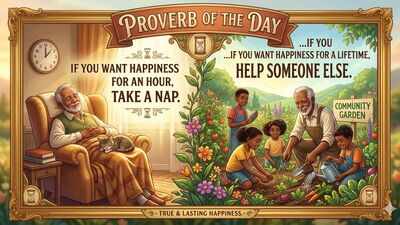
This little proverb is built like a joke, with a punchline at the end. It lists things that make us happy, but cleverly ranks them by how long the happiness lasts. A nap buys you an hour. A day’s fishing buys you a day. Inheriting a fortune, surprisingly, buys you only a year. And then comes the twist the whole saying has been building toward. If you want happiness that lasts a lifetime, help someone else. In a handful of words, it quietly overturns much of what we believe about what makes us happy.
Proverb of the day
“If you want happiness for an hour, take a nap. If you want happiness for a day, go fishing. If you want happiness for a year, inherit a fortune. If you want happiness for a lifetime, help someone else.”
Where the saying comes from
You will almost always see this passed around as a Chinese proverb, and it carries that calm, timeless feel. But the honest answer is that its true origin is uncertain.There is no clear source for it in old Chinese writings, and some people who have looked into it suspect the saying is more modern than it sounds, with versions appearing in English and possible links to Western writers on happiness. As with many sayings labelled a proverb, the tag may tell us more about the kind of wisdom we want to believe is ancient than about where the words actually began. What we can say for certain is that the idea has struck a chord with people all over the world, which is the real test of any proverb worth repeating.
The four kinds of happiness
The beauty of the saying is the way it walks up a ladder, each rung lasting longer than the last.
- A nap gives you happiness for an hour. Rest is a simple, immediate pleasure, and a real one, but it fades almost as soon as you are back on your feet.
- Fishing, or any enjoyable pastime, gives you a day. A good outing lifts your spirits, yet by tomorrow the glow has faded and you are looking for the next one.
- Inheriting a fortune gives you a year. This is the sly line. Money brings genuine comfort and excitement, but the proverb gently suggests that even sudden wealth does not keep you happy forever. The thrill wears off faster than we expect.
- Helping someone else gives you a lifetime. This is the point of the whole thing. Doing good for others, the saying claims, is the one source of happiness that never runs dry.
Why helping others lasts longest
The genius of the proverb is its running order. It places helping others above comfort, above leisure, and even above a fortune. And on this point, modern research agrees to a striking degree.Studies on happiness keep finding the same thing. The joy we get from possessions and money tends to fade as we grow used to them, a pattern researchers call adaptation. The new car becomes just a car. The windfall becomes the new normal. But kindness works differently. Helping others gives us a deeper sense of meaning, connects us to people, and gives our days a purpose that simple pleasures cannot. Best of all, unlike a nap or a one time inheritance, it can be repeated endlessly. Every act of help tops the well back up again.
How to make it part of your life
The lovely thing about this proverb is that it asks for nothing you do not already have. You can start living by it today.
- Look for small, regular ways to help. You do not need grand gestures. A kind word, a helping hand, a little time given to someone who needs it. Small acts done often add up to the lifetime the proverb promises.
- Do not wait until you are rich or free. The saying pointedly ranks helping above inheriting a fortune. You do not need money or spare time to be kind. You can begin right now, exactly as you are.
- Make it personal. Helping a real person whose face you can see tends to feel far more rewarding than a distant, faceless gesture. Choose ways to help where you can witness the difference you make.
- Notice how it feels. Pay attention to the quiet lift you get after helping someone. Noticing it is what turns a single good deed into a lasting, happy habit.
The same wisdom across cultures
The idea that helping others brings the deepest happiness turns up everywhere, which is part of why this proverb rings so true.
- The much repeated thought that we make a living by what we get, but we make a life by what we give.
- The gentle reminder, found in many traditions, that no one has ever become poor by giving.
- The old image of a candle, which loses nothing of its own light by lighting another candle.
- The familiar idea that the surest way to lift yourself up is to reach down and help someone else up.
A happiness that does not fade
Most of what we chase in life gives us a burst of happiness that fades almost as quickly as it came. We rest, we treat ourselves, we dream of money, and each one lifts us for a while before wearing off and leaving us wanting more. The quiet wisdom of this proverb is that there is one exception to the rule.Helping others is the gift that keeps giving, to the person you help and to you. Whatever its true origin, the saying has survived because people keep rediscovering that it is true. So the next time you find yourself wanting to be happy, this old line offers a simple and surprising piece of advice. Stop chasing happiness for yourself, and go find someone to help.