





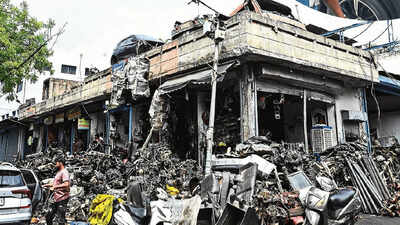
NEW DELHI: The pavements are full of cars, hatchbacks to sedans to SUVs, parked bumper-tobumper, leaving barely enough room for pedestrians to squeeze through. On one side of the road are towering billboards and rows of used car dealers competing for attention; on the other are accessory shops promising everything from customised interiors to fancy alloy wheels and loud sound systems. A little ahead, workshops and mechanics line the streets.Welcome to Karol Bagh’s used car market in central Delhi, where, people say, mechanics have an answer for problems that authorised showrooms cannot solve. However, electric vehicles are still an issue. Looking inside the engine of a car, mechanic Iqbal said, “We have only petrol and diesel for repair as of now. Electric cars hardly come, maybe one or two in a month.”Pausing for a moment, he added, “I remember an EV that came in with a suspension problem. That was easy because suspension systems are similar in all vehicles. Beyond that, I don’t touch them, I usually ask the customer to take it to the company service centre.”But he knows the situation may not remain the same for long. EVs accounted for just 1.1% of all new motor car registrations in Delhi in 2021; by 2022, the share had risen to 1.8%; and by 2023, to 3%. In 2024, the rise was 2.4%, before jumping to 7.5% in 2025. This year, EVs accounted for 10.4% of all new cars till June 12. In other words, roughly one out of every 10 new cars being registered in Delhi today is electric. Inquiries for secondhand EVs have gone up amid increasing fuel prices linked to the ongoing West Asia conflict, but there aren’t many such cars in the inventory as these vehicles are new, said a used car dealer in Lajpat Nagar.Pawan, who deals in fitting accessories, said, “EVs have complex cooling and computer systems that carefully manage electricity use. If too much power is taken from the vehicle, it can send error messages and even affect the car’s electrical system.”Another mechanic, Javed, said that in a petrol or diesel car, people often connect high-power devices such as air compressors or powerful music systems to the socket. “In an EV, it can be risky. These devices may overload the system, blow fuses, or damage electrical circuits, because EVs recharge their 12V battery differently from conventional vehicles.”Across Delhi, thousands of roadside mechanics keep the city’s vehicles running, but most have little or no training in electric mobility. As govt pushes for a faster shift to EVs to tackle worsening air pollution, some questions are surfacing.The draft Delhi EV Policy 2.0, expected to be notified soon, proposes an incentive of Rs 1 lakh for buying an electric car below Rs 30 lakh after scrapping an old BS-IV or older Delhi-registered vehicle. The incentive would be available to the first one lakh eligible applicants. EVs would also continue to enjoy a 100% exemption from road tax and registration fees.Under Delhi’s existing aggregator policy, ride-hailing and delivery companies are required to shift to 100% electric vehicles by April 1, 2030. The new policy retains this mandate.So what happens to the mechanics, spare-parts dealers and second-hand vehicle markets that have long been built around internal combustion engines? “The industry is changing,” said Iqbal. “If we don’t learn, we could be left behind.”
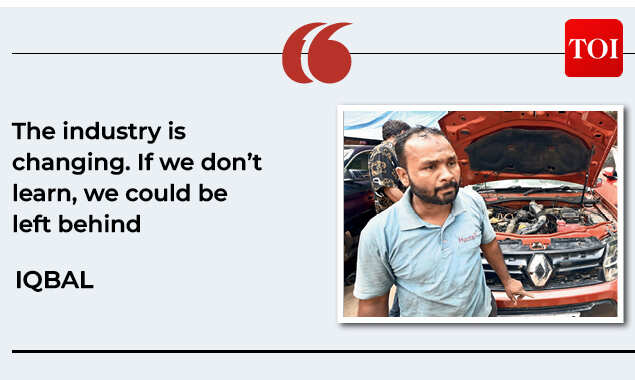
Iqbal
For now, the market continues to run largely on the skills, supply chains and business models built around internal combustion engines. Mention EVs and the conversation often trails off.Arsh, who helps run a family-owned dealership operating since 1984, said the market was still hesitant about electric vehicles. “Reselling an EV is not the problem. The bigger challenge is understanding the post-sale issues. Our mechanics are still not trained to diagnose or repair EV-related problems, so it is not a segment we are actively looking at yet.”For Pawan, who runs a preowned car dealership, the biggest concern is reselling used EVs. “Firstly, they are very new, so it will take years for them to come into the market for resale. Then, whenever a used car comes to us, there are always some refurbishment costs, whether for paintwork, repairs or mechanical work.” With EVs, he added, the biggest concern is the battery. “If the battery needs replacement, it can cost Rs 5-6 lakh, and there are very few local options for repair.”Pawan believes it may take another five to seven years before used EVs become common in the market. “Buyers are still cautious and often do their own research before making a decision.”
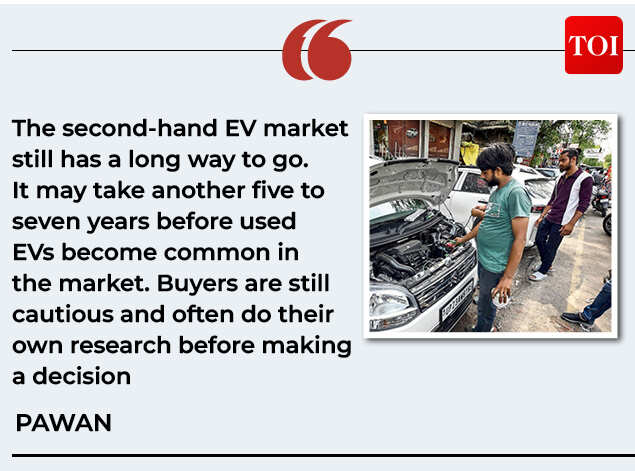
Pawan
He also pointed out that Delhi’s growing charging network didn’t solve the entire problem. “A used car doesn’t necessarily stay in Delhi. We’ve sold many vehicles to buyers in Uttar Pradesh and other states. I remember one customer who struggled to find charging stations after taking his vehicle outside Delhi. Infrastructure may improve in the capital, but resale buyers also look at what the situation is like elsewhere.”According to him, uncertainty around battery health and replacement costs also continue to affect the demand.On the outskirts of Delhi lies Mayapuri, known for its automobile spare-parts market and scrap-recycling yards.Twisted car frames, dented bonnets, rusting gates and discarded machinery are piled one after another. The sound of constant mechanic thud echoes through the lanes of Phase II of Mayapuri Industrial Area. Cranes stand ready beside accident-damaged and ageing cars and motorcycles that have reached the end of their road life and are waiting to be stripped, dismantled and sorted at a remarkable speed, with usable parts salvaged and the rest sent for scrap.One man hammers away at the rusted bonnet of an old car. Nearby, another bends over a motorcycle, dismantling its engine with his bare hands, while workers use a crane to load compressed bales of scrapped car bodies onto trucks.People in the area estimate that around 500 small shops are operating here. Most signboards advertise businesses dealing in old petrol and diesel vehicles. After walking past dozens of such shops, one eventually comes across a few establishments that have begun entering the EV segment.“We are among the rare two or three shops that have slowly started dealing with EVs,” said a representative. “Until about six months ago, we were functioning entirely in the traditional segment.”Sunny, who runs a scrap-andresale shop that has been in business for nearly four decades, said EVs were still a small part of the market, but it was slowly changing. “Around 90% of our vehicles are still petrol or diesel. But that number of EVs is growing and we have started adapting.”The biggest difference, according to him, lies in the parts. “In a conventional vehicle, the engine is usually the most valuable component. EVs don’t have an engine. Instead, they have a motor, battery modules and other electronic components. These parts are expensive and there is demand for them in the spareparts market,” he explained.Sunny said battery modules from accident-damaged EVs were particularly sought after. “In some cases, a part from an EV can be worth more than a lakh, very different from conventional vehicles. The value lies in the battery and electronics,” he said.
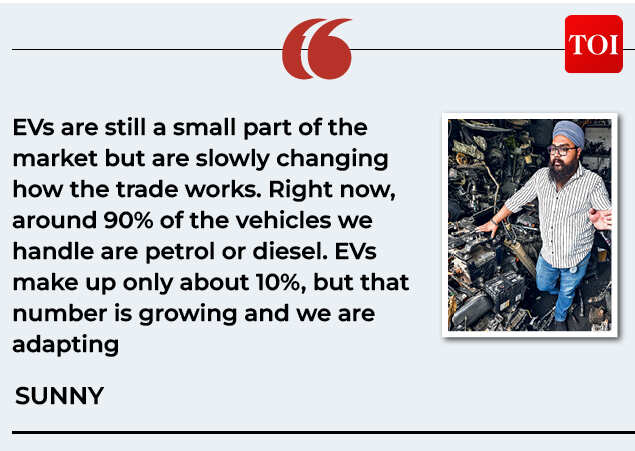
Sunny
EVs are still a niche segment in the city’s resale and scrap market, but, with their numbers growing, dealers are trying to adapt fast.
Reasons Why 5
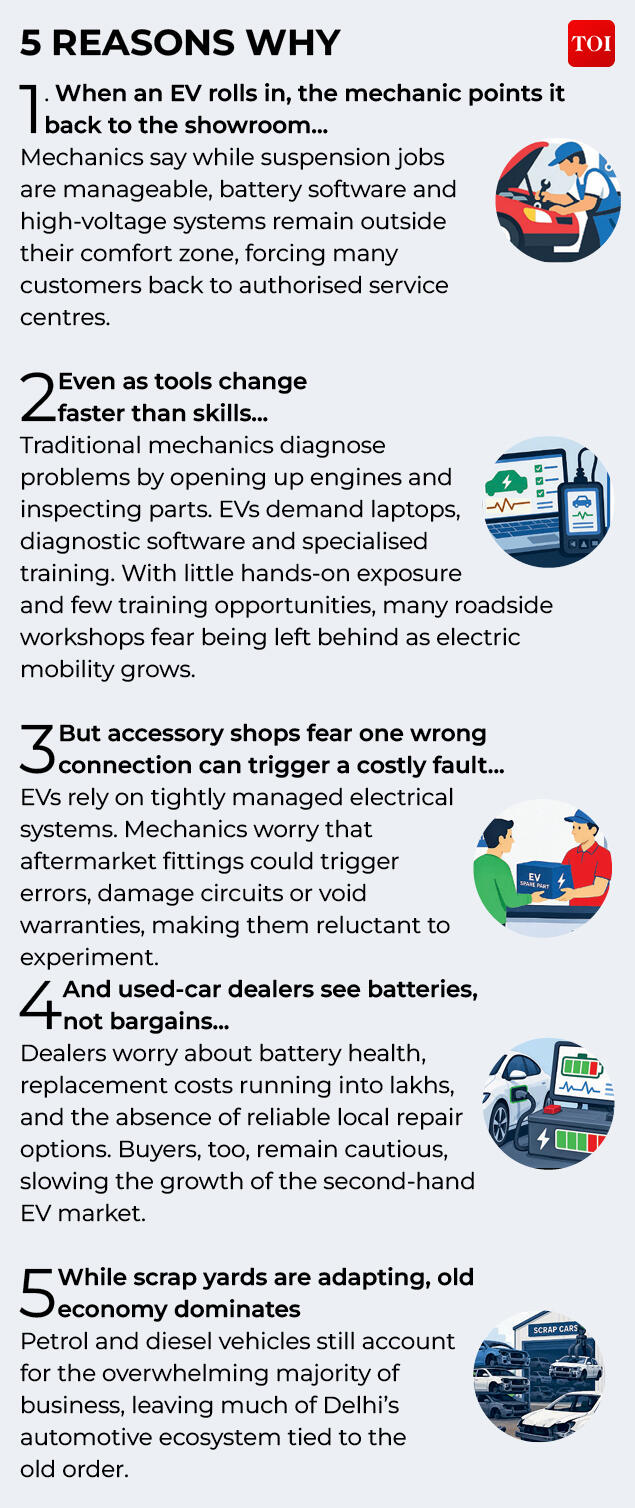
5 Reasons
- When an EV rolls in, the mechanic points it back to the showroom…
Mechanics say while suspension jobs are manageable, battery, software and highvoltage systems remain outside their comfort zone, forcing many customers back to authorised service centres
- Even as tools change faster than skills…
Traditional mechanics diagnose problems by opening up engines and inspecting parts. EVs demand laptops, diagnostic software and specialised training. With little hands-on exposure and few training opportunities, many roadside workshops fear being left behind as electric mobility grows
- But accessory shops fear one wrong connection can trigger a costly fault…
EVs rely on tightly managed electrical systems. Mechanics worry that aftermarket fittings could trigger errors, damage circuits or void warranties, making them reluctant to experiment
- And used-car dealers see batteries, not bargains…
Dealers worry about battery health, replacement costs running into lakhs, and the absence of reliable local repair options. Buyers, too, remain cautious, slowing the growth of the second-hand EV market
- While scrap yards are adapting, old economy dominates
petrol and diesel vehicles still account for the overwhelming majority of business, leaving much of Delhi’s automotive ecosystem tied to the old order