







(RNS) — Many of our nation’s top leaders today openly pronounce their Christian faith. Some even read Scripture (or what they imply to be Scripture) during official government briefings.
But according to a new poll by the Public Religion Research Institute, 64% of Americans do not want to live in a primarily Christian nation. Instead, they prefer an America of many faiths without a Christian majority.
“This is the antithesis of the Christian nationalist worldview, which essentially maintains that America was founded as a Christian nation, (and) it should remain a Christian nation,” said Melissa Deckman, CEO of PRRI.
The survey, “Competing Visions of America: Politics, Religion, and American Identity,” was conducted online May 1-18 among a representative sample of 5,469 adults (age 18 and up) living in all 50 states.
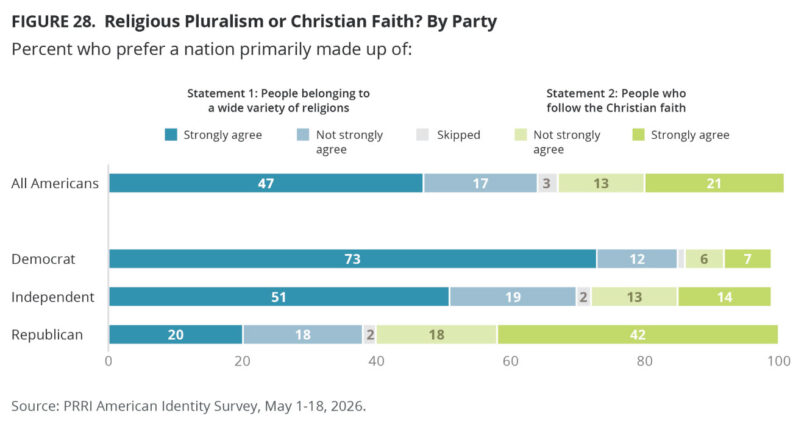
“Religious Pluralism or Christian Faith? By Party.” Chart courtesy PRRI
In addition, 77% of Americans say they would prefer the U.S. to be a nation made up of people from all over the world, a slight decrease from 80% in March 2025. Christian nationalism adherents (55%) and sympathizers (68%) are less likely to prefer a racially diverse nation over a nation primarily made up of people of Western European heritage.
Efforts to strengthen the place of Christianity in the public square have gained currency in recent years, going beyond public statement into public policy. In Texas, the state Legislature voted to require the Ten Commandments be displayed in every public school classroom despite an ongoing legal battle over a similar law in Louisiana. And the Texas state education board approved educational curricula for elementary schools that include stories from the Bible.
The results of this poll offer a rebuttal to such efforts, argues Deckman.
Nevertheless, a sizable portion of the American population agrees with the efforts to infuse Christianity into the public square. An overwhelming majority (94%) of those most strongly committed to the worldview of Christian nationalism believe that being Christian is important to being truly American. This group makes up roughly 11% of the total population of the US.
Similarly, 68% of white evangelical Protestants, President Donald Trump’s most stalwart base of support, prefer a nation primarily made up of Christians. Majorities of all other religious groups surveyed prefer a nation made up of people belonging to a wide variety of religions, with the slight exception of Hispanic Protestants — 51% favor a majority Christian nation.
Positive associations with Christian nationalism have only risen in recent years, however. Around 48% of Republicans favorably view the term today, 12 percentage points more than in 2022. In fact, positive associations with the term “Christian nationalism” have risen across most religious and political groups since 2022. Hispanic Protestants, Black Protestants and Democrats are the only groups that saw favorable views of the term fall. Around 56% of Republicans today espouse some Christian nationalist views, alongside 25% of Independents and 17% of Democrats.
But holding favorable views toward the term “Christian nationalism” does not necessarily translate to holding Christian nationalist views, Deckman clarified.
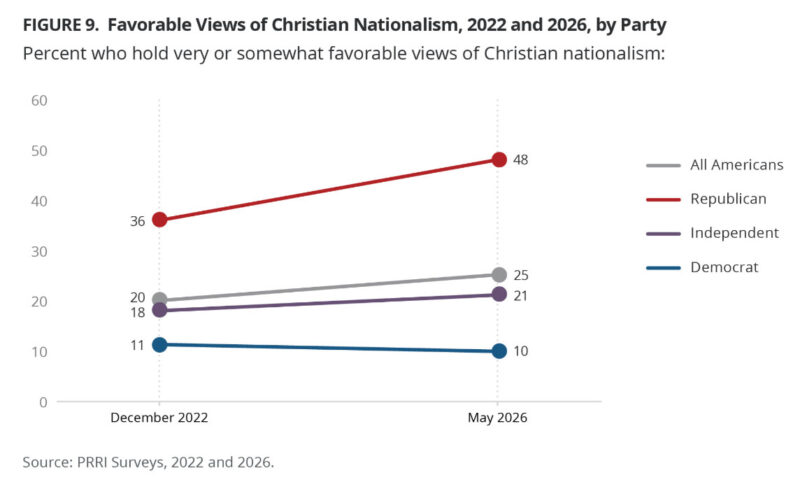
“Favorable Views of Christian Nationalism, 2022 and 2026, by Party.” Chart courtesy of PRRI
“We found consistently over the four years of doing surveys of Americans overall, there’s just no growth in the number of Americans who espouse Christian nationalist views. It’s remained remarkably steady,” said Deckman.
The rise in positive associations can be attributed to familiarity with and openness to the term, especially among those with high-ranking positions in the second Trump administration.
“There’s more willingness to embrace that term among some conservative Republicans,” said Deckman. Even so, those who do not espouse Christian nationalist views still outnumber those who do by roughly 2-to-1, Deckman emphasized.
While Americans are divided on their vision of the ideal religious landscape, most say they are concerned for America’s democratic future. According to the poll, nearly 7 in 10 Americans believe that our nation’s democratic rights and freedoms are under threat, including a majority of all political and religious groups. In fact, only 18% of Americans say they are extremely or very proud of the way democracy is working in America today.
“That was really striking to me, as we’re celebrating the nation’s 250th anniversary,” Deckman noted.
Deckman chalked this up to the current administration’s efforts to curtail people’s free speech and right to protest, especially as evidenced by the events in Minneapolis over the winter and the killings of American citizens Renee Nicole Good and Alex Pretti by federal immigration officers while protesting.
Perhaps unsurprisingly, the poll also detailed the way Americans diverge in their responses to that concern.
For most Americans, it has meant reimagining America’s place on the global stage. Support for the belief that God has granted America a special role in human history has fallen more than 15 percentage points since the mid-2010s, to roughly 44% today. The drop is most pronounced among Democrats, falling from 60% in 2012 to just 27% today.
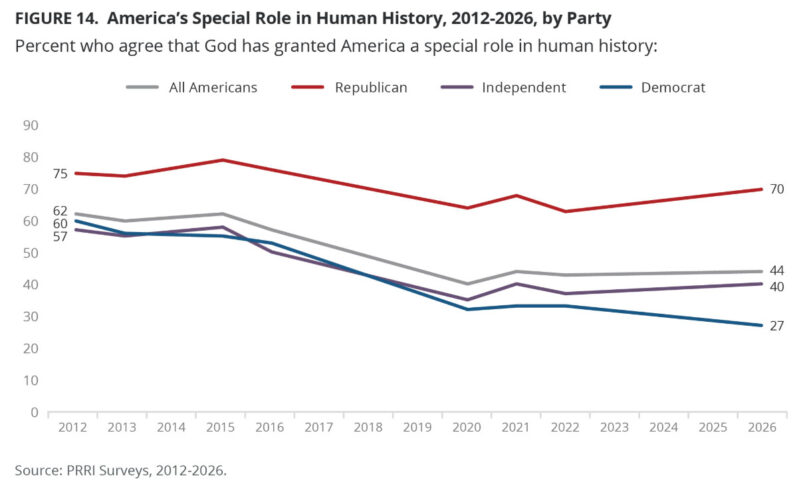
“America’s Special Role in Human History, 2012-2026, by Party.” Chart courtesy of PRRI
White evangelical Protestants, on the other hand, have become more likely to agree — rising 7 percentage points to 75% today — alongside religiously unaffiliated Americans, rising 5 percentage points to 21% since 2022.
Republicans are also far more likely to have pride in their American identity and America’s 250-year history than independents and Democrats — at least 30 percentage points more in both cases. More than three-quarters of white evangelical Protestants share that pride, alongside majorities of white Catholics, white mainline Protestants, Latter-day Saints, Hispanic Protestants and Jews. The unaffiliated and members of other non-Christian religions, as well as Black Protestants and Hispanic Catholics, are more likely to disagree.