



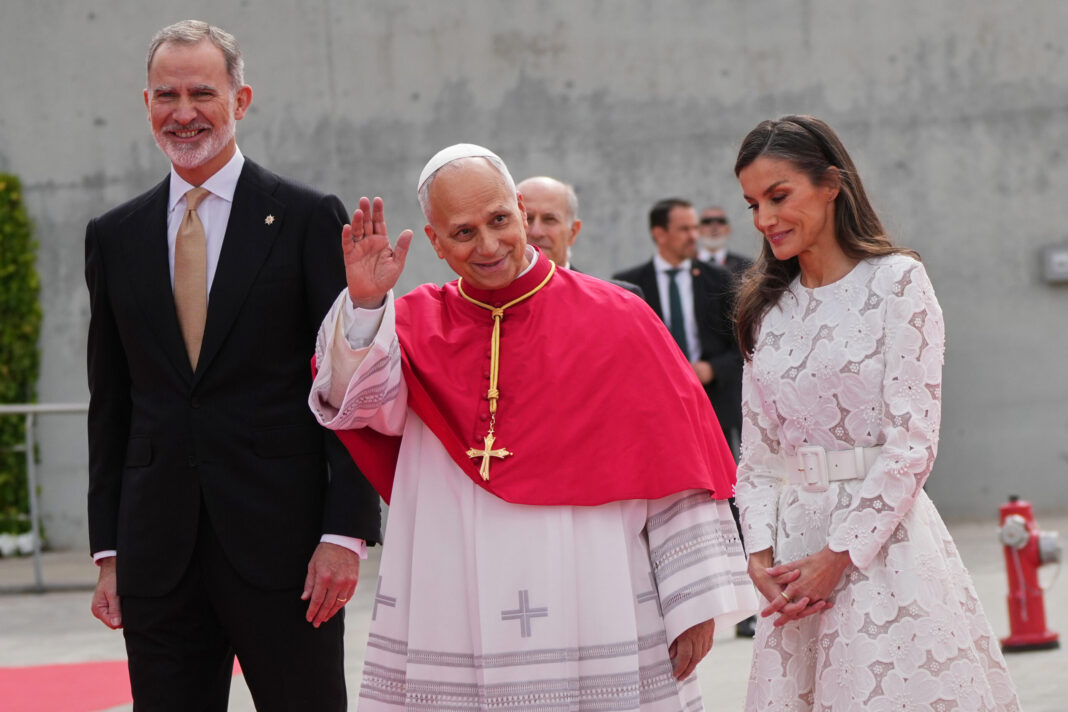
(RNS) — During his addresses to political and diplomatic leaders in Spain, Pope Leo XIV laid out the political theology he believes should guide not only the church but also politicians and diplomats.
He presented his vision in two speeches: one on Saturday (June 6), in the presence of King Felipe VI, to civic and diplomatic leaders; the other on Monday, to the Spanish Parliament.
The church wishes to be in service to humans, Leo explained. It “walks alongside humanity, shares its hopes and its wounds, listens to the questions of every age and allows herself to be challenged by everything concerning the lives of contemporary men and women.”
To those who fear church interference in politics, the pope affirmed, “It is a service not marked by imposition.”
He repeated what he said in his recent encyclical, “Magnifica Humanitas“: “When the church addresses anything concerning public life, she does so while respecting the proper mission of institutions and the legitimate responsibility of those who have received the mandate to legislate.”
The church, he said, recognizes “the autonomy of earthly realities” and “the distinction between the ecclesial community and the political community.”
For the United States, this means he affirms the separation of church and state and rejects Christian nationalism.
Rather, what the church offers is “a reflection born of the desire to serve the common good and to recall what makes human coexistence truly human.”
To Spain’s Congress of Deputies, Leo affirmed the role of legislatures, where “differences are heard, sorted out and, when possible, transformed into shared decisions.” In words that could have been addressed to the U.S. Congress, he said, “Every legislative task ultimately confronts a decisive question: What conception of the human person inspires laws, and what kind of society do those laws build?”
Human beings are “more than just a cog in the social, economic or political order,” he added. They are “open to truth, endowed with freedom, and driven by a thirst for eternity that no temporal reality can quench.”
Leo recalled that Spanish philosophers and theologians “introduced into historical discernment the question of the irreducible value of every human being and the moral limits of power.” But he admitted that “society and the church herself did not always live up to these insights found in their own Christian tradition.”
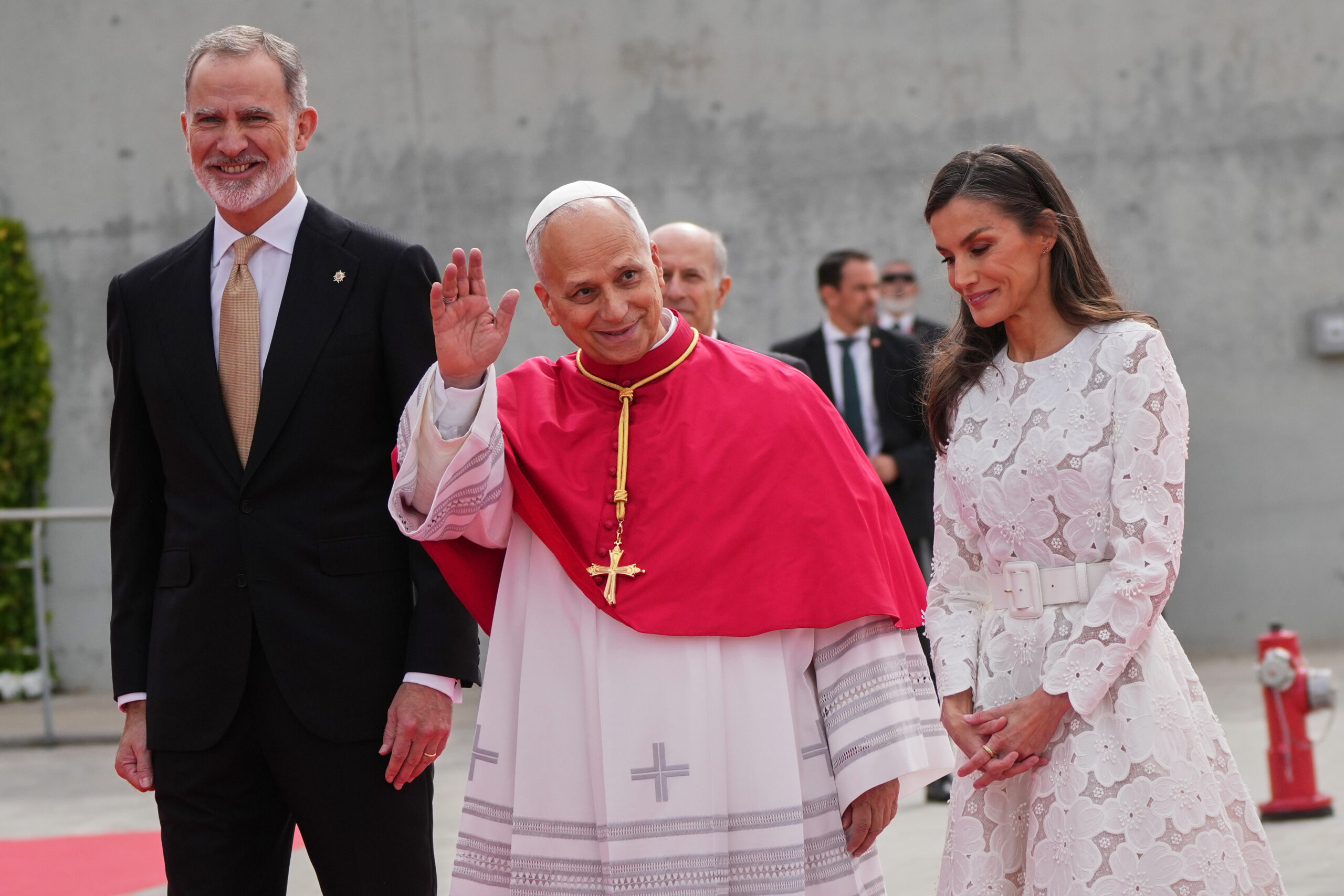
Pope Leo XIV is welcomed by Spain’s King Felipe VI and Queen Letizia upon his arrival at Adolfo Suarez Madrid-Barajas International Airport in Madrid, Saturday, June 6, 2026, marking the start of his seven-day apostolic journey to mainland Spain and the Canary Islands. (AP Photo/Alessandra Tarantino)
In this tradition, “authority always entails responsibility” and “every human being must be recognized as a subject of rights and duties.” That aspiration, he said, “continues to resonate today: that dignity, justice and the common good should be the measure of social relations, both at the national and international levels.”
“Our discernment,” he asserted, “must focus on the place of the human person in our decision-making and on how the dignity of work, solidarity, social policy and the common good are today being addressed in new ways.”
Laws, Leo believes, should be “a safeguard for all and a guarantee against the imposition of particular interests and agendas.”
“Can a community that casts into the shadows the unborn child, the elderly, the sick, those who suffer in silence or those who depend entirely on the care of others be called fully just?” he asked, reflecting his use of a consistent ethic of life in dealing with a wide range of issues.
The defense of human life is neither a partisan issue nor a confessional interest, but a goal of civilization, he added.
Leo also spoke of “the tragic drama of migration,” which has divided Spain and the United States. He is clearly concerned for migrants, who “are forced, by often dramatic circumstances, to leave their communities.” He said they should be offered “safe and legal pathways, a respectful welcome and real opportunities for integration.”
At the same time, to address the causes of migration, he said we need “to promote the right to remain in one’s own land, working to ensure that no one has to leave their home due to a lack of peace, security or decent living conditions, including economic inequalities and the effects of the climate crisis.”
The pope believes that “the world is undergoing a profound spiritual and cultural crisis, which manifests in multiple forms of violence, polarization and mutual distrust.” And sadly, he complained, “the temptation to gain popularity by fanning the flames of polarization seems to have grown rather than diminished.”
What is needed, he said, is “public discourse that respects those who think differently, institutions dedicated to fostering dialogue, a historical memory that seeks truth and reconciliation, and a social life capable of sustaining civic friendship and mutual respect amid disagreement.”
He also expressed concern about the rearmament of Europe and other parts of the world. “True security,” he asserted, “stems from justice, patient dialogue, respect for international law and a policy capable of placing the lives of peoples above the interests that profit from war.”
He called on the international community “to rediscover the indispensable value of dialogue as a patient path toward just and lasting agreements, founded on respect for treaties, on the transparency of diplomatic action and on the sincere will to prioritize peace over the use of force.”
Leo acknowledged that the message of peace within nations and among nations “unfortunately strikes some as naïve and others as confrontational,” but he believes, it is “welcomed by those who do not shut themselves off in preconceived ideologies, but are rather open to the truth.”
The Spanish government has been at odds with the Trump administration’s foreign policy, including its war in Iran. It is therefore significant that the pope thanked Spain for “its faithful adherence to international law and multilateralism.”
The pope’s message is that the Christian tradition has much to offer the world of national and international politics. He affirmed “that law must serve the good, that justice sets limits on force, that power requires legitimacy, that the poor belong fully to the community, that the foreigner must be welcomed in accordance with his dignity and that human life can never be treated as a commodity.”
In Spain, Pope Leo showed how he plans to call world leaders to focus on justice and peace as an essential part of their vocations. We need to support that call with prayer and action.