






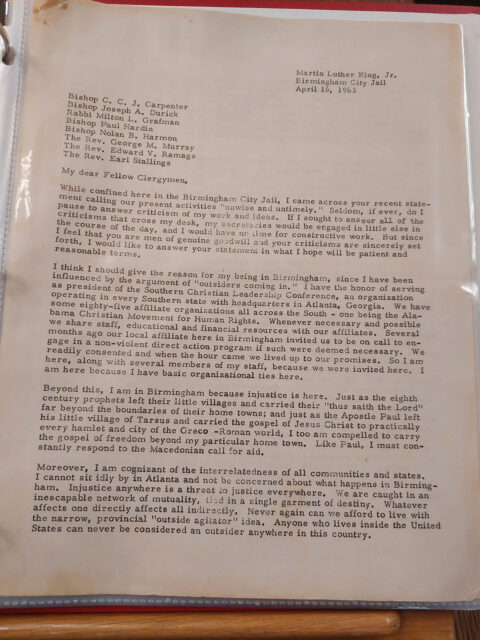
ALEXANDRIA, Va. (RNS) — Within a red binder, each of its typewritten pages encased in plastic sleeves, sits an early draft of the famous letter written by the Rev. Martin Luther King Jr. as he was held in a jail in Birmingham, Alabama.
Ten pages that once were considered for the 1963 “Letter from Birmingham Jail” were discovered in March by a graduate student concluding an internship by examining papers donated to the African American Episcopal Historical Collection, a joint venture of the Virginia Theological Seminary and the Historical Society of the Episcopal Church.
The draft was found in the papers of Bishop John M. Burgess, the first African American to serve as an Episcopal diocesan bishop, and his wife, Esther. The papers, donated by the daughters of the couple that was active in the Civil Rights Movement, are housed at the seminary near Washington, D.C.
“I screamed, but I also wept,” said Riley Temple, the collection’s growth specialist, of seeing the letter, with its yellowed pages, for the first time.
He views it as a part of the “big year” of 1963 that featured a list of changes and challenges, including the desegregation of the University of Alabama, the March on Washington and the bombing of the Sixteenth Street Baptist Church in Birmingham.
“The civil rights revolution had been going on for quite some time when this letter was written, but intellectually and academically, I see the 1963 letter as being a beginning of a scholarship that informed the Civil Rights Movement,” said Temple, who joined other archives staffers in an interview at the seminary’s Bishop Payne Library.
A recently discovered draft of Martin Luther King Jr.’s “Letter from Birmingham Jail” at Bishop Payne Library on the campus of Virginia Theological Seminary, Monday, June 1, 2026, in Alexandria, Va. CLICK the image to view the full letter. (RNS photo/Adelle M. Banks)
RELATED: 60 years on, King’s ‘Letter from Birmingham Jail’ relevant as ever, say faith leaders
King’s letter was sent to white clergy — he referred to them as “my Christian and Jewish brothers” — who had questioned the urgency and the need for the Birmingham campaign of sit-ins and boycotts he had led as the president of the Southern Christian Leadership Conference. He was jailed for its organization of a nonviolent demonstration on Good Friday in the Alabama city that year.
After checking with experts of the Civil Rights Movement and historical documents, staffers of the seminary’s archives determined that the document described as an 11-page typeset — though its last page is missing — was one of several versions of what became one of King’s most well-known writings.
In it he declared: “Injustice anywhere is a threat to justice everywhere. We are caught in an inescapable network of mutuality tied in a single garment of destiny. Whatever affects one directly affects all indirectly.”
Those words are included in the recently discovered version as well as the final published version.
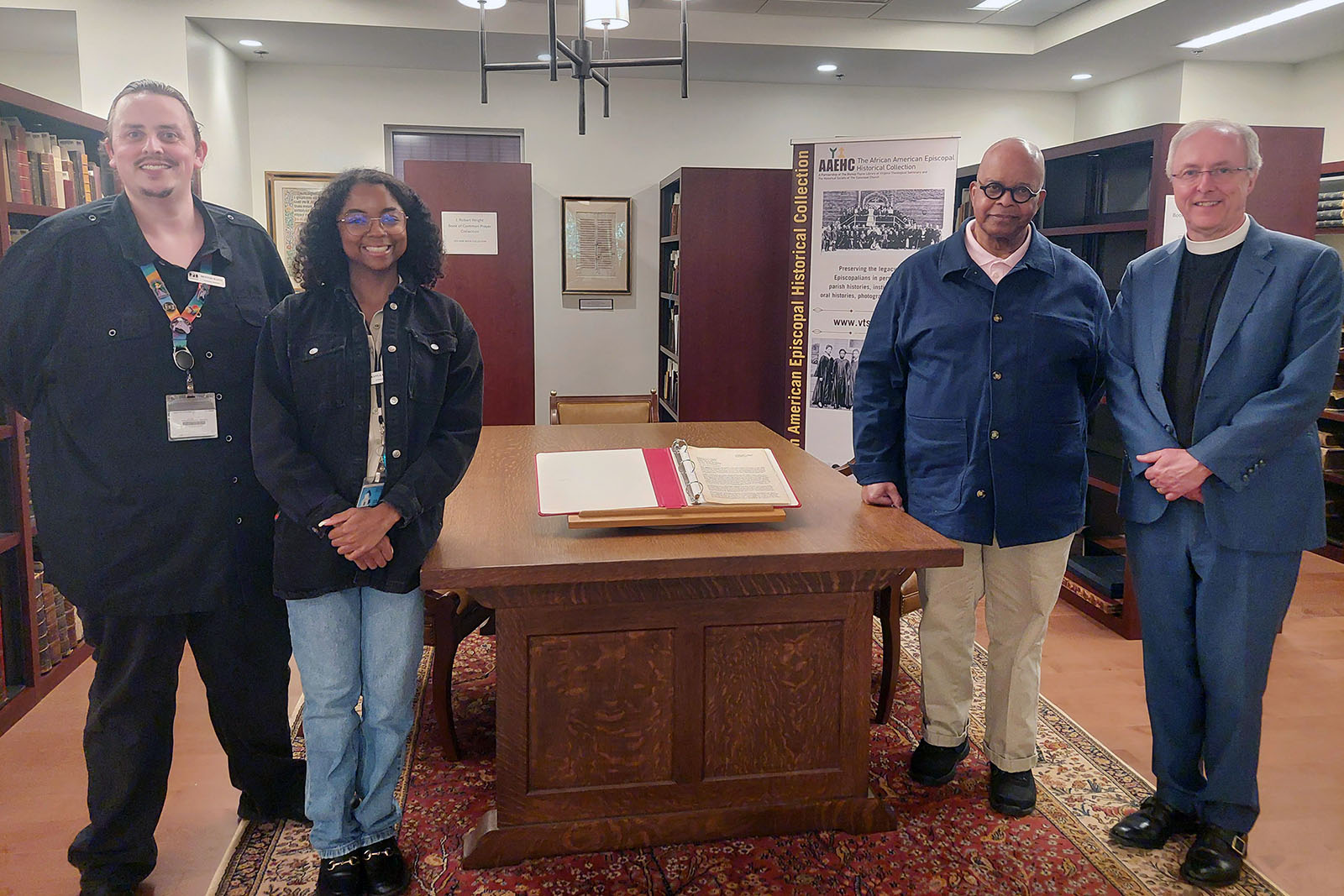
Archivist Denton Waits, from left, archives assistant Kayla Floyd, Riley Temple and the Very Rev. Ian S. Markham pose around a recently discovered draft of Martin Luther King Jr.’s “Letter from Birmingham Jail” at Bishop Payne Library on the campus of Virginia Theological Seminary, Monday, June 1, 2026, in Alexandria, Va. (RNS photo/Adelle M. Banks)
A staffer at Swann Auction Galleries in New York estimated that the document discovered is worth $15,000 to $25,000. The auction house’s sale of another 11-page typeset sold in what that employee described as “a fluke” for $185,000 in 2021. A 13-page version sold for $40,000 in 2017.
But the one housed at VTS is not for sale, said seminary archivist Denton Waits, and archive staffers plan to seek advice from conservationists about the best ways to preserve the draft letter and make its contents available for the public to view.
The single-spaced document found in Virginia was part of a multistep process that began with King writing thoughts in newspaper margins. His notes would eventually be written into a full letter of more than 6,000 words published in a pamphlet of the American Friends Service Committee, a group founded by the Quakers, and included in King’s book “Why We Can’t Wait.”
Archives assistant Kayla Floyd compared the document from the Burgesses’ papers with other drafts, such as a digital version on the University of Alabama’s website, and the final version of the letter to see variations in wording, quotations and punctuation.
“I think the majority of the message is the same, line by line is the same,” she said. “However, there are certain sections where things are kind of pieced differently.”
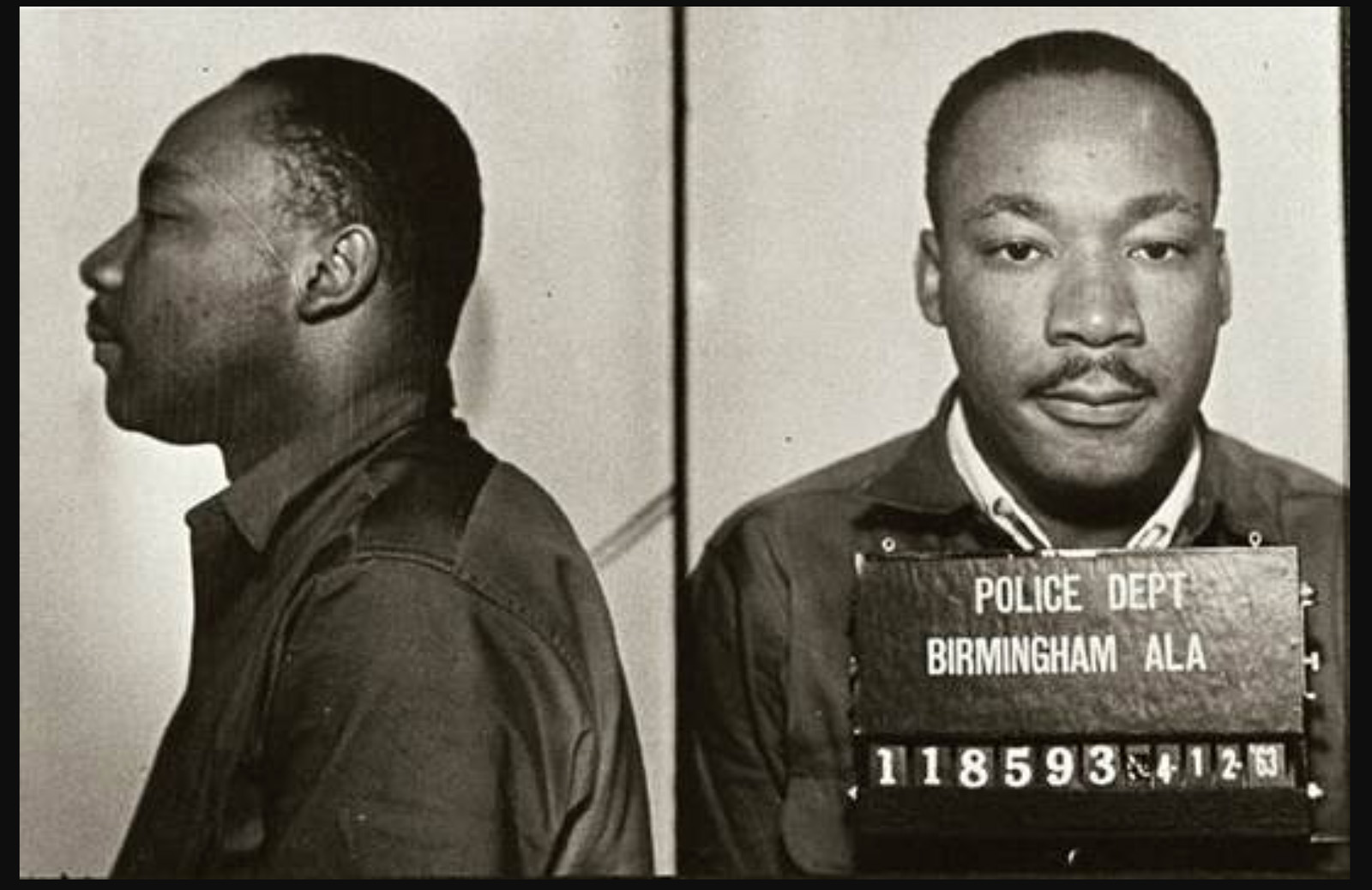
Mugshots of the Rev. Martin Luther King Jr. on April 12, 1963, in Birmingham, Alabama. (Photo courtesy of Creative Commons)
For example, a reference to English preacher and author John Bunyan in the final version — “I will stay in jail to the end of my days before I make a butchery of my conscience.”— is not in the draft version that was among the papers belonging to the Burgesses. It was added in a paragraph where King embraces being described as an extremist and says, before and after the Bunyan reference, that reformer Martin Luther and Abraham Lincoln could share that descriptor.
In the final version, the letter says, “as Reinhold Niebuhr has reminded us, groups tend to be more immoral than individuals.” In the version now located at the seminary, it refers to the theologian by saying, “as Reinhold Niebuhr has reminded us, groups are more immoral than individuals.”
Floyd, who said she was particularly grateful to tell her grandfather, who is in his 90s, about the found draft, pointed to another language change in the section where King discusses laws that are just or unjust.
“Where it talks about, ‘It gives the segregated a false sense of inferiority’ — that’s the quote in ours — in the University of Alabama version, it’s quoted as ‘It gives the segregator a false sense of superiority, and the segregated a false sense of inferiority,’” she said.
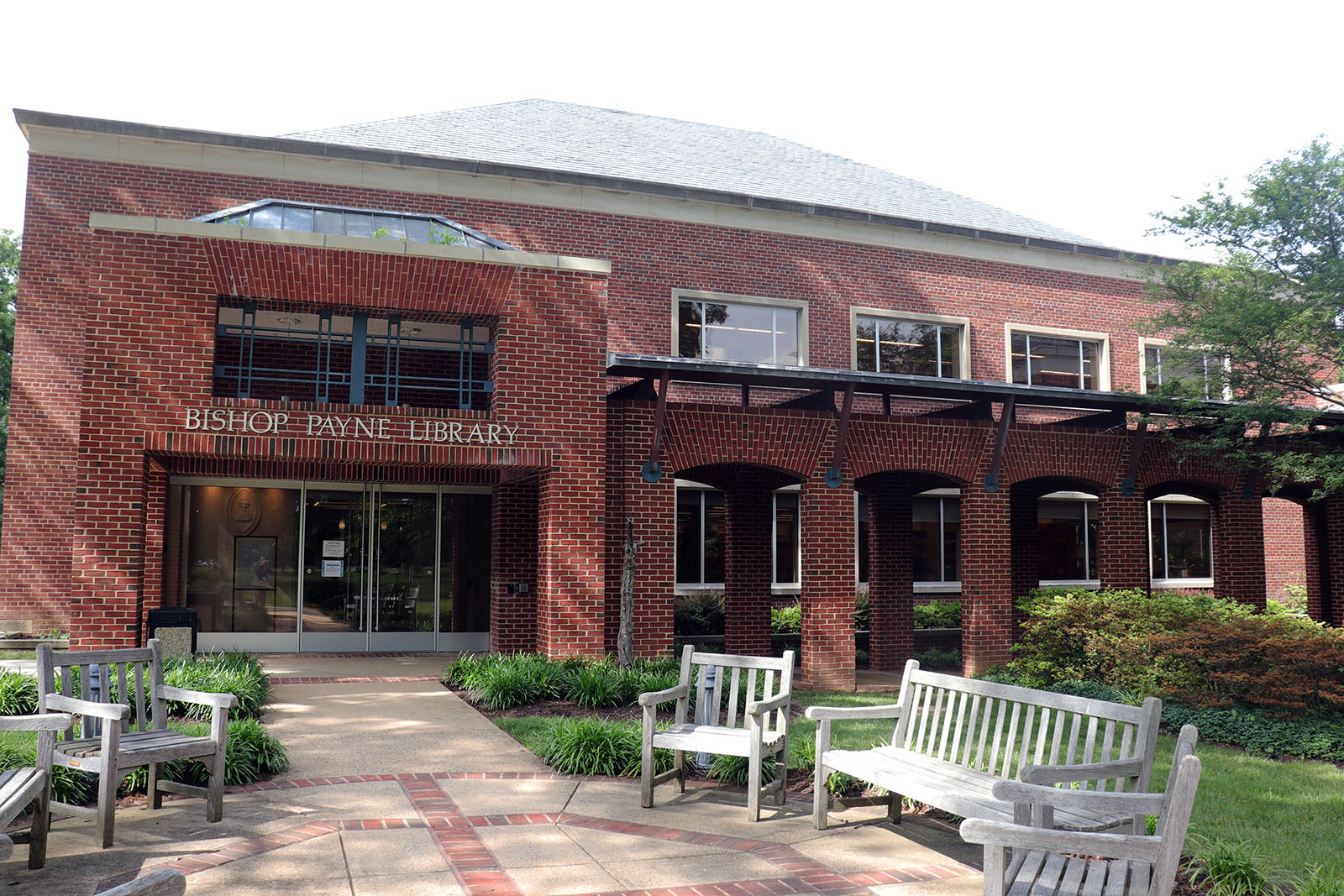
The Bishop Payne Library on the campus of Virginia Theological Seminary, Monday, June 1, 2026, in Alexandria, Va. (RNS photo/Adelle M. Banks)
With the discovery of the letter itself, and its differences from other versions, archives staffers have received requests for it to be shared with students taking ethics and biblical studies at the seminary.
“They have said that they would like to have it brought in as examples of text criticism for their classes,” Waits said.
As archive staff members have reviewed different drafts, they have also noticed that the University of Alabama draft was addressed to seven clergy while the one held by the Burgesses includes eight addressees. Two leaders to whom the letter was addressed in those two drafts were Episcopal bishops who had graduated from VTS.
Waits is conducting historical research and Floyd is doing contextual analysis for a joint article comparing different drafts of King’s letter.
How the draft ended up in the Burgesses’ papers is “a mystery” at this point, said Waits.
Another unknown is the location of the final page of the document found in the collection.
At the seminary archives’ request, Swann sent the school a copy of the page of the version sold in 2021, and it’s included in the binder with a disclaimer in red letters that “we cannot confirm that the content is the same as the page missing from the copy held by the AAEHC.”
The Very Rev. Ian S. Markham, dean and president of the seminary, said he was “overwhelmed” when he learned from Temple about the discovered draft of the letter, which he called an “extraordinary message of the fundamental dignity of all people.”
“It’s not a text just for then, it’s a text for now,” he said. “I think we have a real obligation to tap afresh into that tradition for which Martin Luther King Jr. was an exemplar.”
The seminary, where 38% of the 2026 student body were people of color, is about 10 miles from Washington, D.C. At its recent commencement, a Master of Arts student was the first to graduate from a new Reparations Program that benefits descendants of enslaved people who worked on the campus and constructed some of its buildings.
RELATED: Fifty years later, church leaders respond to King’s “Birmingham Jail” letter