






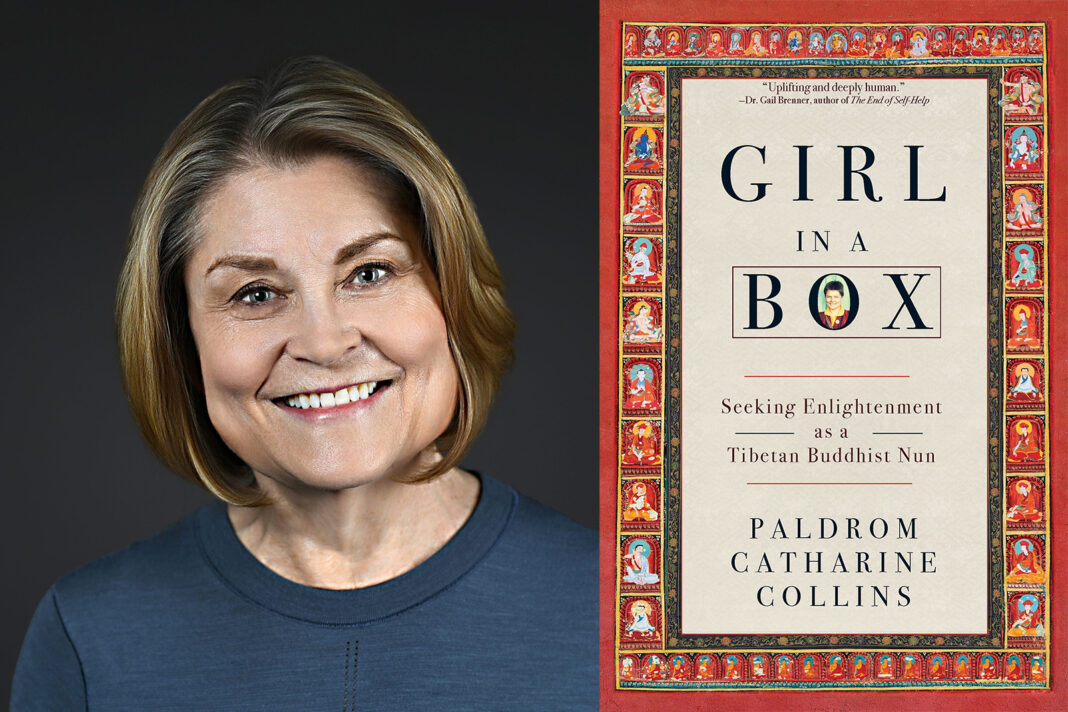
(RNS) — Raised in the Baptist tradition in Oklahoma, a young Paldrom Catharine Collins was a seeker.
Her search for spiritual truth led her to the Vajrayana Tibetan Buddhist monastery in New York, where she spent five years as Buddhist nun. There, she changed her name, took vows, and tried to become a “perfect nun,” according to her new memoir.
Then she left.
Now in her mid-70s and an addiction counselor, Collins shares the complicated story of her time at the monastery in her upcoming book, “Girl in a Box: Seeking Enlightenment as a Tibetan Buddhist Nun,” which she calls a “love letter to the Tibetans.”
“This book is for anyone who’s been on a spiritual search, or is thinking about going on a spiritual search, and for people who have been in some system and are feeling challenged by that,” said Collins in an interview with Religion News Service on April 20. “It’s as an inspiration to say, ‘Yeah, you can step outside of the system and still have the beauty of the teaching, the fundamental of the teaching.’ That’s a big piece of what I was trying to get at.”
This interview has been edited for length and clarity.
Why was it important for you to tell this story?
I realized that I couldn’t talk about my years with the Tibetans in any kind of real way for many, many, many, many years. I left the monastery when I was 40, and now I’m in my mid-70s, so it took a long time for that foundation to settle in and percolate. It continues to teach me, because I think that’s just how life works. The Tibetans changed me. The person who went into the monastery was not the same person who came out. Because before I went to the monastery, I didn’t have the capacity of really watching myself, really slowing down enough to be a true observer. Just being in the field of the Tibetans, I think, altered something in my vibratory system. Something in my fundamental system was upgraded, and then I still assumed that I needed to go back out into the world and get that tested and further tempered, and that tempering just continues.
There were a lot of difficult times. I was lonely a lot, because in a monastic setting, you’re together, but you’re kind of together apart. You’re not encouraged to socialize with each other. But that really taught me. I would be, you know, pointing me back into myself, and now I recognize how valuable that is. There were hard times, all kinds of hard times, and that’s what I wrote about. I so much wanted my lama to approve of me, and he never did. I never got that so but thank goodness, because that gave me everything. It gave me exactly the lesson that I needed.
How does the amalgam of faith you experienced stay with you?
I think because I started out with Jesus, with the Christians, that’s my fundamental basic paradigm, my basic scaffolding. So by being exposed to the Tibetan, sort of, not very nondual paradigm, and then with Gangaji, the whole Ramana Maharshi, that sort of another, another paradigm of looking at that nondual perspective, and then bringing all of that back into the where I started with it, with the Christians, with Jesus, bringing that back around, finally I could start to recognize some of the things that were being said and just really see the through line in every system.
It’s just like a whole different sort of set of clothing that gets put over the truth. What I see is what’s true and something that we can’t, actually, with our minds, even conceive.
In a world with a lot of noise, how do you discern which path is for you?
That’s where you really have to trust yourself. And I, at least for me, there’s like a knowing that there’s this somehow there’s a yes, even though it doesn’t make any sense. And that was certainly true for me with the Tibetans, there was a giant Yes, and it over and over and over again did not make any sense to me, like this is crazy. What am I doing? And for whatever reason, I needed to go to a monastery. I mean, I don’t think everybody needs to go to a monastery, but I did because I needed that level of, that level of being tamed, you know, like I needed that, that strict of a boot camp, right? But, but not everyone does.
So really, to go back to your question, like, how do you know? Because I think you do know, and that’s the whatever, whatever you may do, one one may do to bring yourself just back here, back to the here and now, and wait and listen and be still. I don’t know. I mean all those like this is a cliché in a way, but I find that to be incredibly true.
After this journey, are you closer to knowing true enlightenment?
I have no idea what enlightenment is anymore. Now, if I were going to put some put some words on it, I think that enlightenment can be a distraction, because it’s something that’s out there. It’s something that you’re going to get to, right? There’s this land of enlightenment that you’re going to finally reach. But you’re not being here, right here in this moment, which is really the place where “enlightenment” is. There’s people, and you know, we’ve met them, these more saintly sort of people, and I think we can recognize in just how we feel being around them, that there’s some kind of stillness that is comforting, that that’s an invitation, this feels good to be around. And I think that’s the moving toward what we might label enlightenment.
How has your background influenced how you connect with others today?
It seems to me that for each of us, that the more I can show up authentically, as clearly as I can, the more deeply I’m in service. Not that I’m trying to be in service, but that’s where the service happens. That’s where the service manifests. So I do try to speak the language or the paradigm of the person that I might be talking to. I have several friends who are very fundamentally Christian, and I don’t speak a lot of Tibetan, you know, paradigm, right? ButI do recognize the underlying similarity, the underlying truth.
That’s just lucky. Because I have followed these crazy threads, that’s gifted me with this capacity to see the similarities and the differences in different religious paradigms.
I don’t think I can change anyone’s mind, that’s one. So if someone’s kind of coming after me and saying ‘you shouldn’t think the way you think,’ then I just have to say something like, ‘I hear you,’ and not engage further. As much as I can do that, then that kind of nullifies the difference.
But, you know, sometimes there’s some people I just can’t talk to. Those are not the people that I need to even be talking to, and that I want to. I see just letting them be how they are. Because they’re in their perfect place, on their perfect journey.